First, a couple of caveats. I'm not an economist. Neither have I read the local press much over the years. But one thing is crystal clear: Berlin is in serious trouble.
It's not exactly headline news; anyone who's spent a little time here knows it. As the once-and-future capital of Germany, it wound up absorbing a hugely disproportionate percentage of the costs of reunification. With less than seven years remaining until the government moved from Bonn, Berlin had to get its transportation system, telecommunications system, water and power lines, and, well, just about everything else up to world-class speed before 2000.
Given that half the city had been East Germany, that meant that the eastern part of town got a lot of preferential treatment: I never had touch-tone dialling before moving to the former east in 1996, for instance. But I got it because the East Berlin telephone system was so out of date it couldn't be updated. It had to be replaced. The equipment had already been manufactured before the unification even happened, and it was reassigned to the east.
This caused several problems. For one, taxes were raised to help pay for all of this, and much muttering was heard in the west about having to pay for those damn lazy Ossis, who didn't make enough to even pay those taxes. For another, Helmut Kohl's government made some serious mistakes, starting with a one-for-one currency exchange: one Ostmark for one Deutsche Mark. As I said, I'm not an economist, although I've read numerous accounts of why this was a very bad idea (not only in Germany, but in other East Bloc countries where "shock therapy" tactics were used), and if I understand correctly, it helped dig the hole we're in a little deeper. There was also the matter of some of Kohl's buddies buying up eastern properties and flipping them for huge profits, and there was also a bank some of them were in charge of that went belly-up. Predictably, nobody involved in any of this actually did any hard time.
And the government coming here meant a building boom. Not only the Spreebogen complex of hideous Alphaville buildings stretching along the (rebuilt and rechannelled) Spree River away from the Reichstag, which itself was given Sir Norman Foster's new dome, but a huge amount of retail and residential space went up for all the people who'd be living and shopping here once Berlin became the gleaming new hub of Europe. That explains the eyesore that is Potsdamer Platz, and the mighty scrubbing Friedrichstr. between Kochstr. and Unter den Linden underwent. This was another disaster: plenty of ex-Bonners hated Berlin, and never moved, preferring to rack up frequent flier miles between Berlin Tegel and Cologne-Bonn Airport. And while it's true that Sony, for instance, established their European music center here, very few of its employees wanted to live here, either, and once the merger with Bertelsmann looked like it was happening, they scampered off to Munich, happy as can be. That big old Sony Center at Potz Platz has lots of vacancies, if you're looking for office space. Of course, if you are, there's lots cheaper office space to be had, too. Lots.
As someone covering the culture beat here, as I did for the Wall Street Journal Europe from 1996 to 2003, it all became distressingly obvious after the Millenium. Suddenly, the culture funds started disappearing, and the support the city used to give just dried up. I remember the night this became crystal clear: I went to cover an exhbition of new Australian art that was the keynote of the new arts season at the Hamburger Bahnhof museum, and it was so godawful the editor rejected it. How on earth did this atrocity get mounted, anyway? And then it dawned on me: it had been 100% paid for by the Australians. All Berlin had to give was the space. And that's the way it's been ever since: the big museum shows here have either been wholly assembled elsewhere and set up here (the Museum of Modern Art show of a couple of years ago was the template for that), or else some curator has just re-shuffled Berlin's own holdings into a show.
As for the music scene, that was a scandal, too: the city voted to keep supporting three opera companies, despite the fact that one is almost totally artistically moribund, and totally de-funded Podewil, the scrappy little avant-garde outfit near Alexanderplatz which attracted worldwide audiences and worldwide attention because of them. And forget popular music: that never had any government support at all, and with people's incomes declining, attendance at gigs tapered off so badly that most touring acts totally skip Berlin these days.
Here's the bottom line, though: Berlin is 60 billion Euros in the hole. You read that right. The other night a bunch of us were sitting around and some lightning-fast calculator heard that figure and, after a minute, said "Uh, that's three-quarters the GNP of Australia." Yup. And even higher than the debt of the state of California, which is considered a scandal in some quarters in America.
The schools here, I hear, are falling apart. I do know that the new U-Bahn line that was supposed to run between the Reichstag and Alexanderplatz, the U 5, can't be completed now, even though enough holes have been dug for it. (Exactly why we need to connect the Reichstag and Alex, however, hasn't been explained).
That's why I love it when people extol Berlin's virtues to me. "It's so cheap to live here!" Sure, dude. You're probably too young for the phrase "a cheap holiday in other people's misery" to resonate.
And, just the other week while I was in the States, a small item in the Times caught my eye: the German equivalent of the Supreme Court denied Berlin's appeal for money to help alleviate the debt. Nope. Not gonna happen.
So when I say I need to get out of here, it's not just personal. It's about living in a place where everyone is depressed by the lack of opportunity, not just me. It's about wanting to live somewhere where people are more likely to be employed than not, where you can start a business and maybe have it succeed because people have money to spend.
If you look at people's faces here, unhappiness is written large on a striking number of them. I don't want to become one of those people, scowling, mouths turned down, shuffling along the street. I'm not sure how I'm going to do it (no, I didn't sell my book and I don't know if I actually have an agent to do it, thanks), but it's going to happen. And, I hope, soon.
Tuesday, November 07, 2006

Tuesday, October 31, 2006
Food On The Go
I'm sorry to say that I didn't get nearly as much great food on this trip as I'd hoped. Some of that was due to my insane schedule and the amount of running around I had to do, and some of it is, I think, due to the fact that the cool little dives which once existed in New York have been priced out of what is now a grim, expensive city.
I was also based a lot of the time in suburban New Jersey, as opposed to what I'd call exurban New Jersey (Jersey City, Newark, etc), although there was a good pizzeria (two, actually) in the town I stayed in, as well as the worst Italian place I've eaten at in ages. (Garlic powder in the "garlic spinach" sauce on the pasta? That's impressive in this day and age!) I had a fine sausage-and-peppers sandwich one day and a slice of pizza stuffed with baked ziti (which would have been better if the red sauce that came with it had been edible) another day that brought back some distant nostalgia.
My first evening's meal in New York sent me and my friends to the Saigon Grill on University Place, where there were tremendous summer rolls and a mindblowing "Vietnamese bouillabaisse" so full of seafood (including real crab, not surimi) that I almost ignored the sweet-spicy broth. Highly recommended if you're in the neighborhood, although there's also a branch of Madhur Jaffrey's highly successful and mega-tasty Cafe Spice very nearby. Didn't get there this time.
The next night, although I wasn't wild about more Indian food since I'd just had some on Air India, I met with some folks at a place called Angon on East 6th St., in the middle of that gaggle of Indian restaurants. I was afraid it was going to be like all of them there, but it wasn't. It wasn't unlike them, but it was different. The samosa chaat and the pani puri appetizers were quite distinctive (even if the latter was rather bland), the the khichuri rice dish was another change from the usual stuff.
The next day I met a friend for a really forgettable lunch at a supposed Thai restaurant in the Village. I was already suspicious when the waiter took our orders in Chinese, but soggy pad thai noodles clinched the deal. For dinner, I was with the guy who'd recommended Saigon Grill, so his recommendation of another Vietnamese place, Bao Noodles, was eagerly accepted. Sad to say, they were having an off night, and we were disappointed.
Then it was off on the train to Montreal, fortified with a bagel and coffee from Seattle's Finest (Starbuck's hasn't won -- yet), and I've already commented on la cuisine d'Amtrak. The first dinner was an amazing cassoulet at my hosts' place, with an equally stunning wine I forgot to note. The meats were all hand-picked by the legendary M. Yves at the Atwater Market:

Dessert was a selection of about seven Quebec cheeses, which offered stiff competition to any I've had in France. Man, Quebec's come a long way since I first visited in the mid-'70s!
The next morning, I got a long-held wish, which was to taste the legendary "steel-cut oats" I'd read about. I'm no oatmeal fan, but these barely qualify as oatmeal, especially after a long cooking, dressing with warm cream, and maple syrup bruléed on top with a blowtorch -- not to mention a short shot of whiskey. After that, it was into the car, and a wild trip through Montreal intended to prove to me the superiority of Montreal bagels:
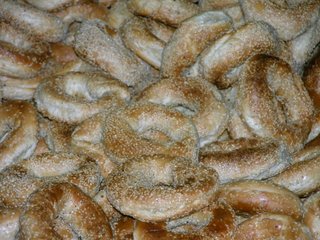
The pictured ones are at St-Viateur, shortly after they've been expertly thrown through the air off the narrow paddle on which they're baked into the pile from which they're selected by customers. I was impressed by the huge stack of 100-lb. sacks of sesame seeds in the bakery area, since apparently the iconic Montreal bagel is a sesame one, but they had other flavors, too. From there we sped to Fairmount Bagels, the dreaded competition, for another dozen. I dutifully sampled each, and, while I agreed with Victoria that the Fairmounts were just a bit better, my problem with Montreal bagels overall is that they're sweet, which bagels should never be unless you're making blueberry bagels or some other form which must be prohibited in the Torah, if not the Old Testament itself. Maybe toasted and buttered they'd be better, but I prefer to think of them the way I think of Cincinnati chili, ie, as a similar, but different foodstuff entirely.
From there it was time for my hosts to do their weekend shopping, which meant stops at both of Montreal's stunning markets, Jean Talon (for vegetables) and Atwater (for meat). Both are available at both places, but it must be admitted that each seems superior to the other in just that way.
It was mid-October, remember, so the glories of the harvest were behind us. I can't imagine what the place must look like in high summer, what with a pepper display like this:

Not to mention psychedelic cauliflower:

Victoria and Rodney patronize M. Charles' vegetable shop, just outside the market, for a lot of their stuff, and he proudly uncorked a box of white truffles he'd bought. Unfortunately, it was one of two, and the other one had walked out as he was helping several restaurants get their orders together. He said he knew it was someone from one of the restaurants, but he was damned if he could tell whom, or even which restaurant. The display at his place, though, was astonishing.
From there it was off across town to the Atwater Market, where, in addition to even more temptations, they were having an "Octoberfest" of micro-brews from around Quebec that I was in no shape to try due to a cold. Here, the mighty M. Yves plies his trade, and my brain was about to explode from the assembled goodies. As arranged, we met my college pal Terry there, and I escaped with him back to his house for some long-delayed catching up. Victoria pressed the remaining bagels, a wedge of local Shropshire Blue cheese, and a little basket of assorted chiles on him.
Dinner that evening with Victoria and Rodney was at Au Pied de Cochon, a place Anthony Bourdain likes a lot, and it was easy to see why: it's not fancy, but it's exquisite in its quality, which means the prices aren't so high. Oh, there's the odd $1700 bottle on the wine list, but we had a microbrewed stout which suited the meal just fine. I'd settled on a bison rib, after one passed me on a plate, looking perfectly barbequed, and, because they had the gall to offer it, I ordered French onion soup for a starter. What a cliché! What a amazing rendition of it, too! Man, it must've been the onions, because I can't think of what else would have imparted such a rich, sweet yet vegetal flavor to the soup. I almost stood up and cheered. Sadly, the rib, although absolutely perfectly cooked, was marred by a "barbeque" sauce slathered on it which was way too sweet. Because I like this place so much, though, I offer the following advice to them: in Texas, they don't use sauce at all. Really. What they do use is a salt-and-pepper rub, and hey, you folks know, just like I do, that there are salts and there are salts, and there are peppers and there are peppers. I offer this as a clue, and look forward to seeing you deal with it next time I'm up there.
The next day's eating was unmitigated disappointment: bad Jamaican meat patty and bad empanada at a bakery near Terry's house, followed by a meal at a Caribbean restaurant which started out fine with good appetizers and then went sharply downhill. If that's jerk chicken, you guys, then...ahhh, there's a jerk joke in there somewhere. Fageddit.
Tuesday saw me hit Philadelphia to say hi to the Fresh Air crew, and record a couple of pieces. As I traditionally do, I lunched at the Reading Terminal Market, getting a "super Italian" sub at Carmen's-Formerly-Known-As-Rocco's. Dinner was along the same lines, although it was home-made, an Italian sausage lasagne at the home of the Philadelphia Inquirer's blogger Dan Rubin, along with his wife Mimi, my sister, the Rubin twins, and my nephew Peter. And because of a screwup with the hotel I'd been stashed in, I wound up at another one just two blocks from the Reading Terminal again, so I got to eat breakfast at their famous Down Home Diner, which was a bit of a disappointment. Dang, I shoulda ordered scrapple!
The flight back on Air India was smooth, the food good (but not as good as going over, possibly because I passed on the mutton curry and went for the vegetarian dish, which I swear the flight attendant said was "bunny"), and my fellow passengers just as anarchic as before. I got a great meal (my usual: duck terrine, steak au poivre with potatoes au gratin) at Chez Paul, and the next morning I was on my way back to Berlin.
And a surprise awaited me: I got in too late to shop (and was in no condition to do so anyway) so the dancer, who met me at the station, and I decided to investigate Toco Rouge, the Chinese-fusion joint that sprung up in the space where my late lamented Döner place had been. We each had a different soup and entree, and I have to say, this place looks like it's really happening. Open for lunch, too, so I can see soup for lunch in my future. What a pleasant surprise! Hope it lasts.
Of course, Monday took me to the supermarket, where I beheld acres of empty shelves. Okay, home again.
I was also based a lot of the time in suburban New Jersey, as opposed to what I'd call exurban New Jersey (Jersey City, Newark, etc), although there was a good pizzeria (two, actually) in the town I stayed in, as well as the worst Italian place I've eaten at in ages. (Garlic powder in the "garlic spinach" sauce on the pasta? That's impressive in this day and age!) I had a fine sausage-and-peppers sandwich one day and a slice of pizza stuffed with baked ziti (which would have been better if the red sauce that came with it had been edible) another day that brought back some distant nostalgia.
My first evening's meal in New York sent me and my friends to the Saigon Grill on University Place, where there were tremendous summer rolls and a mindblowing "Vietnamese bouillabaisse" so full of seafood (including real crab, not surimi) that I almost ignored the sweet-spicy broth. Highly recommended if you're in the neighborhood, although there's also a branch of Madhur Jaffrey's highly successful and mega-tasty Cafe Spice very nearby. Didn't get there this time.
The next night, although I wasn't wild about more Indian food since I'd just had some on Air India, I met with some folks at a place called Angon on East 6th St., in the middle of that gaggle of Indian restaurants. I was afraid it was going to be like all of them there, but it wasn't. It wasn't unlike them, but it was different. The samosa chaat and the pani puri appetizers were quite distinctive (even if the latter was rather bland), the the khichuri rice dish was another change from the usual stuff.
The next day I met a friend for a really forgettable lunch at a supposed Thai restaurant in the Village. I was already suspicious when the waiter took our orders in Chinese, but soggy pad thai noodles clinched the deal. For dinner, I was with the guy who'd recommended Saigon Grill, so his recommendation of another Vietnamese place, Bao Noodles, was eagerly accepted. Sad to say, they were having an off night, and we were disappointed.
Then it was off on the train to Montreal, fortified with a bagel and coffee from Seattle's Finest (Starbuck's hasn't won -- yet), and I've already commented on la cuisine d'Amtrak. The first dinner was an amazing cassoulet at my hosts' place, with an equally stunning wine I forgot to note. The meats were all hand-picked by the legendary M. Yves at the Atwater Market:

Dessert was a selection of about seven Quebec cheeses, which offered stiff competition to any I've had in France. Man, Quebec's come a long way since I first visited in the mid-'70s!
The next morning, I got a long-held wish, which was to taste the legendary "steel-cut oats" I'd read about. I'm no oatmeal fan, but these barely qualify as oatmeal, especially after a long cooking, dressing with warm cream, and maple syrup bruléed on top with a blowtorch -- not to mention a short shot of whiskey. After that, it was into the car, and a wild trip through Montreal intended to prove to me the superiority of Montreal bagels:
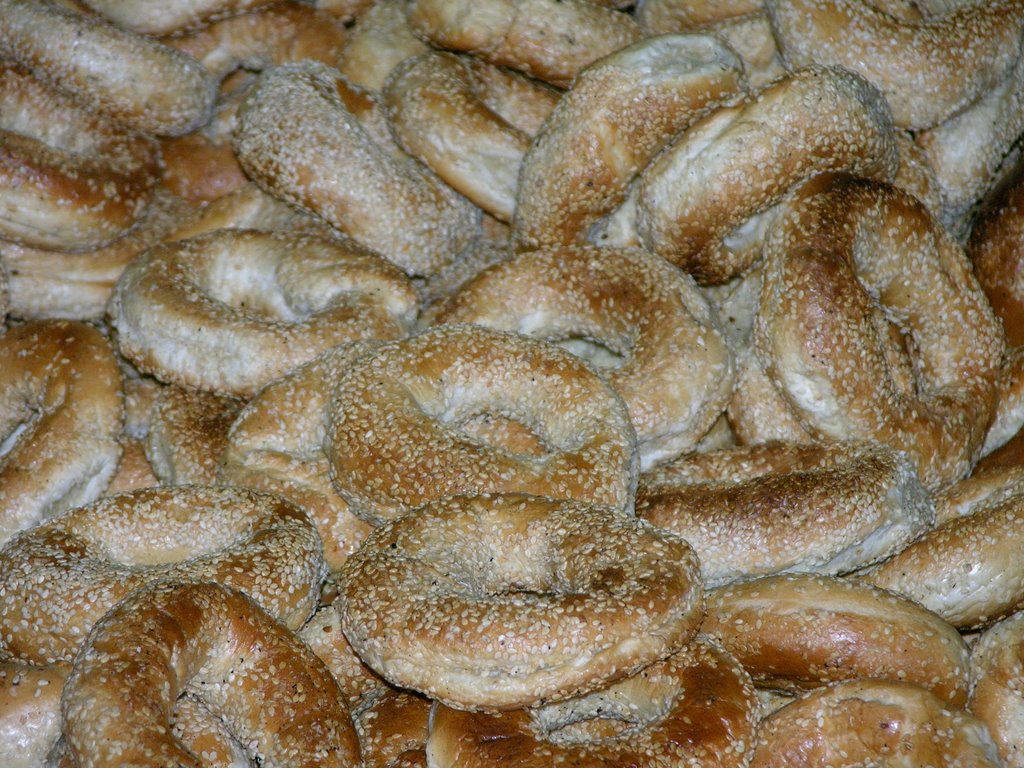
The pictured ones are at St-Viateur, shortly after they've been expertly thrown through the air off the narrow paddle on which they're baked into the pile from which they're selected by customers. I was impressed by the huge stack of 100-lb. sacks of sesame seeds in the bakery area, since apparently the iconic Montreal bagel is a sesame one, but they had other flavors, too. From there we sped to Fairmount Bagels, the dreaded competition, for another dozen. I dutifully sampled each, and, while I agreed with Victoria that the Fairmounts were just a bit better, my problem with Montreal bagels overall is that they're sweet, which bagels should never be unless you're making blueberry bagels or some other form which must be prohibited in the Torah, if not the Old Testament itself. Maybe toasted and buttered they'd be better, but I prefer to think of them the way I think of Cincinnati chili, ie, as a similar, but different foodstuff entirely.
From there it was time for my hosts to do their weekend shopping, which meant stops at both of Montreal's stunning markets, Jean Talon (for vegetables) and Atwater (for meat). Both are available at both places, but it must be admitted that each seems superior to the other in just that way.
It was mid-October, remember, so the glories of the harvest were behind us. I can't imagine what the place must look like in high summer, what with a pepper display like this:

Not to mention psychedelic cauliflower:

Victoria and Rodney patronize M. Charles' vegetable shop, just outside the market, for a lot of their stuff, and he proudly uncorked a box of white truffles he'd bought. Unfortunately, it was one of two, and the other one had walked out as he was helping several restaurants get their orders together. He said he knew it was someone from one of the restaurants, but he was damned if he could tell whom, or even which restaurant. The display at his place, though, was astonishing.
From there it was off across town to the Atwater Market, where, in addition to even more temptations, they were having an "Octoberfest" of micro-brews from around Quebec that I was in no shape to try due to a cold. Here, the mighty M. Yves plies his trade, and my brain was about to explode from the assembled goodies. As arranged, we met my college pal Terry there, and I escaped with him back to his house for some long-delayed catching up. Victoria pressed the remaining bagels, a wedge of local Shropshire Blue cheese, and a little basket of assorted chiles on him.
Dinner that evening with Victoria and Rodney was at Au Pied de Cochon, a place Anthony Bourdain likes a lot, and it was easy to see why: it's not fancy, but it's exquisite in its quality, which means the prices aren't so high. Oh, there's the odd $1700 bottle on the wine list, but we had a microbrewed stout which suited the meal just fine. I'd settled on a bison rib, after one passed me on a plate, looking perfectly barbequed, and, because they had the gall to offer it, I ordered French onion soup for a starter. What a cliché! What a amazing rendition of it, too! Man, it must've been the onions, because I can't think of what else would have imparted such a rich, sweet yet vegetal flavor to the soup. I almost stood up and cheered. Sadly, the rib, although absolutely perfectly cooked, was marred by a "barbeque" sauce slathered on it which was way too sweet. Because I like this place so much, though, I offer the following advice to them: in Texas, they don't use sauce at all. Really. What they do use is a salt-and-pepper rub, and hey, you folks know, just like I do, that there are salts and there are salts, and there are peppers and there are peppers. I offer this as a clue, and look forward to seeing you deal with it next time I'm up there.
The next day's eating was unmitigated disappointment: bad Jamaican meat patty and bad empanada at a bakery near Terry's house, followed by a meal at a Caribbean restaurant which started out fine with good appetizers and then went sharply downhill. If that's jerk chicken, you guys, then...ahhh, there's a jerk joke in there somewhere. Fageddit.
Tuesday saw me hit Philadelphia to say hi to the Fresh Air crew, and record a couple of pieces. As I traditionally do, I lunched at the Reading Terminal Market, getting a "super Italian" sub at Carmen's-Formerly-Known-As-Rocco's. Dinner was along the same lines, although it was home-made, an Italian sausage lasagne at the home of the Philadelphia Inquirer's blogger Dan Rubin, along with his wife Mimi, my sister, the Rubin twins, and my nephew Peter. And because of a screwup with the hotel I'd been stashed in, I wound up at another one just two blocks from the Reading Terminal again, so I got to eat breakfast at their famous Down Home Diner, which was a bit of a disappointment. Dang, I shoulda ordered scrapple!
The flight back on Air India was smooth, the food good (but not as good as going over, possibly because I passed on the mutton curry and went for the vegetarian dish, which I swear the flight attendant said was "bunny"), and my fellow passengers just as anarchic as before. I got a great meal (my usual: duck terrine, steak au poivre with potatoes au gratin) at Chez Paul, and the next morning I was on my way back to Berlin.
And a surprise awaited me: I got in too late to shop (and was in no condition to do so anyway) so the dancer, who met me at the station, and I decided to investigate Toco Rouge, the Chinese-fusion joint that sprung up in the space where my late lamented Döner place had been. We each had a different soup and entree, and I have to say, this place looks like it's really happening. Open for lunch, too, so I can see soup for lunch in my future. What a pleasant surprise! Hope it lasts.
Of course, Monday took me to the supermarket, where I beheld acres of empty shelves. Okay, home again.
Sunday, October 29, 2006
More Transportation
Last night I staggered off the train from Cologne, which I'd boarded after getting off the train from Paris, fifteen minutes late, the apologies of the train crew, broadcast on the intercom, still ringing in my ears. What a difference from Amtrak, I thought.
I'd wanted to visit Montreal on this trip, because I hadn't seen my old college friend Terry in what turned out to be 19 years, which is way too long. I also wanted to visit a couple of friends I knew only from the Well, and, mostly, I figured that after four days, I'd want to get out of New York. I'd remembered how wonderful the trip up there was when I'd taken the train -- a long trip, sure, ten hours or so, but among some of the most gorgeous scenery the East Coast has to offer. Idly, I went by the website and found I could make the round trip for a whopping $113, or just under half what a similar trip on Deutsche Bahn would cost. How could I resist?
So last Friday morning, bright and early, I found myself in Penn Station, sticking my credit card into a machine which identified me immediately, had me punch in the code they'd sent me in confirmation of the purchase, and seconds later two tickets slid out. Boy, that was easy. Easier than Deutsche Bahn's website, which works until you get to the moment of purchase, and then crashes, and which won't quote you fares or sell you tickets if you're leaving Germany, for some reason.
At 8:30, we pulled out of Penn Station on schedule. I found it rather odd that, although the ticket said "reserved" on it, there wasn't a seat or car number on it, as there would have been in Europe. Still, there weren't enough people on the train to make that an issue. Unfortunately for the scenery, it was raining hard. Maybe, I thought, this will let up at some point. Didn't really matter when; the whole trip, pretty much, is scenic.
It was at our first stop that I noticed the first big difference between Amtrak and European trains. There's a board by the exit, just as there is here, but it only gives you the name of the train, and, for variety, a couple of ads for Amtrak, including one for something called Rail Fone, long superceded by the cell phone. Where were we? I had no idea, and, having grown up in the area, I had some interest in knowing. But there was no indication from the board, and no announcement over the loudspeaker. Nor were the signs at the station terribly visible. It was Yonkers, I think.
Later, I discovered that in the snack car there was a stack of timetables, French on one side, English on the other (hey, it was going to Quebec; no sense in risking a fine!). This was good as long as you were capable of remembering what the last stop was or could find a sign (some of the stations we stopped at were so small only one car was opened at the stop, while the rest of the train slopped over each end). But really, folks, what's wrong with making an announcement? Or jiggering the sign so it shows the station, and maybe even the next station with estimated time of arrival and all?
Sad to say, as we proceeded up the Hudson, the scenery was behind a scrim of driving grey rain, so any sightseeing was restricted to the marshes just off the river and the river itself. There was an awful lot of wildlife: several species of ducks, blue and green herons, and, once, a glimpse of a group of those flat-shelled, bottle-nosed snapping turtles. I'd have thought it was too cold for them by now.
Once past Albany, though, you're off the Hudson, and you plunge right into the fall foliage as you work your way towards several other lakes, winding up with the huge one which divides Vermont from New York, Lake Champlain. This is summer tourist country, and yet it's very nice at this time of year (well, it was a week ago: a couple of good cold rainstorms and that foliage just says good-bye). The train zips through some nice granite outcroppings, and you realize just how depopulated bits of upstate New York are.
Poor, too. That was one thing that shocked me. Of course, the nicest parts of anyplace are rarely found by the railroad tracks, for obvious reasons, but in Europe that usually means either industrial or immigrant areas. You don't see rural poverty in the parts of Europe I've ridden through on trains -- largely Germany, France, Switzerland, Holland, Belgium, Denmark and Norway. Only in Poland have I seen dwellings I assumed belonged to poor people. But it's a shock in America: some of the houses out there in the country are downright hovels, and yet there were people living in them. This was a shock not only after relatively affluent Europe, but after deeply sanitized New York, which seems to have had a soulectomy since I was last there about eight years ago.
The border check was painless. We'd been warned at the start of the journey to attach tags which had been stamped CANADA onto all of our bags, and I, of course, managed to drop one on the way in. I was afraid my camera or my laptop would be impounded on the way in. Fortunately, I found it on the floor, but the conductor said there was no worry about them anyway. The Canadian border guards were friendly, joked in French and English with the passengers, and got in and out fast.
By then, the sun was going down, and it looked like we'd make our destination only a half hour late -- not, again, that anyone was telling us this except for Dean. Dean looked like one of the Village People, specifically the one with the leather cap, and was one of a number of homosexual stereotypes in our car; perhaps there was a convention that weekend, because there were two more of them sitting across from me, going "Tsk" loudly every time Dean made or received a call on his cell phone. Oblivious to the fact that we didn't all want to know the intimate details of his life, he shared them with his friends and us in a voice that I'm sure carried to the next car. It was, however, useful for knowing how close we were to Montreal.
Thirty minutes late is early for Amtrak, sad to say, although things have improved since the day in the early '70s when, frightened out of the sky by a plane ride from hell that had nuns praying at the top of their lungs and the businessman who just a moment earlier had been saying how boring flying was yelling "I don't want to die" at the top of his lungs, I took the train from San Francisco to Austin -- well, San Antonio, which was as close as it went -- for my first visit to that city. It was understood we'd take the bus to Oakland, because there was no train from San Francisco, but when we got there -- and I am not making this up -- the train from Seattle was 24 hours late. Thus, we took the bus from Oakland to Los Angeles, where there actually was a train.
The ride back from Montreal, though, wasn't nearly as punctual, and this one was more of a nail-biter, because I was staying in New Jersey, and the trains there don't run all night. The U.S. border guards took several people for questioning into the snack car, but they all -- all the ones I saw, anyway -- returned to their seats without incident. We were a good 2 1/2 hours late getting to Penn Station. No apologies, let alone the discount cards Deutsche Bahn hands out when things like this happen.
Oh, and I mentioned the snack car? I'm going to do a post later on some of the food I encountered, but let's just say that Amtrak is still upholding some great traditions: I fondly remember biting into a roast-beef sandwich on that early '70s trip and finding the center frozen solid. This time, I bought an "Italian sandwich" on the way down, fairly certain I'd get back to Jersey too late to get delivery pizza, even (I was right), and although the guy stuck it in the oven for a goodly amount of time, when I took it out of the cellophane, there was a comforting cold, wet spot directly in the center. The mighty Hudson still shows off its colors in the fall, and Amtrak still can't manage to defrost a sandwich.
I'd wanted to visit Montreal on this trip, because I hadn't seen my old college friend Terry in what turned out to be 19 years, which is way too long. I also wanted to visit a couple of friends I knew only from the Well, and, mostly, I figured that after four days, I'd want to get out of New York. I'd remembered how wonderful the trip up there was when I'd taken the train -- a long trip, sure, ten hours or so, but among some of the most gorgeous scenery the East Coast has to offer. Idly, I went by the website and found I could make the round trip for a whopping $113, or just under half what a similar trip on Deutsche Bahn would cost. How could I resist?
So last Friday morning, bright and early, I found myself in Penn Station, sticking my credit card into a machine which identified me immediately, had me punch in the code they'd sent me in confirmation of the purchase, and seconds later two tickets slid out. Boy, that was easy. Easier than Deutsche Bahn's website, which works until you get to the moment of purchase, and then crashes, and which won't quote you fares or sell you tickets if you're leaving Germany, for some reason.
At 8:30, we pulled out of Penn Station on schedule. I found it rather odd that, although the ticket said "reserved" on it, there wasn't a seat or car number on it, as there would have been in Europe. Still, there weren't enough people on the train to make that an issue. Unfortunately for the scenery, it was raining hard. Maybe, I thought, this will let up at some point. Didn't really matter when; the whole trip, pretty much, is scenic.
It was at our first stop that I noticed the first big difference between Amtrak and European trains. There's a board by the exit, just as there is here, but it only gives you the name of the train, and, for variety, a couple of ads for Amtrak, including one for something called Rail Fone, long superceded by the cell phone. Where were we? I had no idea, and, having grown up in the area, I had some interest in knowing. But there was no indication from the board, and no announcement over the loudspeaker. Nor were the signs at the station terribly visible. It was Yonkers, I think.
Later, I discovered that in the snack car there was a stack of timetables, French on one side, English on the other (hey, it was going to Quebec; no sense in risking a fine!). This was good as long as you were capable of remembering what the last stop was or could find a sign (some of the stations we stopped at were so small only one car was opened at the stop, while the rest of the train slopped over each end). But really, folks, what's wrong with making an announcement? Or jiggering the sign so it shows the station, and maybe even the next station with estimated time of arrival and all?
Sad to say, as we proceeded up the Hudson, the scenery was behind a scrim of driving grey rain, so any sightseeing was restricted to the marshes just off the river and the river itself. There was an awful lot of wildlife: several species of ducks, blue and green herons, and, once, a glimpse of a group of those flat-shelled, bottle-nosed snapping turtles. I'd have thought it was too cold for them by now.
Once past Albany, though, you're off the Hudson, and you plunge right into the fall foliage as you work your way towards several other lakes, winding up with the huge one which divides Vermont from New York, Lake Champlain. This is summer tourist country, and yet it's very nice at this time of year (well, it was a week ago: a couple of good cold rainstorms and that foliage just says good-bye). The train zips through some nice granite outcroppings, and you realize just how depopulated bits of upstate New York are.
Poor, too. That was one thing that shocked me. Of course, the nicest parts of anyplace are rarely found by the railroad tracks, for obvious reasons, but in Europe that usually means either industrial or immigrant areas. You don't see rural poverty in the parts of Europe I've ridden through on trains -- largely Germany, France, Switzerland, Holland, Belgium, Denmark and Norway. Only in Poland have I seen dwellings I assumed belonged to poor people. But it's a shock in America: some of the houses out there in the country are downright hovels, and yet there were people living in them. This was a shock not only after relatively affluent Europe, but after deeply sanitized New York, which seems to have had a soulectomy since I was last there about eight years ago.
The border check was painless. We'd been warned at the start of the journey to attach tags which had been stamped CANADA onto all of our bags, and I, of course, managed to drop one on the way in. I was afraid my camera or my laptop would be impounded on the way in. Fortunately, I found it on the floor, but the conductor said there was no worry about them anyway. The Canadian border guards were friendly, joked in French and English with the passengers, and got in and out fast.
By then, the sun was going down, and it looked like we'd make our destination only a half hour late -- not, again, that anyone was telling us this except for Dean. Dean looked like one of the Village People, specifically the one with the leather cap, and was one of a number of homosexual stereotypes in our car; perhaps there was a convention that weekend, because there were two more of them sitting across from me, going "Tsk" loudly every time Dean made or received a call on his cell phone. Oblivious to the fact that we didn't all want to know the intimate details of his life, he shared them with his friends and us in a voice that I'm sure carried to the next car. It was, however, useful for knowing how close we were to Montreal.
Thirty minutes late is early for Amtrak, sad to say, although things have improved since the day in the early '70s when, frightened out of the sky by a plane ride from hell that had nuns praying at the top of their lungs and the businessman who just a moment earlier had been saying how boring flying was yelling "I don't want to die" at the top of his lungs, I took the train from San Francisco to Austin -- well, San Antonio, which was as close as it went -- for my first visit to that city. It was understood we'd take the bus to Oakland, because there was no train from San Francisco, but when we got there -- and I am not making this up -- the train from Seattle was 24 hours late. Thus, we took the bus from Oakland to Los Angeles, where there actually was a train.
The ride back from Montreal, though, wasn't nearly as punctual, and this one was more of a nail-biter, because I was staying in New Jersey, and the trains there don't run all night. The U.S. border guards took several people for questioning into the snack car, but they all -- all the ones I saw, anyway -- returned to their seats without incident. We were a good 2 1/2 hours late getting to Penn Station. No apologies, let alone the discount cards Deutsche Bahn hands out when things like this happen.
Oh, and I mentioned the snack car? I'm going to do a post later on some of the food I encountered, but let's just say that Amtrak is still upholding some great traditions: I fondly remember biting into a roast-beef sandwich on that early '70s trip and finding the center frozen solid. This time, I bought an "Italian sandwich" on the way down, fairly certain I'd get back to Jersey too late to get delivery pizza, even (I was right), and although the guy stuck it in the oven for a goodly amount of time, when I took it out of the cellophane, there was a comforting cold, wet spot directly in the center. The mighty Hudson still shows off its colors in the fall, and Amtrak still can't manage to defrost a sandwich.
Wednesday, October 18, 2006
Very Public Transportation
I'll have to confess: ever since I was a kid, I've wanted to fly Air India. Many years ago, someone told me the world's best Indian restaurant was the Air India flight from New York to London. London was someplace I wanted to see, and getting there with good food just made it all the more attractive. But when I finally did get to go to London, economy won out over gastronomy, and I flew, uhhh, whatever was cheapest from Austin.
But it was "whatever was cheaper" that got me onto Air India for this trip to the States which started on Monday. Rock-bottom prices from Paris made the deal inevitable, although I'd been warned that the flights originate in India and can be late. Mine was -- by 90 minutes. But it was an education.
It had originated in Bombay -- or Mumbai, if you will -- and there weren't many places for us Paris-boarding passengers. But that didn't matter, because I had a center group of seats in the aging 747 all to myself. But I'd never been on a plane like this. Not the equipment -- I've been on plenty of 747s -- but the social scene. I've never been to India, but I'd be willing to bet that a significant number of my fellow-passengers were flying for the first time, and likely not urban dwellers. How else, after all, to explain the video demonstrating how to flush the toilet? (Which, I hasten to add, unlike on other flights I've been on, they did, thank heavens).
Another way you knew it was an Indian flight was that the little map with the little plane on it was interrupted now and again by a screen that said "Physical features map only. NO POLITICAL BORDERS DEPICTED." Take that, Pakistan! Oh, and the entertainment, which alternated between the most lascivious (and unintentionally funny) rock videos ever (yes, there were a couple of clowns in that party scene where the guy gets shot, although what they were doing there was obscure) and Hindi TV shows, American TV shows I'd never heard of, a film about basketball which reinforced every stereotype about black people the NAACP has been trying to overturn since Reconstruction, and a ludicrous Indian film about entrepreneurs called Corporate, which I dozed through.
Not that I could have accessed the soundtrack if I'd wanted. I was delighted to see a channel of Indian classical music, but apparently the sound system didn't work at all. Not surprising: the video was so out of whack that everything showed in sepia, giving an appropriately antique touch to things.
But the food made up for it. With drinks we were served some astonishing little chips, pillow-shaped, made from potato flour, and spiced just enough to make me sit up and take notice. They were called, appropriately enough, Mo'pleez, although I notice the website given on the bag is a list of janitorial services. After a decent interval, the meal was wheeled around, and I got the Indian one, non-vegetarian, with a chicken curry called Dum Ka Murg, okay pilau rice, and a nice dal. I even ate the dessert, which was very low-sugar, unlike any Indian dessert I've ever had, something called Shahi Tukla, which had little cubes of what seemed to be dense bread in a sauce made from concentrated milk, the whole thing dusted with crushed pistachios. I'd tried to order a Gujarati meal from the bewildering variety offered by the Air India website, but twice got back an enigmatic e-mail saying Mr. Gomes was not in the database. I don't care about Mr. Gomes, I want my Gujarati feast!
When the plane touched down in Newark the entire cabin rose as one man and started stampeding to the door, despite the fact that the plane was still taxiing down the runway. The cabin attendants beat them back, and only had to restore order twice more.
India is a place about which I've always quipped that I read about it obsessively to keep from actually going there. I think this flight actually added a bit of reinforcement to that theory, although I gotta say, I can't wait to see what the grub on the return is going to be like. But...I've got to wait a week to find out.
***
Footnote: The biggest disappointment about not being able to hear the audio on the flight was that the classical channel heavily featured my new favorite Indian classical musician, Amjad Ali Khan, who plays with all the clarity of a well-performed Mozart piano sonata. He communicates so well that I believe someone who knew nothing whatever about Indian classical music could pretty much get the basics after one of his better-performed ragas (the titles I'd point you to are on CDs I burned from eMusic downloads back in Berlin, though). Anyway, I was walking past Carnegie Hall yesterday and was astonished to see that Amjad Ali Khan, Amaan Ali Khan, and Ayaan Ali Khan were playing there on Sunday, with tickets maxing out at $90. I don't know if anyone reading this has that kind of dough or that kind of interest, but boy, if I had the money, and was going to be in New York at that time (I'll be in Montreal), I'd have walked in and snapped one up. Adventurous New Yorkers take note.
But it was "whatever was cheaper" that got me onto Air India for this trip to the States which started on Monday. Rock-bottom prices from Paris made the deal inevitable, although I'd been warned that the flights originate in India and can be late. Mine was -- by 90 minutes. But it was an education.
It had originated in Bombay -- or Mumbai, if you will -- and there weren't many places for us Paris-boarding passengers. But that didn't matter, because I had a center group of seats in the aging 747 all to myself. But I'd never been on a plane like this. Not the equipment -- I've been on plenty of 747s -- but the social scene. I've never been to India, but I'd be willing to bet that a significant number of my fellow-passengers were flying for the first time, and likely not urban dwellers. How else, after all, to explain the video demonstrating how to flush the toilet? (Which, I hasten to add, unlike on other flights I've been on, they did, thank heavens).
Another way you knew it was an Indian flight was that the little map with the little plane on it was interrupted now and again by a screen that said "Physical features map only. NO POLITICAL BORDERS DEPICTED." Take that, Pakistan! Oh, and the entertainment, which alternated between the most lascivious (and unintentionally funny) rock videos ever (yes, there were a couple of clowns in that party scene where the guy gets shot, although what they were doing there was obscure) and Hindi TV shows, American TV shows I'd never heard of, a film about basketball which reinforced every stereotype about black people the NAACP has been trying to overturn since Reconstruction, and a ludicrous Indian film about entrepreneurs called Corporate, which I dozed through.
Not that I could have accessed the soundtrack if I'd wanted. I was delighted to see a channel of Indian classical music, but apparently the sound system didn't work at all. Not surprising: the video was so out of whack that everything showed in sepia, giving an appropriately antique touch to things.
But the food made up for it. With drinks we were served some astonishing little chips, pillow-shaped, made from potato flour, and spiced just enough to make me sit up and take notice. They were called, appropriately enough, Mo'pleez, although I notice the website given on the bag is a list of janitorial services. After a decent interval, the meal was wheeled around, and I got the Indian one, non-vegetarian, with a chicken curry called Dum Ka Murg, okay pilau rice, and a nice dal. I even ate the dessert, which was very low-sugar, unlike any Indian dessert I've ever had, something called Shahi Tukla, which had little cubes of what seemed to be dense bread in a sauce made from concentrated milk, the whole thing dusted with crushed pistachios. I'd tried to order a Gujarati meal from the bewildering variety offered by the Air India website, but twice got back an enigmatic e-mail saying Mr. Gomes was not in the database. I don't care about Mr. Gomes, I want my Gujarati feast!
When the plane touched down in Newark the entire cabin rose as one man and started stampeding to the door, despite the fact that the plane was still taxiing down the runway. The cabin attendants beat them back, and only had to restore order twice more.
India is a place about which I've always quipped that I read about it obsessively to keep from actually going there. I think this flight actually added a bit of reinforcement to that theory, although I gotta say, I can't wait to see what the grub on the return is going to be like. But...I've got to wait a week to find out.
***
Footnote: The biggest disappointment about not being able to hear the audio on the flight was that the classical channel heavily featured my new favorite Indian classical musician, Amjad Ali Khan, who plays with all the clarity of a well-performed Mozart piano sonata. He communicates so well that I believe someone who knew nothing whatever about Indian classical music could pretty much get the basics after one of his better-performed ragas (the titles I'd point you to are on CDs I burned from eMusic downloads back in Berlin, though). Anyway, I was walking past Carnegie Hall yesterday and was astonished to see that Amjad Ali Khan, Amaan Ali Khan, and Ayaan Ali Khan were playing there on Sunday, with tickets maxing out at $90. I don't know if anyone reading this has that kind of dough or that kind of interest, but boy, if I had the money, and was going to be in New York at that time (I'll be in Montreal), I'd have walked in and snapped one up. Adventurous New Yorkers take note.
Friday, October 13, 2006
Crumby Miscellany
First, a word to regular visitors that I'm off on Sunday morning for a trip to New York, Montreal, and Philadelphia, among other places, and won't be back until the evening of the 28th. My newly-repaired (and, seemingly well-functioning) laptop will be making the trip with me, and I may add a word or two while on the road. Or not.
The main aim of the trip is to push ahead the acquisition of my book, which got rudely interrupted when my "agent" turned out not to be one this summer. I've rewritten the pitch, and it's already been turned down with a great deal of snark by one publisher. But I figure over ten million people hear the words "Ed Ward lives in Berlin" on Fresh Air with Terry Gross each week, and if one percent of them ask themselves "Why on earth?" and are willing to spend a little money to find out, I'm in good shape.
Plus, it's, like, a good read.
***
I splurged a few Euros for something to read on the trip, and thus went to the "culture department store" Dussmann down on Friedrichstr. Interestingly, the new hotel on Friedrichstr. whose construction has blocked the sidewalk and imperilled foot-traffic for well over two years is open at last, and you can walk on the eastern side of the street without a Berlin driver trying to pick you off. I walked past the place and it looked like, well, another high-end hotel. Just what we need, with almost no tourism and virtually nothing in the middle-price business-traveller class.
But its gift shop had a sign in the window advertising a perfume called Berlin (no, not the Joop fragrance; it apparently has no web presence) for men and women, each variety of which comes in a bottle shaped like the Fernsehturm. Its motto is priceless:
"As diverse as its city will never be
But always will be becoming."
Get back to me when you've got that figured out, okay? And no, it doesn't make any more sense in German.
***
More news of NIke! The torso of the woman on all fours which I blogged last October vanished overnight. It had already been defaced days after I shot it last year by some idiot with a sharpie showing off. I suspect this disappearance, though, was intentional. The former White Trash club location has been taken over by one of Berlin's worst art galleries, one which professes feminism while showing art which seems to prove that women shouldn't even think of becoming artists. Honestly, if junior high students did this well, they'd be called "promising," but adults should be held to a higher standard. I suspect that Nike's torso (which I'd begun calling Ostrich Woman because of her weirdly elongated neck) was so much better on both a conceptual and technical level that the jealous gallery folks decided it was showing them up. I don't get to meditate, now, on the mysterious inscription ("You mustn't think...") every time I pass it.
***
I occasionally get criticized for never saying anything positive about Germany. I think it's more accurate to accuse me of never saying anything positive about Berlin, but I was quite amused by this cartoon in Salon the other day. Our own Sauerkrautmeister (in his "Steven Augustine" disguise -- and no, that's not his real name) comments and plugs this blog, but I think the cartoon's got some points.
***
Anyway, time to hope my meager packings meet the latest standards of the security guys and it's an uneventful flight. After I get there, that's another matter.
The main aim of the trip is to push ahead the acquisition of my book, which got rudely interrupted when my "agent" turned out not to be one this summer. I've rewritten the pitch, and it's already been turned down with a great deal of snark by one publisher. But I figure over ten million people hear the words "Ed Ward lives in Berlin" on Fresh Air with Terry Gross each week, and if one percent of them ask themselves "Why on earth?" and are willing to spend a little money to find out, I'm in good shape.
Plus, it's, like, a good read.
***
I splurged a few Euros for something to read on the trip, and thus went to the "culture department store" Dussmann down on Friedrichstr. Interestingly, the new hotel on Friedrichstr. whose construction has blocked the sidewalk and imperilled foot-traffic for well over two years is open at last, and you can walk on the eastern side of the street without a Berlin driver trying to pick you off. I walked past the place and it looked like, well, another high-end hotel. Just what we need, with almost no tourism and virtually nothing in the middle-price business-traveller class.
But its gift shop had a sign in the window advertising a perfume called Berlin (no, not the Joop fragrance; it apparently has no web presence) for men and women, each variety of which comes in a bottle shaped like the Fernsehturm. Its motto is priceless:
"As diverse as its city will never be
But always will be becoming."
Get back to me when you've got that figured out, okay? And no, it doesn't make any more sense in German.
***
More news of NIke! The torso of the woman on all fours which I blogged last October vanished overnight. It had already been defaced days after I shot it last year by some idiot with a sharpie showing off. I suspect this disappearance, though, was intentional. The former White Trash club location has been taken over by one of Berlin's worst art galleries, one which professes feminism while showing art which seems to prove that women shouldn't even think of becoming artists. Honestly, if junior high students did this well, they'd be called "promising," but adults should be held to a higher standard. I suspect that Nike's torso (which I'd begun calling Ostrich Woman because of her weirdly elongated neck) was so much better on both a conceptual and technical level that the jealous gallery folks decided it was showing them up. I don't get to meditate, now, on the mysterious inscription ("You mustn't think...") every time I pass it.
***
I occasionally get criticized for never saying anything positive about Germany. I think it's more accurate to accuse me of never saying anything positive about Berlin, but I was quite amused by this cartoon in Salon the other day. Our own Sauerkrautmeister (in his "Steven Augustine" disguise -- and no, that's not his real name) comments and plugs this blog, but I think the cartoon's got some points.
***
Anyway, time to hope my meager packings meet the latest standards of the security guys and it's an uneventful flight. After I get there, that's another matter.
Tuesday, October 10, 2006
The Last Nice Day
Around about noon today, the phone rang and it was the guy at the repair shop telling me my iBook was ready, so after I'd done some stuff around the house I headed for the U-Bahn and went down there. It was about 2 when I got out, and, checking my change, I saw I didn't have enough to take the U-Bahn back. This is one of the more annoying innovations of recent years: it used to be that your (slightly more expensive) ticket bought you two hours of riding the public transportation system. Now, it only goes for two hours in one direction, although if you keep going and make creative use of the Ringbahn, you can likely make it home from the opposite direction from which you left.
Still, although I also had a €20 bill in my pocket, I figured that, with the weather in the mid-60s, no clouds in sight, and the sun warming you further when you stood in it, it might be a good day for a slow walk home. Not that I had nothing else to do, but it's almost inevitable that within a week or so our usual winter weather's going to start closing in, not to lift until at least May. Gather ye rosebuds and all that good stuff.
The repair place is in a rather nondescript section of Kreuzberg below Oranienstr., so I headed up towards it and then headed north on Heinrich-Heine-Str. This was to be what the Germans call a Bummel, a stroll without any particular urgency, and one of my Bummel-rules is always to investigate placards and historical markers. That's how I found the marker for what had been the Heinrich-Heine-Str. Checkpoint, a German-German checkpoint in the Wall. Several people had been shot trying to escape, and a truckdriver had rammed himself into the West, only to die as soon as he got there from his injuries. There's a photo of his wrecked truck on the glass placard.
The last time I'd walked back from the place (and then I really didn't have €2.10 for the ticket) I'd headed down Köpenicker Str., but this time I just kept heading straight ahead as the street turned into Brückestr. Sure enough, as I'd thought, it ended at a bridge right by the Chinese Embassy. I decided to walk west along the water instead, because this was the neighborhood I'd worked in when I'd helped put on the music conference here in 1993, after I'd moved -- the event had been held at the Haus am Köllnischen Park, a ratty little convention center.
Pretty soon the bulk of the Märkisches Museum rose in front of me, and I decided to take a look at it again, my first in about 13 years. They'd added some slices of the Wall to the mix of miscellaneous bits of stone on the grounds, as well as an audio stand where you could hear important excerpts from radio programs about the Wall, as well as speeches in the Bundestag and the like. Another thing I hadn't noticed back then was a statue of Heinrich Zille, the famous Berlin caricaturist, cartoonist, and photographer, standing with cigar stub firmly clenched in his jaws, drawing something, while a kid looked over his shoulder. The Märkisches Museum I remember as a dark, disorganized place filled with badly sourced and badly selected exhibits. I remember one, about iron works in early Berlin, showing some iron tools and hinges and the like with a caption that said something like "The products of the early Berlin iron works probably looked like these," and going on to say they were from a whole other part of the country. Didn't make me want to go back.
Anyway, as long as I was there, I figured I'd go pay my respects to the official Berlin bears. I used to be able to look out the window of the Haus and see Tilo and Maxi pacing around, but today there was only one bear, not distinguished by name. A drunk came by, making odd noises and yelling things I couldn't understand, and the bear looked at him with disdain. "But it's true!" the guy said, before lurching off in the direction of the museum. By now, I was beginning to regret not taking my camera, but I had no idea I was going to end up at the bear pit, or, indeed, taking this walk.
At any rate, I turned the corner and there was the seafood restaurant I'd noticed when I'd first come here. The fish they offered back then was all fresh-water fish, not much to my liking, and today I didn't investigate the menu so much as a freshly-cleaned bronze plaque which proclaimed the house which contained the restaurant to have been the headquarters of some Prussian maritime union which held the fort against the forces of counterrevolution after the First World War and always took the side of the proletariat. No points for guessing the vintage of that plaque.
I crossed a bridge and found myself on Fischerinsel, the smaller of the two islands on which the city was founded. Here there's the Historic Harbor of Berlin, an institution I've never figured out, but which seems to be a collection of old boats, some of which are available for rent, some of which are just sitting there. There's apparently a museum on one of them, but I've never seen any sign that it's ever open (although the website indicates otherwise). At any rate, it was nice to see the old boats sitting in the algae-choked water.
Fischerinsel leads to Museumsinsel, the larger of the two founding islands, and one which, while very central, still holds some secrets. Approaching it from the south, as I did, by the Gertraudenbrücke with its mysterious statue of St. Gertrude, the gooseherd, and the mice (again, I have to photograph this bizarre statue), if you walk along the east side of the river (as you have to, thanks to construction these days), you find remnants of an 18th Century neighborhood that's worth roaming around if you have the time. There's another obscure museum in here, in a former wealthy doctor's house, but I'm not sure what's in it. These houses have yet to be fully restored, but once they are, I bet they'll go for a ton of money. You'll also come to Berlin's oldest intact bridge, the Jungfernbrücke, with its four wheels attached (once upon a time) to the chains which can raise and lower it for boat traffic. Nearby, there's a small metal placard with a photo on it taken around the turn of the century, showing the neighborhood as it was, complete with vanished streets and a lock in the Spree River where the Schleussbrücke, Berlin's oldest bridge, but bombed and rebuilt dozens of times since the 1650s, stands. The photo reminded me that this was one of the neighborhoods the great Willy Römer had documented.
I walked the Spree all the way to Tucholskystr., and noticed a lot of fishermen, which brought up two questions: what were they fishing for, and, you're not going to eat it, are you? One guy hauled in a three-incher as I walked past, and a woman gave him a horrified expression. I didn't stop to see if he threw it back. And as I got to Tucholskystr. I saw that the ship which has been anchored there, the MS Marie, was from the Historic Harbor. They play bad Shakespeare there and give salsa-dancing lessons, although my guess is it's going to shut down pretty soon.
After all, the nice days are just about over.
Still, although I also had a €20 bill in my pocket, I figured that, with the weather in the mid-60s, no clouds in sight, and the sun warming you further when you stood in it, it might be a good day for a slow walk home. Not that I had nothing else to do, but it's almost inevitable that within a week or so our usual winter weather's going to start closing in, not to lift until at least May. Gather ye rosebuds and all that good stuff.
The repair place is in a rather nondescript section of Kreuzberg below Oranienstr., so I headed up towards it and then headed north on Heinrich-Heine-Str. This was to be what the Germans call a Bummel, a stroll without any particular urgency, and one of my Bummel-rules is always to investigate placards and historical markers. That's how I found the marker for what had been the Heinrich-Heine-Str. Checkpoint, a German-German checkpoint in the Wall. Several people had been shot trying to escape, and a truckdriver had rammed himself into the West, only to die as soon as he got there from his injuries. There's a photo of his wrecked truck on the glass placard.
The last time I'd walked back from the place (and then I really didn't have €2.10 for the ticket) I'd headed down Köpenicker Str., but this time I just kept heading straight ahead as the street turned into Brückestr. Sure enough, as I'd thought, it ended at a bridge right by the Chinese Embassy. I decided to walk west along the water instead, because this was the neighborhood I'd worked in when I'd helped put on the music conference here in 1993, after I'd moved -- the event had been held at the Haus am Köllnischen Park, a ratty little convention center.
Pretty soon the bulk of the Märkisches Museum rose in front of me, and I decided to take a look at it again, my first in about 13 years. They'd added some slices of the Wall to the mix of miscellaneous bits of stone on the grounds, as well as an audio stand where you could hear important excerpts from radio programs about the Wall, as well as speeches in the Bundestag and the like. Another thing I hadn't noticed back then was a statue of Heinrich Zille, the famous Berlin caricaturist, cartoonist, and photographer, standing with cigar stub firmly clenched in his jaws, drawing something, while a kid looked over his shoulder. The Märkisches Museum I remember as a dark, disorganized place filled with badly sourced and badly selected exhibits. I remember one, about iron works in early Berlin, showing some iron tools and hinges and the like with a caption that said something like "The products of the early Berlin iron works probably looked like these," and going on to say they were from a whole other part of the country. Didn't make me want to go back.
Anyway, as long as I was there, I figured I'd go pay my respects to the official Berlin bears. I used to be able to look out the window of the Haus and see Tilo and Maxi pacing around, but today there was only one bear, not distinguished by name. A drunk came by, making odd noises and yelling things I couldn't understand, and the bear looked at him with disdain. "But it's true!" the guy said, before lurching off in the direction of the museum. By now, I was beginning to regret not taking my camera, but I had no idea I was going to end up at the bear pit, or, indeed, taking this walk.
At any rate, I turned the corner and there was the seafood restaurant I'd noticed when I'd first come here. The fish they offered back then was all fresh-water fish, not much to my liking, and today I didn't investigate the menu so much as a freshly-cleaned bronze plaque which proclaimed the house which contained the restaurant to have been the headquarters of some Prussian maritime union which held the fort against the forces of counterrevolution after the First World War and always took the side of the proletariat. No points for guessing the vintage of that plaque.
I crossed a bridge and found myself on Fischerinsel, the smaller of the two islands on which the city was founded. Here there's the Historic Harbor of Berlin, an institution I've never figured out, but which seems to be a collection of old boats, some of which are available for rent, some of which are just sitting there. There's apparently a museum on one of them, but I've never seen any sign that it's ever open (although the website indicates otherwise). At any rate, it was nice to see the old boats sitting in the algae-choked water.
Fischerinsel leads to Museumsinsel, the larger of the two founding islands, and one which, while very central, still holds some secrets. Approaching it from the south, as I did, by the Gertraudenbrücke with its mysterious statue of St. Gertrude, the gooseherd, and the mice (again, I have to photograph this bizarre statue), if you walk along the east side of the river (as you have to, thanks to construction these days), you find remnants of an 18th Century neighborhood that's worth roaming around if you have the time. There's another obscure museum in here, in a former wealthy doctor's house, but I'm not sure what's in it. These houses have yet to be fully restored, but once they are, I bet they'll go for a ton of money. You'll also come to Berlin's oldest intact bridge, the Jungfernbrücke, with its four wheels attached (once upon a time) to the chains which can raise and lower it for boat traffic. Nearby, there's a small metal placard with a photo on it taken around the turn of the century, showing the neighborhood as it was, complete with vanished streets and a lock in the Spree River where the Schleussbrücke, Berlin's oldest bridge, but bombed and rebuilt dozens of times since the 1650s, stands. The photo reminded me that this was one of the neighborhoods the great Willy Römer had documented.
I walked the Spree all the way to Tucholskystr., and noticed a lot of fishermen, which brought up two questions: what were they fishing for, and, you're not going to eat it, are you? One guy hauled in a three-incher as I walked past, and a woman gave him a horrified expression. I didn't stop to see if he threw it back. And as I got to Tucholskystr. I saw that the ship which has been anchored there, the MS Marie, was from the Historic Harbor. They play bad Shakespeare there and give salsa-dancing lessons, although my guess is it's going to shut down pretty soon.
After all, the nice days are just about over.
Tuesday, October 03, 2006
Neighborhood Noodlings
I guess someone's been reading this blog; immediately after I complained about the second-rate galleries springing up on Brunnenstr. just off Rosenthaler Platz, Nike got to work:
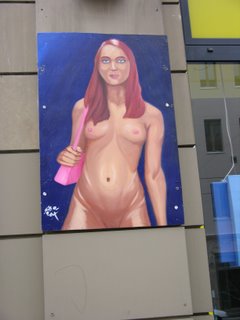
Thanks, Nike! And this makes a real nice contrast with the canary-yellow Statue of Liberty the travel-agency in the building to which this is affixed puts out on the sidewalk during opening hours, too. My only concern is that this painting is dated '04, like most of them are, and I'm wondering if there's any recent work. Still, the pink handbag and rather ambiguous nether regions are all part of that weird primitive Nike vibe, so long may she wave.
***
Long ago, I posted two paper graffiti naked lady wrestlers who appeared on a doorstop just a few buildings away from me, and I forgot to document how, in the middle of a particularly cold winter, one of them got warmed up with an "I [heart] NY" t-shirt. The same artist, though, appeared a few months ago just a block away, and I'd been meaning to shoot this funny piece for ages. Got it today while I set out for the Nike shoot, though:
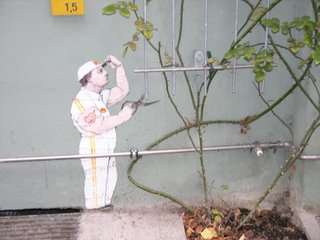
The name in the heart tattoo is in Russian, a language I simply can't read, but what the photo really fails to make plain is that he's only about nine inches tall and the rose bush he's standing by is over six feet tall. I like seeing him as I walk down Torstr., with his mixture of awe and determination as he gets ready to trim the giant rose.
***
Finally, the late, beloved Bistro Tor, the Döner Kebap place which stood for years outside my place, and which closed suddenly and permanently a couple of months ago, is slowly turning into something called Toco Rouge. There are Toco Rouge stickers all over the neighborhood, as well as on the bikes of the folks who are busily working inside. From the fact that they all look Thai or Vietnamese, and the fact that, in a rare moment when I could see inside, there were woks on the stove, I'm afraid we're in for another "Asia Food" place serving brown glop on glass-noodles. Gotta have glass-noodles: I was in a Japanese restaurant a couple of weeks back, and the meal began with a small glass-noodle salad, which would certainly have puzzled any Japanese person who ate there. Anyway, my expectations are nil for this place, and I'm wondering where I can get a decent Döner -- something I eat about once a month, if that often -- close enough so that in the cold weather it won't totally cool off before I get it home.

Thanks, Nike! And this makes a real nice contrast with the canary-yellow Statue of Liberty the travel-agency in the building to which this is affixed puts out on the sidewalk during opening hours, too. My only concern is that this painting is dated '04, like most of them are, and I'm wondering if there's any recent work. Still, the pink handbag and rather ambiguous nether regions are all part of that weird primitive Nike vibe, so long may she wave.
***
Long ago, I posted two paper graffiti naked lady wrestlers who appeared on a doorstop just a few buildings away from me, and I forgot to document how, in the middle of a particularly cold winter, one of them got warmed up with an "I [heart] NY" t-shirt. The same artist, though, appeared a few months ago just a block away, and I'd been meaning to shoot this funny piece for ages. Got it today while I set out for the Nike shoot, though:
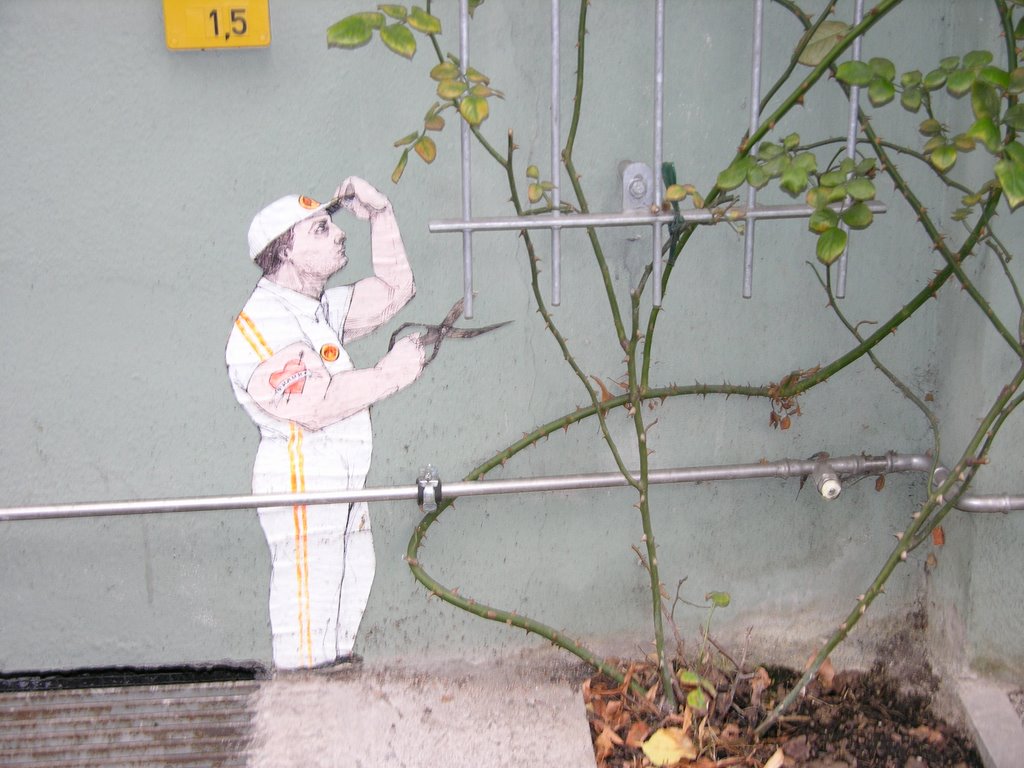
The name in the heart tattoo is in Russian, a language I simply can't read, but what the photo really fails to make plain is that he's only about nine inches tall and the rose bush he's standing by is over six feet tall. I like seeing him as I walk down Torstr., with his mixture of awe and determination as he gets ready to trim the giant rose.
***
Finally, the late, beloved Bistro Tor, the Döner Kebap place which stood for years outside my place, and which closed suddenly and permanently a couple of months ago, is slowly turning into something called Toco Rouge. There are Toco Rouge stickers all over the neighborhood, as well as on the bikes of the folks who are busily working inside. From the fact that they all look Thai or Vietnamese, and the fact that, in a rare moment when I could see inside, there were woks on the stove, I'm afraid we're in for another "Asia Food" place serving brown glop on glass-noodles. Gotta have glass-noodles: I was in a Japanese restaurant a couple of weeks back, and the meal began with a small glass-noodle salad, which would certainly have puzzled any Japanese person who ate there. Anyway, my expectations are nil for this place, and I'm wondering where I can get a decent Döner -- something I eat about once a month, if that often -- close enough so that in the cold weather it won't totally cool off before I get it home.
Sunday, October 01, 2006
Weekend Wordage
Blog Post of the Week: When belledame222 gets mad, she doesn't hold back. I was absolutely thrilled by this post, even though she didn't write a word of it herself. Errr, not that she couldn't write that well if she tried, he said, not wanting to incur her wrath.
***
In other news of the blogosphere, some months ago I was astonished to find an outpost of the extreme American right blogging here in Berlin. Called Davids Medienkritik, it analyzed German media for "anti-American bias," and not only found loads of it lurking in the mainstream media, but found actual socialism happening at the highest government levels! Like most of the echo chamber, they don't take well to criticism, and so Radio Free Mike, who freelances for Spiegel Online, has been taking crap from them recently. If you've got an interest in this sort of thing, I invite you to go over there and check out the ongoing battle. You can find Davids Medienkritik's link yourself, if you see fit. I don't much feel like giving them more hits, for some reason.
***
In a daring experiment, the government, this weekend, allowed stores to open on Sunday for a few hours. The reason is that German Unity Day, Oct. 3, a federal holiday, falls on Tuesday, so this Sunday opening takes the place of that. Not that anyone was at the Stupidmarket when I was over there just now (including the personnel in the fish, meat, and cheese departments), but it was nice not to have to jam everything into a Saturday rush. It appears also that a lot of art galleries took advantage of this, particularly the brand-new ones on Brunnenstr., which seems to be picking up the second-rate gallery banner from Schröderstr., which now only has one mediocre gallery on it. But Germans still haven't picked up on the idea of Sunday shopping, and they may never do so.
As for me, I hope to enjoy the holiday at the last races of the season out at Hoppegarten. From the looks of things, fall is coming in, and one last day in the sun sounds like a real good idea.
***
In other news of the blogosphere, some months ago I was astonished to find an outpost of the extreme American right blogging here in Berlin. Called Davids Medienkritik, it analyzed German media for "anti-American bias," and not only found loads of it lurking in the mainstream media, but found actual socialism happening at the highest government levels! Like most of the echo chamber, they don't take well to criticism, and so Radio Free Mike, who freelances for Spiegel Online, has been taking crap from them recently. If you've got an interest in this sort of thing, I invite you to go over there and check out the ongoing battle. You can find Davids Medienkritik's link yourself, if you see fit. I don't much feel like giving them more hits, for some reason.
***
In a daring experiment, the government, this weekend, allowed stores to open on Sunday for a few hours. The reason is that German Unity Day, Oct. 3, a federal holiday, falls on Tuesday, so this Sunday opening takes the place of that. Not that anyone was at the Stupidmarket when I was over there just now (including the personnel in the fish, meat, and cheese departments), but it was nice not to have to jam everything into a Saturday rush. It appears also that a lot of art galleries took advantage of this, particularly the brand-new ones on Brunnenstr., which seems to be picking up the second-rate gallery banner from Schröderstr., which now only has one mediocre gallery on it. But Germans still haven't picked up on the idea of Sunday shopping, and they may never do so.
As for me, I hope to enjoy the holiday at the last races of the season out at Hoppegarten. From the looks of things, fall is coming in, and one last day in the sun sounds like a real good idea.
Saturday, September 30, 2006
Apartment Quest Berlin: A Few Bits Of Advice
A couple of weeks ago, a reader of this blog contacted me about finding an apartment here. His girlfriend has a grant, he's coming with her, they're going to live here until next summer. So far, so straightforward. They want to live in the east, naturally, since it's Hip! Edgy! Berlin! and to tell the truth, if I were in the same position, I would, too. This narrows down the possibilities, because apartments are slightly harder to find on this side of town, but not by very much.
It occurs to me that there may be one or two of you out there in blog-reading land who are entertaining similar fantasies, and so I thought I'd take a few minutes to say some things that people here would find incredibly obvious and elementary, but might be less so especially to residents of the U.S. So, in no particular order:
* In Europe, the first floor is the second floor. In other words, you have the ground floor, and above it the first floor, then the second floor, and so on. It took me a couple of years to internalize this.
* What you're renting is a box. It is empty, although the chances are the kitchen will have a stove and a very rudimentary refrigerator of the type Americans call "dorm-size" because it can just accommodate a six-pack and what's left of last night's pizza. (It should also be noted that American pizzas are bigger than European ones). Oh, and there'll be a toilet and a shower and/or bath in the bathroom. Everything else, you're going to have to provide yourself. There are no closets. You'll have to buy a clothes cabinet to hang your clothes in. That wire sticking out of the ceiling? You'll turn off the electricity at the fuse-box and install a light fixture and a ceiling lamp, if you want one. Otherwise, you can get floor lamps like I did. You'll provide your own rugs or do without. In other words, a lot of the stuff that's already there in an American apartment rental isn't in a European one.
* The electricity may be on, and the heat almost certainly will be. If you're very, very lucky you'll have a gas stove and the gas will also be on. The cable for the TV will also be on. You'll need to get all of this stuff in your name immediately. The telephone will not be on, and after prostrating yourself to Satan, ie, Deutsche Telekom, you'll wait a couple of weeks for that, which may be one reason so many people have given up on land-lines here. Also: check to see if the rent is "warm" or "cold." If it's the latter, the utility bills aren't included. Also check what the "Nebenskosten," the yearly maintenance fees, for cleaning the stairwells and other services, come to.
* You can't get a bank account without an address. You can't get an address without a bank account, unless you find a landlord who doesn't want money. These people are usually identified by a thin glowing toroid hovering several inches above their heads, I'm told. Having had my first address given to me free, I never had to wrestle with this, so I can't advise you here.
* The absolute best way to find an apartment used to be -- and may still be -- to head down to Zoo Station on a Saturday night and offer sexual services to...wait a minute, I mean pick up a copy of the Berliner Morgenpost's Sunday edition when it arrives from the printer. Throw out all of it except the Immobilien pages, find the area of town you want to move to, and start trying to figure out the abbreviations. Don't worry about calling the numbers you find at any time of night or day; nobody else does, and do you want to miss the apartment of a lifetime? And don't worry about the person renting the apartment speaking English. You can be assured they don't.
* You will notice that some -- most -- ads contain the word "Makler." This means broker, and it also means that you'll be parting with at least one month's rent for the honor of renting from this person. Often the Makler conducts a "Besichtigung," which is a cattle-call for all the people who have called expressing interest in the same apartment. Walking down the streets of Berlin on a Friday night, you sometimes come to these groups of people, gathered into clumps of two or three, each clump eyeing the other clumps suspiciously, the odd single person looking paranoid. These people are all competing for the same place, and the wily Makler, who is showing up late to show it to them, almost certainly has two or three other apartments in the building for those who want to strike deals or have lost out on the (invariably bargain-priced, to provoke an on-the-spot auction and attract the suckers who'll bid on the other available apartments) place that's been advertised. The way to avoid Maklers is to look for the word "privat." That way you're dealing with the owner directly.
* Another couple of words to look out for are "Untermieter" and "Nachmieter." An Untermieter is a sub-letter, and subletting is a very popular activity in a place which, the 100,000-plus vacancies currently on the market notwithstanding, still remembers the days when it could take, conservatively speaking, a year to find an apartment. You'd get a place. You'd meet a girl. You'd move in with her or she'd move in with you. One of you sublets the unused apartment. That's how I -- and many other people I knew -- got their first apartments here. A word of caution, though: make sure the sublet is legal. Many rental contracts specifically forbid subletting, which doesn't stop most people, because for the most part nobody concerned cares as long as the rent is paid. Nor does this stop people from offering sublets which are illegal and not telling the poor renter. One more strip of paper goes on the mailbox, which is already collecting mail for a half-dozen past tenants, you add "bei So-and-So" to your address and it's cool. Unless, as happened to me, your mailman is a stickler for rules, his ponytail and John Lennon glasses being just a disguise for a rigid, rules-for-their-own-sake kinda guy. The eviction notice comes quickly and is enforced by various police. But hey, that's the kind of thing that only happens to me.
* Now, a Nachmieter is something else entirely, and it's a much friendlier situation. If you can't serve out your lease, you may offer it to someone else. Of course, the landlord has to approve, but because this is Germany, it has to be complicated. By law, you have to offer the lease to three people, of which the landlord will pick one. This is the only way the lease can be transferred. I happen to be the Nachmieter in the apartment I've been in here for almost ten years, and the way we handled the situation was this. The woman who lived here before me had inherited a pile of money and bought a gorgeous house elsewhere in the city as a tax dodge. She put an ad in the Morgenpost -- see above -- for a Nachmieter and I called her. Turned out she knew who I was because she worked for an American wire service here and she decided the landlord would like me, so she arranged for two of her friends who had no intention of moving out of their own apartments to apply before me. Then I met with the landlord, and the next thing you know I was out of my postman-informer situation and in here. Just remember: applying for Nachmieter status doesn't mean you'll get it. But it does mean the rent won't go up as a result of your moving in.
* Furniture is the least of your worries, which is why I find it bizarre that the folks I referred to at the start of this post are insisting on renting a furnished apartment. Who wants to be responsible for someone else's furniture? Who wants to live with what someone else finds attractive? But those considerations pale against the fact that there aren't any furnished apartments anywhere you'd want to live in this city. People throw out nearly-new furniture every day in Berlin -- I'm currently eyeing a nice clothes-cupboard one of my neighbors has out, although I'm not sure if it's for the taking or not, but it'd make a nice replacement for the falling-apart one I have in the bedroom. People give away furniture in the classifieds and on Craigslist. People sell beautiful pieces of antique furniture for fifty bucks. In large part, this is because people are getting the hell out of here. But you can also buy an apartment's worth of new furniture at Ikea and they'll deliver it for a flat fee of €40. There's no reason to rent a furnished apartment in Berlin.
* Remember, too, that apartments are small. You may see ads for big ones, but there are restrictions a lot of the time on how few people are allowed to live in an apartment. If you're a single person, you may or may not be allowed a huge place. Best to check with the owner and see what the restrictions are. I have a couple of friends who bought an apartment and have a ghost roommate because the two of them wouldn't have been allowed to own the place by themselves. (And no, they can't have a baby because they're both guys. Although, come to think of it, they could adopt).
I'd advise against moving here period, but I know that's not going to stop anyone who'd heard the Hip! Edgy! chant of the media and the perfectly real statistic that it's by far the cheapest city in Western Europe to live in. Mind you, you get what you pay for, but it takes a while to realize that.
And finally, no. I don't know of any four-room, sunny, parquet-floor, quiet apartments in Prenzlauer Berg for around €400 warm, so don't ask.
It occurs to me that there may be one or two of you out there in blog-reading land who are entertaining similar fantasies, and so I thought I'd take a few minutes to say some things that people here would find incredibly obvious and elementary, but might be less so especially to residents of the U.S. So, in no particular order:
* In Europe, the first floor is the second floor. In other words, you have the ground floor, and above it the first floor, then the second floor, and so on. It took me a couple of years to internalize this.
* What you're renting is a box. It is empty, although the chances are the kitchen will have a stove and a very rudimentary refrigerator of the type Americans call "dorm-size" because it can just accommodate a six-pack and what's left of last night's pizza. (It should also be noted that American pizzas are bigger than European ones). Oh, and there'll be a toilet and a shower and/or bath in the bathroom. Everything else, you're going to have to provide yourself. There are no closets. You'll have to buy a clothes cabinet to hang your clothes in. That wire sticking out of the ceiling? You'll turn off the electricity at the fuse-box and install a light fixture and a ceiling lamp, if you want one. Otherwise, you can get floor lamps like I did. You'll provide your own rugs or do without. In other words, a lot of the stuff that's already there in an American apartment rental isn't in a European one.
* The electricity may be on, and the heat almost certainly will be. If you're very, very lucky you'll have a gas stove and the gas will also be on. The cable for the TV will also be on. You'll need to get all of this stuff in your name immediately. The telephone will not be on, and after prostrating yourself to Satan, ie, Deutsche Telekom, you'll wait a couple of weeks for that, which may be one reason so many people have given up on land-lines here. Also: check to see if the rent is "warm" or "cold." If it's the latter, the utility bills aren't included. Also check what the "Nebenskosten," the yearly maintenance fees, for cleaning the stairwells and other services, come to.
* You can't get a bank account without an address. You can't get an address without a bank account, unless you find a landlord who doesn't want money. These people are usually identified by a thin glowing toroid hovering several inches above their heads, I'm told. Having had my first address given to me free, I never had to wrestle with this, so I can't advise you here.
* The absolute best way to find an apartment used to be -- and may still be -- to head down to Zoo Station on a Saturday night and offer sexual services to...wait a minute, I mean pick up a copy of the Berliner Morgenpost's Sunday edition when it arrives from the printer. Throw out all of it except the Immobilien pages, find the area of town you want to move to, and start trying to figure out the abbreviations. Don't worry about calling the numbers you find at any time of night or day; nobody else does, and do you want to miss the apartment of a lifetime? And don't worry about the person renting the apartment speaking English. You can be assured they don't.
* You will notice that some -- most -- ads contain the word "Makler." This means broker, and it also means that you'll be parting with at least one month's rent for the honor of renting from this person. Often the Makler conducts a "Besichtigung," which is a cattle-call for all the people who have called expressing interest in the same apartment. Walking down the streets of Berlin on a Friday night, you sometimes come to these groups of people, gathered into clumps of two or three, each clump eyeing the other clumps suspiciously, the odd single person looking paranoid. These people are all competing for the same place, and the wily Makler, who is showing up late to show it to them, almost certainly has two or three other apartments in the building for those who want to strike deals or have lost out on the (invariably bargain-priced, to provoke an on-the-spot auction and attract the suckers who'll bid on the other available apartments) place that's been advertised. The way to avoid Maklers is to look for the word "privat." That way you're dealing with the owner directly.
* Another couple of words to look out for are "Untermieter" and "Nachmieter." An Untermieter is a sub-letter, and subletting is a very popular activity in a place which, the 100,000-plus vacancies currently on the market notwithstanding, still remembers the days when it could take, conservatively speaking, a year to find an apartment. You'd get a place. You'd meet a girl. You'd move in with her or she'd move in with you. One of you sublets the unused apartment. That's how I -- and many other people I knew -- got their first apartments here. A word of caution, though: make sure the sublet is legal. Many rental contracts specifically forbid subletting, which doesn't stop most people, because for the most part nobody concerned cares as long as the rent is paid. Nor does this stop people from offering sublets which are illegal and not telling the poor renter. One more strip of paper goes on the mailbox, which is already collecting mail for a half-dozen past tenants, you add "bei So-and-So" to your address and it's cool. Unless, as happened to me, your mailman is a stickler for rules, his ponytail and John Lennon glasses being just a disguise for a rigid, rules-for-their-own-sake kinda guy. The eviction notice comes quickly and is enforced by various police. But hey, that's the kind of thing that only happens to me.
* Now, a Nachmieter is something else entirely, and it's a much friendlier situation. If you can't serve out your lease, you may offer it to someone else. Of course, the landlord has to approve, but because this is Germany, it has to be complicated. By law, you have to offer the lease to three people, of which the landlord will pick one. This is the only way the lease can be transferred. I happen to be the Nachmieter in the apartment I've been in here for almost ten years, and the way we handled the situation was this. The woman who lived here before me had inherited a pile of money and bought a gorgeous house elsewhere in the city as a tax dodge. She put an ad in the Morgenpost -- see above -- for a Nachmieter and I called her. Turned out she knew who I was because she worked for an American wire service here and she decided the landlord would like me, so she arranged for two of her friends who had no intention of moving out of their own apartments to apply before me. Then I met with the landlord, and the next thing you know I was out of my postman-informer situation and in here. Just remember: applying for Nachmieter status doesn't mean you'll get it. But it does mean the rent won't go up as a result of your moving in.
* Furniture is the least of your worries, which is why I find it bizarre that the folks I referred to at the start of this post are insisting on renting a furnished apartment. Who wants to be responsible for someone else's furniture? Who wants to live with what someone else finds attractive? But those considerations pale against the fact that there aren't any furnished apartments anywhere you'd want to live in this city. People throw out nearly-new furniture every day in Berlin -- I'm currently eyeing a nice clothes-cupboard one of my neighbors has out, although I'm not sure if it's for the taking or not, but it'd make a nice replacement for the falling-apart one I have in the bedroom. People give away furniture in the classifieds and on Craigslist. People sell beautiful pieces of antique furniture for fifty bucks. In large part, this is because people are getting the hell out of here. But you can also buy an apartment's worth of new furniture at Ikea and they'll deliver it for a flat fee of €40. There's no reason to rent a furnished apartment in Berlin.
* Remember, too, that apartments are small. You may see ads for big ones, but there are restrictions a lot of the time on how few people are allowed to live in an apartment. If you're a single person, you may or may not be allowed a huge place. Best to check with the owner and see what the restrictions are. I have a couple of friends who bought an apartment and have a ghost roommate because the two of them wouldn't have been allowed to own the place by themselves. (And no, they can't have a baby because they're both guys. Although, come to think of it, they could adopt).
I'd advise against moving here period, but I know that's not going to stop anyone who'd heard the Hip! Edgy! chant of the media and the perfectly real statistic that it's by far the cheapest city in Western Europe to live in. Mind you, you get what you pay for, but it takes a while to realize that.
And finally, no. I don't know of any four-room, sunny, parquet-floor, quiet apartments in Prenzlauer Berg for around €400 warm, so don't ask.
Tuesday, September 26, 2006
A Few More Thoughts On Service
When last we saw the saga of my laptop, I'd rescued it from drug-addled service personnel who refused to touch it and made another call to Apple, who assured me that if I'd pay the labor (€100) they'd buy the logic board (€500).
Naturally, I had to wait until I had that kind of change, so it wasn't until today that I could try the next on the list of service places on Apple's very short list. It took me a while to find them (but boy am I collecting odd corners of town), and when I did, the whole transaction was very short. The guy snapped open the laptop, read the serial number, and handed the machine back to me. "No," was what he said. Unlike at the last place, nobody spoke English, but I figured out that he'd not found the serial number on some website, and, thus, no claim to the contrary would let him accept the thing for repair.
"Typical," I said. "Yes, typical Apple," the guy said. "No, typical German," I said, and stomped out.
Some 40 minutes on hold after I'd walked home from the shop later, I talked to a guy at Apple who was astonished to find that the first time I'd called, the guy had mis-typed the serial number. He was so embarrassed that his boss called me back to say that Apple would eat the labor, too.
But there's an underlying problem here. Why would I walk into a place and say Apple had agreed to repair my computer if it wasn't true? It's all too easy to disprove, as I found out. The guy checks, and the number's not there. But I insisted to him that I had case numbers and incident numbers that proved I was right. Nope: didn't want to look at them.
When I related this to the guy at Apple, he said -- as I thought he would -- "They have a number they can call, and they should call that number." This was such a simple screw-up that it could have been spotted. Apple had my name, my serial number (except for one figure of it), and all the rest. But it would have been too much trouble.
Here's the deal with service in Germany. Anyone who's in the position to fix something has been through a training program. Doesn't matter if it's your car, your washing-machine, or your computer. They're certified, and have framed certificates to prove it. This means they're better than you are, because if you knew how to fix it you wouldn't bring it to someone else, you'd fix it yourself, wouldn't you? This means, to the service guy, that he's inherently better than you, at least in one area, and he's going to let you know that. Because he's German, he also believes there's only one way to do something, and that's the way he's been taught. You couldn't possibly know enough about it to have an alternative suggestion.
This Grand Magus mindset is what kept Deutsche Telekom from offering real internet service to its customers for years, until they realized, too late, that a lot of those customers had read stuff in magazines and knew at least as much as Deutsche Telekom did, and they wanted on, goddammit. That mindset is why my ID that gets me hooked up to their broadband service is 36 letters and numbers long and the password that goes with it is 128. I'm not supposed to know that it's just as likely I could be ed at t-online with "puffball" as a password.
Plus, of course, there's the "customer is always wrong" mindset which goes with any retail or service business in this country. Just by walking in the door, you're disrupting the pleasant tedium of the day. Life without you would be so much easier, so much calmer, so much more enjoyable. Enough days without you and there's the holy grail of retirement. That, not helping people, not providing a service, is what labor is for.
Just remember that if you ever need to get anything done in Germany.
Naturally, I had to wait until I had that kind of change, so it wasn't until today that I could try the next on the list of service places on Apple's very short list. It took me a while to find them (but boy am I collecting odd corners of town), and when I did, the whole transaction was very short. The guy snapped open the laptop, read the serial number, and handed the machine back to me. "No," was what he said. Unlike at the last place, nobody spoke English, but I figured out that he'd not found the serial number on some website, and, thus, no claim to the contrary would let him accept the thing for repair.
"Typical," I said. "Yes, typical Apple," the guy said. "No, typical German," I said, and stomped out.
Some 40 minutes on hold after I'd walked home from the shop later, I talked to a guy at Apple who was astonished to find that the first time I'd called, the guy had mis-typed the serial number. He was so embarrassed that his boss called me back to say that Apple would eat the labor, too.
But there's an underlying problem here. Why would I walk into a place and say Apple had agreed to repair my computer if it wasn't true? It's all too easy to disprove, as I found out. The guy checks, and the number's not there. But I insisted to him that I had case numbers and incident numbers that proved I was right. Nope: didn't want to look at them.
When I related this to the guy at Apple, he said -- as I thought he would -- "They have a number they can call, and they should call that number." This was such a simple screw-up that it could have been spotted. Apple had my name, my serial number (except for one figure of it), and all the rest. But it would have been too much trouble.
Here's the deal with service in Germany. Anyone who's in the position to fix something has been through a training program. Doesn't matter if it's your car, your washing-machine, or your computer. They're certified, and have framed certificates to prove it. This means they're better than you are, because if you knew how to fix it you wouldn't bring it to someone else, you'd fix it yourself, wouldn't you? This means, to the service guy, that he's inherently better than you, at least in one area, and he's going to let you know that. Because he's German, he also believes there's only one way to do something, and that's the way he's been taught. You couldn't possibly know enough about it to have an alternative suggestion.
This Grand Magus mindset is what kept Deutsche Telekom from offering real internet service to its customers for years, until they realized, too late, that a lot of those customers had read stuff in magazines and knew at least as much as Deutsche Telekom did, and they wanted on, goddammit. That mindset is why my ID that gets me hooked up to their broadband service is 36 letters and numbers long and the password that goes with it is 128. I'm not supposed to know that it's just as likely I could be ed at t-online with "puffball" as a password.
Plus, of course, there's the "customer is always wrong" mindset which goes with any retail or service business in this country. Just by walking in the door, you're disrupting the pleasant tedium of the day. Life without you would be so much easier, so much calmer, so much more enjoyable. Enough days without you and there's the holy grail of retirement. That, not helping people, not providing a service, is what labor is for.
Just remember that if you ever need to get anything done in Germany.
Sunday, September 24, 2006
Another Year, Another PopKomm
Right from the start, it gave signs of German efficiency. The e-mail alerting me to my registration was addressed "Dear Ward," and my badge, when printed out, noted I was from AUS, which I presume means Australia. Fortunately, I was in no danger of being mistaken for an Australian, since pretty much 100% of my time was spent at the SXSW stand, answering bone-headed questions to deflect them from the management folks, who had actual important business to transact.
Once I had my badge, I was also given a wristband, which I assumed was for entry into showcases. Since I had no intention whatever of subjecting myself to the barrage of mediocrity that is Euro-rock, I slipped it into my back pocket. Nope. Came the first day, I wasn't allowed into the hall until the sweet, innocent-looking girl at the door had attached it. Sweet and innocent-looking she may have been, but clearly her day-job is bondage; over the next three days, unable to take it off, I developed a mild skin rash, and it got slimy when I showered. Not to mention the pain.
As always, there was a bag, and as always, it was devoid of goodies with any use, unless you consider an orange-flavored Chupa Chups lollipop to have a use. It did have a schedule of events, but this year, no book of registrants. It had been replaced by a Windows-only CD-ROM, showing how technologically sophisticated PopKomm had gotten. Two minutes inside the right computer and you've got a very nicely filtered list of people to spam to. I can't wait.
Did I mention the bone-headed questions? Ah, yes, I see I did. Here's my favorite. A giant of a guy in an appalling jacket walks up, and announces "I am Rossiyan boblisher. I look for boblishing bartners." Then he stares at me. "You are interested?" Well, I explain, we're not publishers, we're an event. "Ewent," he says. "You are not interested in Rossiya." No, I said patiently, we're like PopKomm, only larger, older, and in Texas. "Taixes," he says. You could come and find partners at our event, because we have a trade-show like this, and lots and lots of people in the music business from all over the world come -- not many from Russia, so you have a big advantage. He has this stunned-deer expression on his face. "So. You are not interested in Rossiya." Whatever, dude. He takes a brochure and walks away.
Which I wish he hadn't done. The charming folks at British Airways had lost the suitcase full of brochures, sales information, photographs, banners, and all the other stuff we were supposed to have at the stand. Our Festival Director spent lots of time on the phone trying to get them to give him some idea of when it would arrive. It was on "the next flight" from Tuesday evening until Friday morning, when it actually arrived. Too bad we were planning to be out of there by 4 that afternoon. So we were a little short of information, graphics, and the like, for the uninitiated, the vast majority of whom, thank whatever deities look over such things, were a great deal smarter than our Russian friend.
One great thing about this year's SXSW stand is that now all submissions of music for the music festival are done online. You go to the SXSW website, upload your music samples, your press kit, your application, pay your fees, and that's it. Given the amount of trash we've thrown away on previous Fridays, it was a sheer joy to say "We don't want your CDs." I came back with exactly one, from a gorgeous Norwegian woman whose artists, the Festival Director assured me, were the best-kept secret in Scandinavia. We shall see. He had also urged a CD on me last year by Deerhoof, a band with out-of-tune instruments and girlfriend vocals (the vocalist is in the band because she's someone's girlfriend -- thanks, Tim, for coining this term so many years ago, and too bad it never caught on) that was excruciating.
So most of the time I was just standing there -- PopKomm's trade show isn't the best-attended on earth, and it's far smaller than it was when the event was in Cologne, I think -- watching the passing parade, thin as it was. In my head, I was writing a fashion critique, because these days there's so little originality in the music for sale at events like this that how its vendors and creators represent themselves is more interesting.
The worst fashion trend of the year -- and it's not limited to PopKomm at all -- is the faux-Americanoid t-shirt, pre-washed and pre-distressed so that the silk-screen's already flaking off when you buy it, pretending to be from some camp, tavern, gas station, bowling alley, or something in the '60s or '70s. What's annoying about them is that there's always a detail fudged, so there won't be a lawsuit, and that makes the damn thing scream fake. Fortunately, as the weather cools, these won't be practical to wear as outer garments. I blame Abercrombie-Fitch, who I think started this stupid trend.
Not that there weren't a couple of clever t-shirts there. By a couple, I mean just that: one guy ran by with a shirt saying "Hangover" in perfect Heinecken script, while another guy, who looked like a German lawyer, had one saying "Malt Whiskey" in script that exactly mimicked Walt Disney's signature.
But for the most part, the participants were drab. Tattoos...lord, where to start with the tattoos? If you have expensive tattoos, you don't expose them to the sun because they fade and the outlines blur and you wind up with a couple thousand bucks' worth of blotch. And if you're going to invest that much money in tattoos, for heaven's sake have a plan. When you walk around with your arms and legs (and, presumably, other regions you're not showing us) covered wtih a patchwork of different styles and artists' work, you're what the tattoo artists call (not, mind you, to your face) a potato. And there were a lot of potatoes walking around.
Standing around like I was doing, you get to watch people's faces, their attention to what's around them. Sometimes you want to yell at them. Hey, you! Listen, dude, you guys have walked past here three times, and I've got to tell you, your girlfriend is a lot smarter and a lot harder than you are. In five years, she's going to be on her way to a big-time law career and you're going to be sitting in a bar going "Ummm, what happened?" And you, lady: listen, I'm not a pedophile, but is your 13-year-old daughter -- the one you had when you were 35 -- sitting at home naked? Because clearly you're wearing her clothing. Yes, it's that obvious. Go home and change and people might take you seriously. And while we're on the subject, sir, you're German, not Afro-American, and yet you've got several hundred dollars' worth of hip-hop clothing on. This is something you're ill-advised to do as your 30s wear on, let alone at your age, which I estimate to be over 45. Plus, you're German. You just look stupid in them. Go home and change into some floor-length pants. And much as I don't get the shaved-head look, well in evidence at PopKomm, of course, the short hair with a tiny rat-tail in the back is about as silly as you can get.
I only got to wander around the trade-fair once, and wasn't terribly impressed. But then, I wasn't in the market for much that was going on. One really bright spot was seeing a guy I knew when he'd just given up his gig driving a bus in East Berlin and who is now a huge star in the dance-music world, Paul van Dyk. Not only did he remember me, he even brought his wife by and introduced her. There are a few nice folks in this business. Plus, he's now got a real interesting business going, something called Vonyc, a "radio and download station for advanced electronic music," which he demonstrated to me. I'll have to listen -- the business model is smart, but for me the music's the thing -- but I've always admired Paul's work, even though I long became too old to get into the clubs where he performs himself.
The thing is, I don't pretend I'm doing anything but selling a product some friends of mine make. I'm not chasing a lost youth or "getting down with the kids" or any of that. There comes a time when you have to define your relationship to pop music, and an awful lot of Peter Pans seem to be wandering around the music business at events like PopKomm. It was, in short, more than a little depressing. But I did my job: I kept the numbskulls from the crew, chatted with some old friends I only see at events like this, and, Friday night, joined everyone at my favorite Italian restaurant for a typically fantastic meal, and at the end of the evening said good-bye to the folks as they got into a cab. PopKomm was over until next year, although next year, if I'm living in France as I desperately hope I will be, I may not be there.
Once I had my badge, I was also given a wristband, which I assumed was for entry into showcases. Since I had no intention whatever of subjecting myself to the barrage of mediocrity that is Euro-rock, I slipped it into my back pocket. Nope. Came the first day, I wasn't allowed into the hall until the sweet, innocent-looking girl at the door had attached it. Sweet and innocent-looking she may have been, but clearly her day-job is bondage; over the next three days, unable to take it off, I developed a mild skin rash, and it got slimy when I showered. Not to mention the pain.
As always, there was a bag, and as always, it was devoid of goodies with any use, unless you consider an orange-flavored Chupa Chups lollipop to have a use. It did have a schedule of events, but this year, no book of registrants. It had been replaced by a Windows-only CD-ROM, showing how technologically sophisticated PopKomm had gotten. Two minutes inside the right computer and you've got a very nicely filtered list of people to spam to. I can't wait.
Did I mention the bone-headed questions? Ah, yes, I see I did. Here's my favorite. A giant of a guy in an appalling jacket walks up, and announces "I am Rossiyan boblisher. I look for boblishing bartners." Then he stares at me. "You are interested?" Well, I explain, we're not publishers, we're an event. "Ewent," he says. "You are not interested in Rossiya." No, I said patiently, we're like PopKomm, only larger, older, and in Texas. "Taixes," he says. You could come and find partners at our event, because we have a trade-show like this, and lots and lots of people in the music business from all over the world come -- not many from Russia, so you have a big advantage. He has this stunned-deer expression on his face. "So. You are not interested in Rossiya." Whatever, dude. He takes a brochure and walks away.
Which I wish he hadn't done. The charming folks at British Airways had lost the suitcase full of brochures, sales information, photographs, banners, and all the other stuff we were supposed to have at the stand. Our Festival Director spent lots of time on the phone trying to get them to give him some idea of when it would arrive. It was on "the next flight" from Tuesday evening until Friday morning, when it actually arrived. Too bad we were planning to be out of there by 4 that afternoon. So we were a little short of information, graphics, and the like, for the uninitiated, the vast majority of whom, thank whatever deities look over such things, were a great deal smarter than our Russian friend.
One great thing about this year's SXSW stand is that now all submissions of music for the music festival are done online. You go to the SXSW website, upload your music samples, your press kit, your application, pay your fees, and that's it. Given the amount of trash we've thrown away on previous Fridays, it was a sheer joy to say "We don't want your CDs." I came back with exactly one, from a gorgeous Norwegian woman whose artists, the Festival Director assured me, were the best-kept secret in Scandinavia. We shall see. He had also urged a CD on me last year by Deerhoof, a band with out-of-tune instruments and girlfriend vocals (the vocalist is in the band because she's someone's girlfriend -- thanks, Tim, for coining this term so many years ago, and too bad it never caught on) that was excruciating.
So most of the time I was just standing there -- PopKomm's trade show isn't the best-attended on earth, and it's far smaller than it was when the event was in Cologne, I think -- watching the passing parade, thin as it was. In my head, I was writing a fashion critique, because these days there's so little originality in the music for sale at events like this that how its vendors and creators represent themselves is more interesting.
The worst fashion trend of the year -- and it's not limited to PopKomm at all -- is the faux-Americanoid t-shirt, pre-washed and pre-distressed so that the silk-screen's already flaking off when you buy it, pretending to be from some camp, tavern, gas station, bowling alley, or something in the '60s or '70s. What's annoying about them is that there's always a detail fudged, so there won't be a lawsuit, and that makes the damn thing scream fake. Fortunately, as the weather cools, these won't be practical to wear as outer garments. I blame Abercrombie-Fitch, who I think started this stupid trend.
Not that there weren't a couple of clever t-shirts there. By a couple, I mean just that: one guy ran by with a shirt saying "Hangover" in perfect Heinecken script, while another guy, who looked like a German lawyer, had one saying "Malt Whiskey" in script that exactly mimicked Walt Disney's signature.
But for the most part, the participants were drab. Tattoos...lord, where to start with the tattoos? If you have expensive tattoos, you don't expose them to the sun because they fade and the outlines blur and you wind up with a couple thousand bucks' worth of blotch. And if you're going to invest that much money in tattoos, for heaven's sake have a plan. When you walk around with your arms and legs (and, presumably, other regions you're not showing us) covered wtih a patchwork of different styles and artists' work, you're what the tattoo artists call (not, mind you, to your face) a potato. And there were a lot of potatoes walking around.
Standing around like I was doing, you get to watch people's faces, their attention to what's around them. Sometimes you want to yell at them. Hey, you! Listen, dude, you guys have walked past here three times, and I've got to tell you, your girlfriend is a lot smarter and a lot harder than you are. In five years, she's going to be on her way to a big-time law career and you're going to be sitting in a bar going "Ummm, what happened?" And you, lady: listen, I'm not a pedophile, but is your 13-year-old daughter -- the one you had when you were 35 -- sitting at home naked? Because clearly you're wearing her clothing. Yes, it's that obvious. Go home and change and people might take you seriously. And while we're on the subject, sir, you're German, not Afro-American, and yet you've got several hundred dollars' worth of hip-hop clothing on. This is something you're ill-advised to do as your 30s wear on, let alone at your age, which I estimate to be over 45. Plus, you're German. You just look stupid in them. Go home and change into some floor-length pants. And much as I don't get the shaved-head look, well in evidence at PopKomm, of course, the short hair with a tiny rat-tail in the back is about as silly as you can get.
I only got to wander around the trade-fair once, and wasn't terribly impressed. But then, I wasn't in the market for much that was going on. One really bright spot was seeing a guy I knew when he'd just given up his gig driving a bus in East Berlin and who is now a huge star in the dance-music world, Paul van Dyk. Not only did he remember me, he even brought his wife by and introduced her. There are a few nice folks in this business. Plus, he's now got a real interesting business going, something called Vonyc, a "radio and download station for advanced electronic music," which he demonstrated to me. I'll have to listen -- the business model is smart, but for me the music's the thing -- but I've always admired Paul's work, even though I long became too old to get into the clubs where he performs himself.
The thing is, I don't pretend I'm doing anything but selling a product some friends of mine make. I'm not chasing a lost youth or "getting down with the kids" or any of that. There comes a time when you have to define your relationship to pop music, and an awful lot of Peter Pans seem to be wandering around the music business at events like PopKomm. It was, in short, more than a little depressing. But I did my job: I kept the numbskulls from the crew, chatted with some old friends I only see at events like this, and, Friday night, joined everyone at my favorite Italian restaurant for a typically fantastic meal, and at the end of the evening said good-bye to the folks as they got into a cab. PopKomm was over until next year, although next year, if I'm living in France as I desperately hope I will be, I may not be there.
Friday, September 22, 2006
Tuesday, September 19, 2006
That Time Again
I may very well be absent here until Saturday, because PopKomm is here again, and as I type I'm waiting to hear from the SXSW crew to show up so we can head over to the ICC and start building up our stand. Since I'm the guy who gets to stand there and explain that no, we're not a record company; no, we don't want your CD just at the moment; no we can't book your band, while the other folks are doing business, I'll be out of pocket until the circus leaves town on Saturday. Meanwhile Berlin's clubs are filled to bursting with bands -- the only time of the year this happens, actually; hell, you'd think there was a music scene here if this was the only time you ever showed up in this city -- and I will, most likely, see exactly none of them.
But you can bet I'll post a PopKomm post-mortem.
But you can bet I'll post a PopKomm post-mortem.
A Very Short Tale Of Love In Berlin
This story was recalled during the course of a correspondence I had yesterday, and I thought it might be worth repeating, if only to explain how a magnificent specimen such as myself has managed to remain single during the majority of my 13-year stretch here.
An old friend told me this story. There was this couple she knew, they'd been together for years. One Sunday, the woman walks in and says she's found another guy and she's leaving. The man is devastated. Wrecked. His life has been shattered. But she's as good as her word: Monday morning she's packed and a cab's waiting outside.
Naturally, after all those years of living together, you don't get everything in a quick pack like that, so she had to call him later Monday and ask him if he'd mind looking for this and that. Did it again Tuesday night, too, another few things she'd forgotten. He could just put them in a box and call a cab to deliver it. And here was her new address.
So this guy's dealing with the fact that not only is this woman out of his life and enjoying herself just a couple of U-Bahn stops away, the very thought of which makes him miserable, but she's calling him every day. Mail needs to be forwarded: did the stuff from the insurance company come? Don't forget to water the plants in the kitchen; you were never very good at that, but I'd hate to see them die, and there's no room for them here.
Friday she calls and...invites him over to dinner on Saturday night.
He went.
My friend pre-emptively protested that this story was true, but by the time I heard it I already knew it had to be.
An old friend told me this story. There was this couple she knew, they'd been together for years. One Sunday, the woman walks in and says she's found another guy and she's leaving. The man is devastated. Wrecked. His life has been shattered. But she's as good as her word: Monday morning she's packed and a cab's waiting outside.
Naturally, after all those years of living together, you don't get everything in a quick pack like that, so she had to call him later Monday and ask him if he'd mind looking for this and that. Did it again Tuesday night, too, another few things she'd forgotten. He could just put them in a box and call a cab to deliver it. And here was her new address.
So this guy's dealing with the fact that not only is this woman out of his life and enjoying herself just a couple of U-Bahn stops away, the very thought of which makes him miserable, but she's calling him every day. Mail needs to be forwarded: did the stuff from the insurance company come? Don't forget to water the plants in the kitchen; you were never very good at that, but I'd hate to see them die, and there's no room for them here.
Friday she calls and...invites him over to dinner on Saturday night.
He went.
My friend pre-emptively protested that this story was true, but by the time I heard it I already knew it had to be.
Sunday, September 17, 2006
The Indian Summer Crumber
I cannot believe how wonderful it is outside, so I'm going to keep today's miscellanea short, and then head out to buy some coffee, which you can actually buy on Sundays. I still miss the Malongo boutique at Galleries Lafayette, but the quick-and-dirty solution is one bag of Starbuck's Gold Coast Blend and one of Balzac's House Blend mixed together. Not what I'd make if I had access to a decent selection of varietals, but hey, this is World City Berlin, and there's no place to buy 'em.
***
First off, a couple of technical notes. With Marie's help from far-off New Jersey, I managed to learn how to make various adjustments in the blog, and will be adding several new blog-links in the near future. I also learned how to modify my statistics thingy there at the bottom of the page and now I can see how people get here and where they go afterwards. This is totally useless information, for the most part, but I hope to use it to dazzle potential publishers for my book when I head to New York in about a month.
***
The Pope is back in town. No, not the guy who put his beslippered foot in his mouth in re Islam the other day, but the Pope of Mope, Berlin's unluckiest guy. Only a couple of days after returning here, he managed to get his arm broken by a gang of bicycle theives who operate around the Kaffee Burger on Torstr., ripping off the bikes of the hip and trendy while they're inside doing whatever it is hip and trendy people do. It's his belief that these guys operate out of the Döner Kebap place on the corner, the one that was a sort of DDR-moderne-themed bar that never made it, Luxe. Since I refuse to ride a bike -- I'd much rather walk -- and since Kaffee Burger's walking distance for me, and since I'm not hip and trendy, and the one time I was at Kaffee Burger I had to leave almost immediately to find a couple of molecules of oxygen, I'm just passing this along for the edification and delectation of such of my readers who might bike down there, emerge mildly intoxicated, and find themselves suddenly at the mercy of the Nachtbus.
It's also worth noting that the poor Pope is the first person I've known or heard of among my circle of friends and acquaintences, male or female, who has been the victim of physical assault in the 13 years I've been in Berlin. That's what I mean by unlucky, but it's also a fairly remarkable statement for a city of this size over that amount of time.
***
He also passed on yet another Hip! Edgy! Berlin! story, this one from the New York Observer, whatever that is. I actually sat down with this Galapagos guy for two hours and tried to let him know what happens when foreigners come here and try to start businesses, but from the looks of this article, he must have thought I was a crank. That said, he really, really needs to learn something about this city, because besides the insanity of trying to start a business here, he was looking in districts like Neukölln (yes, David Bowie named a song after it; big deal, it's a ghetto) and Hohenschönhausen, where nobody but nobody would go. As a friend who's put on events in the latter part of town observed, people from West Berlin refuse to ride trams (why? But I believe her) and nobody's going to spend close to an hour getting someplace they can't get in and out of, especially late at night. Hell, the tram to my neighborhood from the LSD District in Prenzlauer Berg (that's Lychner, Schönhauser, Danziger, the border streets to the district where every third person seems to be an American) shuts down at midnight.
But he's in love. He came here for a couple of weeks, let various trust-fund artists walk him through their favorite Szene-kneipen, and now he thinks he knows Berlin. I've seen this movie before. I know he doesn't have very deep pockets, so I wish him luck.
***
Bike thieves are one thing, terrorist plots are another. One of the local tabloids the other day had a screamer headline: the Berlin Police had disrupted a terrorist plot to kill thousands of people at ... a Nena concert! This was presumably the concert I saw advertised at the Hauptbahnhof, which would be behind the station on the banks of the Spree river. According to the tabloid, a ship filled with explosives would come down the river and go off, killing all aboard and loads of concert-goers, and, presumably Nena und Band.
This is why I love the tabloids. I couldn't make this stuff up if I tried.
But they can. And do. I heard a great story once about a freelancer who lucked into an interview with one of Germany's biggest idols, Tina Turner. Realizing he had an exclusive, he sold it to the highest bidder, the national tabloid Bild. They read it, didn't think it was too terribly exciting, and made up their own interview and signed his name to it. Tina Turner read it, flipped out, and sued. Bild coolly informed her that the writer wasn't on staff, but was a freelancer, so they couldn't take responsibility. So she sued him. He is no longer a journalist. Which, on some days, I consider a happy ending to the story, except for the lawyer's fees.
***
Thanks to the opening of the TeaRoom Berlin, to which I'll post a link if they ever get their website up, I'm in Prenzlauer Berg more often than usual, and the other day, walking down Metzer Str. towards Kollwitzstr., I saw green spiny things on the sidewalk, and, because I'm that kind of person, I gave one a kick. A bunch of little nuts flew out of it, and I realized that this wasn't a chestnut (which are all over the place), but, rather hazlenuts. I looked them up when I got home and sure enough, they come packed four to the pod. It just never occurred to me that they'd grow wild, but then I realized that that's stupid: there are those ubiquitous chestnuts, after all, and my friend Natalie once worked with a woman who had a couple of walnut trees. Once I made it known that I had uses for walnuts, I wound up with five or ten kilos of them.
So yes: Berlin is nut country. Especially in the fall. And the advent of another fall was the message those little hazelnuts were sending.
Which reminds me: time to go buy that coffee before it cools off out there.
***
First off, a couple of technical notes. With Marie's help from far-off New Jersey, I managed to learn how to make various adjustments in the blog, and will be adding several new blog-links in the near future. I also learned how to modify my statistics thingy there at the bottom of the page and now I can see how people get here and where they go afterwards. This is totally useless information, for the most part, but I hope to use it to dazzle potential publishers for my book when I head to New York in about a month.
***
The Pope is back in town. No, not the guy who put his beslippered foot in his mouth in re Islam the other day, but the Pope of Mope, Berlin's unluckiest guy. Only a couple of days after returning here, he managed to get his arm broken by a gang of bicycle theives who operate around the Kaffee Burger on Torstr., ripping off the bikes of the hip and trendy while they're inside doing whatever it is hip and trendy people do. It's his belief that these guys operate out of the Döner Kebap place on the corner, the one that was a sort of DDR-moderne-themed bar that never made it, Luxe. Since I refuse to ride a bike -- I'd much rather walk -- and since Kaffee Burger's walking distance for me, and since I'm not hip and trendy, and the one time I was at Kaffee Burger I had to leave almost immediately to find a couple of molecules of oxygen, I'm just passing this along for the edification and delectation of such of my readers who might bike down there, emerge mildly intoxicated, and find themselves suddenly at the mercy of the Nachtbus.
It's also worth noting that the poor Pope is the first person I've known or heard of among my circle of friends and acquaintences, male or female, who has been the victim of physical assault in the 13 years I've been in Berlin. That's what I mean by unlucky, but it's also a fairly remarkable statement for a city of this size over that amount of time.
***
He also passed on yet another Hip! Edgy! Berlin! story, this one from the New York Observer, whatever that is. I actually sat down with this Galapagos guy for two hours and tried to let him know what happens when foreigners come here and try to start businesses, but from the looks of this article, he must have thought I was a crank. That said, he really, really needs to learn something about this city, because besides the insanity of trying to start a business here, he was looking in districts like Neukölln (yes, David Bowie named a song after it; big deal, it's a ghetto) and Hohenschönhausen, where nobody but nobody would go. As a friend who's put on events in the latter part of town observed, people from West Berlin refuse to ride trams (why? But I believe her) and nobody's going to spend close to an hour getting someplace they can't get in and out of, especially late at night. Hell, the tram to my neighborhood from the LSD District in Prenzlauer Berg (that's Lychner, Schönhauser, Danziger, the border streets to the district where every third person seems to be an American) shuts down at midnight.
But he's in love. He came here for a couple of weeks, let various trust-fund artists walk him through their favorite Szene-kneipen, and now he thinks he knows Berlin. I've seen this movie before. I know he doesn't have very deep pockets, so I wish him luck.
***
Bike thieves are one thing, terrorist plots are another. One of the local tabloids the other day had a screamer headline: the Berlin Police had disrupted a terrorist plot to kill thousands of people at ... a Nena concert! This was presumably the concert I saw advertised at the Hauptbahnhof, which would be behind the station on the banks of the Spree river. According to the tabloid, a ship filled with explosives would come down the river and go off, killing all aboard and loads of concert-goers, and, presumably Nena und Band.
This is why I love the tabloids. I couldn't make this stuff up if I tried.
But they can. And do. I heard a great story once about a freelancer who lucked into an interview with one of Germany's biggest idols, Tina Turner. Realizing he had an exclusive, he sold it to the highest bidder, the national tabloid Bild. They read it, didn't think it was too terribly exciting, and made up their own interview and signed his name to it. Tina Turner read it, flipped out, and sued. Bild coolly informed her that the writer wasn't on staff, but was a freelancer, so they couldn't take responsibility. So she sued him. He is no longer a journalist. Which, on some days, I consider a happy ending to the story, except for the lawyer's fees.
***
Thanks to the opening of the TeaRoom Berlin, to which I'll post a link if they ever get their website up, I'm in Prenzlauer Berg more often than usual, and the other day, walking down Metzer Str. towards Kollwitzstr., I saw green spiny things on the sidewalk, and, because I'm that kind of person, I gave one a kick. A bunch of little nuts flew out of it, and I realized that this wasn't a chestnut (which are all over the place), but, rather hazlenuts. I looked them up when I got home and sure enough, they come packed four to the pod. It just never occurred to me that they'd grow wild, but then I realized that that's stupid: there are those ubiquitous chestnuts, after all, and my friend Natalie once worked with a woman who had a couple of walnut trees. Once I made it known that I had uses for walnuts, I wound up with five or ten kilos of them.
So yes: Berlin is nut country. Especially in the fall. And the advent of another fall was the message those little hazelnuts were sending.
Which reminds me: time to go buy that coffee before it cools off out there.
Thursday, September 14, 2006
Hair-Raising Question
Now listen all you people, especially you girls
As Marvin Gaye calls the congregation to order, I have a very serious question for the ladies out there, particularly the German ladies, but really nationality is secondary to gender here, because I need some information only you can provide me with.
Right. Take a look at the gentleman below, whose picture is tied to every single lamppost in my neighborhood, since he's running for some local office on the CDU ticket. Never mind that he hasn't a chance in hell, just check out the picture.
Now, just what is your reaction to him as a sex object?
a) "Ohhhh, I am so consumed by lust!"
b) "Dang, he makes that ugly guy over to the right on this blog look like Paul Newman."
c) "Enh. I'm a lesbian."
If you answered c you're encouraged to stick around and contribute to the theoretical discussion, especially if you're Belledame222 or of a similarly cranky disposition.
But if you answered a, I have a question.
Huh?
Now, actually, what's weird about this particular photo is that if you look at it closely, you'll see he's actually just cut his hair way short, and it's greying. But on the campaign photos -- and I've looked carefully -- he's been Photoshopped to a skin-smooth shave. And the reason for this is obvious: to increase his appeal, to glamorize his image. Plus, there's a threat involved, because the other posters he's put up in the past couple of days don't have his image on them, but, instead, three promises: More work, more art, more children. The "more work" is what every politician's offering in a city with 20% unemployment, and the "more art" implies he'll loosen the purse-strings for the starving cultural budget here, but I'm really worried about that last one. Is he planning to do this all by himself? And if so, is this why he's presenting himself looking like this, Photoshop or no?
From what I've been able to tell, this particular concept of male beauty is indigenous to Germany. I'm not talking about skinheads; they have their own costume, their own rituals, their own look. No, I'm talking about professional men, artists, intellectuals, people in or aspiring to the higher economic and social reaches. I've noticed this for years around here. And does it work? Boy, does it ever: you go to some event, look around for the most beautiful woman there, and dollars to doughnuts she'll soon float into the orbit of a suit with a pink knob on top of it and just go all limp.
Now, okay, there's a certain amount of jealousy at work here. I was doomed from the beginning. My dad and every one of his brothers was hit by male pattern baldness, and, starting in my late 20s just like the textbooks say, so was I. I have this fantasy of discovering our ancestral home in Devonshire, where we settled as Normans and changed from Oeuvrards to Wards, walking into the pub, and having it go quiet as they do when an outsider walks in, and dozens of similar hairlines all craning around to see who the intruder is. Naturally, the minute I take off my hat, they're all eager to know who I am.
But the thing is, I don't think my hair looks bad. Well, it does now; I'm in need of a haircut, and I'll get one as soon as I visit the States next month. But in general, given my genes, I like to think it makes me look distinguished, maybe even smart, like the hair evaporated due to the intensity of the thought occurring directly underneath it. And then there's that belief among African-American women that it's proof of extra virility (not completely a legend, since testosterone does play a part in balding, which is why you see so very few naturally bald women).
Still: do you suppose it would help my utterly moribund social life if I just took a razor to what little remains? I mean, I could buy a black scarf and a yellow sweater and go out on Halloween as a #2 pencil. Were I to do the Mr. Clean (Mr. Proper here in Germany), would the fräuleins flock around, all seeking to know my mystery? Would I be able to stand looking in a mirror, though, without feeling queasy?
I really don't know. It's possibly the most unfathomable of all the German cultural mysteries, and one I'll probably never solve. But I do know this: the image this politician immediately brought to my mind: the Martian Popping Thing.
Can I get a wi-iit-ness?
Thanks, Marvin.
As Marvin Gaye calls the congregation to order, I have a very serious question for the ladies out there, particularly the German ladies, but really nationality is secondary to gender here, because I need some information only you can provide me with.
Right. Take a look at the gentleman below, whose picture is tied to every single lamppost in my neighborhood, since he's running for some local office on the CDU ticket. Never mind that he hasn't a chance in hell, just check out the picture.
Now, just what is your reaction to him as a sex object?
a) "Ohhhh, I am so consumed by lust!"
b) "Dang, he makes that ugly guy over to the right on this blog look like Paul Newman."
c) "Enh. I'm a lesbian."
If you answered c you're encouraged to stick around and contribute to the theoretical discussion, especially if you're Belledame222 or of a similarly cranky disposition.
But if you answered a, I have a question.
Huh?
Now, actually, what's weird about this particular photo is that if you look at it closely, you'll see he's actually just cut his hair way short, and it's greying. But on the campaign photos -- and I've looked carefully -- he's been Photoshopped to a skin-smooth shave. And the reason for this is obvious: to increase his appeal, to glamorize his image. Plus, there's a threat involved, because the other posters he's put up in the past couple of days don't have his image on them, but, instead, three promises: More work, more art, more children. The "more work" is what every politician's offering in a city with 20% unemployment, and the "more art" implies he'll loosen the purse-strings for the starving cultural budget here, but I'm really worried about that last one. Is he planning to do this all by himself? And if so, is this why he's presenting himself looking like this, Photoshop or no?
From what I've been able to tell, this particular concept of male beauty is indigenous to Germany. I'm not talking about skinheads; they have their own costume, their own rituals, their own look. No, I'm talking about professional men, artists, intellectuals, people in or aspiring to the higher economic and social reaches. I've noticed this for years around here. And does it work? Boy, does it ever: you go to some event, look around for the most beautiful woman there, and dollars to doughnuts she'll soon float into the orbit of a suit with a pink knob on top of it and just go all limp.
Now, okay, there's a certain amount of jealousy at work here. I was doomed from the beginning. My dad and every one of his brothers was hit by male pattern baldness, and, starting in my late 20s just like the textbooks say, so was I. I have this fantasy of discovering our ancestral home in Devonshire, where we settled as Normans and changed from Oeuvrards to Wards, walking into the pub, and having it go quiet as they do when an outsider walks in, and dozens of similar hairlines all craning around to see who the intruder is. Naturally, the minute I take off my hat, they're all eager to know who I am.
But the thing is, I don't think my hair looks bad. Well, it does now; I'm in need of a haircut, and I'll get one as soon as I visit the States next month. But in general, given my genes, I like to think it makes me look distinguished, maybe even smart, like the hair evaporated due to the intensity of the thought occurring directly underneath it. And then there's that belief among African-American women that it's proof of extra virility (not completely a legend, since testosterone does play a part in balding, which is why you see so very few naturally bald women).
Still: do you suppose it would help my utterly moribund social life if I just took a razor to what little remains? I mean, I could buy a black scarf and a yellow sweater and go out on Halloween as a #2 pencil. Were I to do the Mr. Clean (Mr. Proper here in Germany), would the fräuleins flock around, all seeking to know my mystery? Would I be able to stand looking in a mirror, though, without feeling queasy?
I really don't know. It's possibly the most unfathomable of all the German cultural mysteries, and one I'll probably never solve. But I do know this: the image this politician immediately brought to my mind: the Martian Popping Thing.

Can I get a wi-iit-ness?
Thanks, Marvin.
Friday, September 08, 2006
How I Got The Posters
I've been trying to sell off my old Avalon Ballroom posters for a year and a half. I don't really want to see them go, of course, but part of being broke is hacking off pieces of your flesh and offering them to the highest bidder. Anyway, my pal Nels, who's a laywer as well as a poster artist, is a member of a poster-collectors' club, and he's undertaken to make the sales for me. The rarer items went pretty quickly, but then things got stuck. He's offering them still, via Craigslist and maybe even eBay, and with a big meeting of the poster club coming up, he asked me to write an article for their newsletter about how I came to get them.
I knocked it off this afternoon, and thought, hey, I should stick this on the blog. So I will.
Naturally, if I were writing this for a more "serious" outlet, I'd flesh out the story much more, drop a few more names maybe, contextualize a lot of stuff, and so on. But for now, here's what I did. Many years ago, in a far distant land...
***
In December, 1966, I was an 18-year-old Antioch college student, on their work-study program, finishing up a job in the Christmas card department of the Metropolitan Museum of Art in New York in the week between Christmas and New Year's. I'd decided to delay my return to school and try to find another job because I'd recently acquired a girlfriend with a fascinating family, and wanted to explore all the cool stuff I was discovering both in her circle and in and around New York City.
But Christmas cards are seasonal, and the job was about to end until next season. My "assistant" was a painter several years older than me, and we'd gotten to be good friends. Meanwhile, my girlfriend wanted to see Judy Collins, who was about to play Town Hall, so I went to buy some tickets to celebrate the end of my employment. The painter thought that as long as I was going to be in town, he'd cook dinner for us, after which we could go see the show. It was already shaping up to be a fine evening when I got to the box office and found a woman I'd worked with a couple of years earlier behind the glass. She was delighted to see me, we talked for a while, and then she sold me some up-close tickets in the press section for the price of a couple of bottom-of-the-line nosebleed seats.
No surprise that it turned out to be a memorable evening, then, but not in the way I'd expected. The dinner was great, some hash was smoked, and we caught a cab downtown to the show. Manhattan in winter was like a movie, and then we were in the concert hall, about six rows from the stage. Tom Rush opened the show, and captivated everyone with a song by some songwriter he'd just discovered named Joni Mitchell, as well as his usual repertoire. The lights came up, and I became aware of a nervous, skinny guy behind me urgently looking around the crowd. He had a manila envelope with a stack of mimeographed magazines in it, and I realized I'd just read about him in Howard Smith's column in the Village Voice, where Smith had started the item by saying "Behind a door in the Village, an 18-year-old ego burns."
"Hey," I said to the guy, "Are you Paul Williams?" "Yeah, why do you want to know?" "Oh, I read about you in the Voice and I thought this Crawdaddy! magazine idea sounded interesting." He stared at me. "You want one?" I took it. "I have something you might like to look at," I continued. "My girlfriend's father got ahold of galleys for a book Bob Dylan has written, which Macmillan's going to publish this spring." He glared at me. "If Bob Dylan had a book coming out, I'd know about it!" he snapped. "Well, he does, and she's got the galleys." "I really do," she said. "It's called Tarantula. You ought to believe him." Paul snatched back the copy of the magazine, with Howlin' Wolf's photograph on the cover, and scrawled an address on 6th Avenue. "Come see me with it. I'm there most of the time."
My Lower East Side apartment had been robbed, and although they got nothing of value (some dirty laundry an ex-roommate wanted me to mail to him, a typewriter that I hated), it was a power move, the neighborhood amphetamine junkies serving notice that they were in our territory. Realizing this, I'd moved out, back to my parents' house in suburban New York. On weekends (my girlfriend was still in high school) I'd go to Princeton to visit her and her family, who seemed to understand what I was up to better than my own family. I was looking for another job, because I had to have one in order not to go back to college -- I was still protected by the 2-S student draft deferment -- and so the Monday after the concert, I took the precious envelope with the Tarantula galleys in it, schlepped to a couple of employment agencies and took typing tests and filled out forms, and then showed up at the Crawdaddy! offices about 3 in the afternoon.
The offices were in a building over a Greek diner (now a pizza place) right at the entrance to the W. 4th Street subway on 6th Avenue, on the second floor in a tiny apartment whose bathtub was filled with bundled magazines. Two IBM Executive electric typewriters stood on a table. Paul snatched the envelope from my hands, sat down and started reading. Another guy, with curly hair, introduced himself as Tim Jurgens, and we talked while Paul read. Finally he looked up and said "I can't believe it! It's the real thing! You have to let me borrow this." "Sorry," I said, "it's not mine to lend." "But you've got to! I've got to show this to Paul Rothschild!" Now, there was a name I recognized: he produced records for Elektra, the legendary folk label which had, among others, Tom Rush and Judy Collins. "Look, here's what I'll do. Let me have this overnight and I'll go to Elektra and make a copy. Then you can take it back to New Jersey. Call your girlfriend and ask her if it's okay." So I did. She was nervous, but if it was just overnight, it was okay. Anyway, we'd both read it (or, rather, she'd read all of it and I'd read bits -- she'd also read Finnegan's Wake, so gibberish was second nature to her) and agreed it was pretty lame. Suddenly Paul had another idea. "Can you type?" Sure I could type: that's all I'd been doing at the employment agencies, so I said so. "Whaddya think, Tim?" Tim shrugged. I had a job.
A month later, we'd moved the office upstairs after putting out the first New York-based issue of Crawdaddy!, with a cover designed by my girlfriend's famous graphic designer dad and an excerpt from an unpublished book by some madman named Richard Meltzer. (The graphic designer, after reading it, took it to his friend Dick Higgins, who had a small avant-garde press in New York, and suddenly Richard had a book out). The new offices were a lot more spacious, having previously been the showroom and offices of Fretted Instruments, the folk instrument shop and instruction studio. I worked there during the week, and spent my weekends in Princeton with my new family.
One day, my girlfriend's father asked me if I'd like to go to San Francisco. "Sure!" I said. Paul had been there the previous year, and he couldn't stop talking about it. "That's good. You're a college student, but you're not in college, so you're free to travel on the half-price fares. I want you to meet some people." So I wound up one afternoon at a cocktail party on the Upper East Side in a multi-story house with a Louise Nevelson sculpture in the living room talking to people who were involved with a magazine called Aspen. Aspen was a little different: it came in a box. Each article was on a different kind of paper, or done as a little book, or as a poster. My girlfriend's father was art-directing the next issue, and they wanted a story about the hippies in San Francisco. I was introduced to a short, dark guy named Steve Schapiro, who worked for Life magazine. He was going to be the photographer. I was handed an envelope with a phenomenal amount of money -- $175, round-trip airfare at half-price -- to get me to San Francisco. I bought a ticket.
The day I was going to leave, I was wrestling my suitcase out of the office when the door to the apartment next door opened up. We didn't really know who lived there, although Paul said it smelled like an opium den (like he should've talked about dope-smells!), but this guy looked amiable enough. "Hi," he said. "I'm Travis. Where ya off to?" "San Francisco." "Got a place to stay?" Damn, I hadn't thought about that, I'd been so eager to go. "Hey, that's okay. Can you remember an address? 1836 Pine. It's the old Dog house. I'm sure they can find you somewhere. It's early out there right now, but I'll call 'em later, and when you land, just take a cab to 1836 Pine."
So I did, and entered an alternate dimension. I hadn't quite understood what Travis had said, but these, indeed, were the folks who had founded the Family Dog, with which I was already familiar. Luria Castell was the earth mother, and there was another woman, a singer, named Lin Hughes, who played her 12-string guitar a lot. There was a resident astrologer/magician, and various other people who came and went. One resident was a guy from Detroit named Larry Miller, who wasn't around. I slept in his bed, in a closet. The group in the house, who called themselves the Mystic Research Foundation, had split with Chet Helms, who still operated the Family Dog, which they'd founded together. There didn't seem to be much bad blood between them, although there were dark mutterings about "selling out" and "going commercial," but mostly everyone seemed concerned about the new society they were building, the groovy possibilities ahead, and they were most gracious about introducing me around as the guy from the magazine in New York who was writing about them.
Naturally, rock politics being what they are, I was introduced to Chet Helms -- but not to that spawn of Satan Bill Graham, who was trying to ruin everything for everyone, although it had to be admitted his dances were pretty cool, too. And so, after interviewing the Cohen brothers at the Psychedelic Shop, and the editor of the San Francisco Oracle, and a couple of Diggers (who of course denied being Diggers), I went to the offices of the Family Dog and talked to Helms, who spoke in a voice so quiet it was hard to believe he was in such an important position. At the end of our talk, he asked me if I liked posters. Sure, I told him, and, after signing me up on the mailing list for post cards announcing each week's dance (and signing up my girlfriend, too -- why not?), he gave me one of each of the posters up to that date. I rolled them up, put them in a tube, and, I believe, checked them with my luggage when I flew back.
I have a lot of memories about that visit: watching (and recording on the newfangled cartridge tape recorder -- cassettes, they were called -- that someone had given me to use) Big Brother and the Holding Company with Janis Joplin from the vantage point of the light-show booth at the Avalon; meeting her a couple of days later as I walked with Luria down Haight Streeet, and Janis being so happy I'd liked her that she jumped out of the car and kissed me on my cheek; becoming so entranced by San Francisco that I vowed I'd move there some day; buying a koto-like stringed instrument from China called a cheng for practically nothing at Cost Plus; flying back impatient to tell Paul all about it -- and, of course, to tell my girlfriend about the new society that we'd be bringing our kids up in some day.
Of course, there were disappointments ahead. For one thing, the Aspen people dragged their feet, and my long article got reduced to a couple of quotes from Alan Cohen on a poster of an abstract photo Steve Schapiro had shot at the Avalon, an evening that had clearly made a deep impression on him. For another, nobody could stand my Janis Joplin recordings -- she didn't sound like anything on the radio! Most immediately and worst of all, I got back to the Crawdaddy! offices late at night after the cross-country flight to find some woman I'd never seen working there who initially refused to let me stay in my own bed, but relented on the grounds that she'd have to ask Paul -- who had gone on the road somewhere -- who I was, and if I wasn't who I said I was she'd call the cops. I quit the next day, and got ready to go back to school.
But man, with that roll of posters, my dorm room was going to be the coolest one on campus!
I knocked it off this afternoon, and thought, hey, I should stick this on the blog. So I will.
Naturally, if I were writing this for a more "serious" outlet, I'd flesh out the story much more, drop a few more names maybe, contextualize a lot of stuff, and so on. But for now, here's what I did. Many years ago, in a far distant land...
***
In December, 1966, I was an 18-year-old Antioch college student, on their work-study program, finishing up a job in the Christmas card department of the Metropolitan Museum of Art in New York in the week between Christmas and New Year's. I'd decided to delay my return to school and try to find another job because I'd recently acquired a girlfriend with a fascinating family, and wanted to explore all the cool stuff I was discovering both in her circle and in and around New York City.
But Christmas cards are seasonal, and the job was about to end until next season. My "assistant" was a painter several years older than me, and we'd gotten to be good friends. Meanwhile, my girlfriend wanted to see Judy Collins, who was about to play Town Hall, so I went to buy some tickets to celebrate the end of my employment. The painter thought that as long as I was going to be in town, he'd cook dinner for us, after which we could go see the show. It was already shaping up to be a fine evening when I got to the box office and found a woman I'd worked with a couple of years earlier behind the glass. She was delighted to see me, we talked for a while, and then she sold me some up-close tickets in the press section for the price of a couple of bottom-of-the-line nosebleed seats.
No surprise that it turned out to be a memorable evening, then, but not in the way I'd expected. The dinner was great, some hash was smoked, and we caught a cab downtown to the show. Manhattan in winter was like a movie, and then we were in the concert hall, about six rows from the stage. Tom Rush opened the show, and captivated everyone with a song by some songwriter he'd just discovered named Joni Mitchell, as well as his usual repertoire. The lights came up, and I became aware of a nervous, skinny guy behind me urgently looking around the crowd. He had a manila envelope with a stack of mimeographed magazines in it, and I realized I'd just read about him in Howard Smith's column in the Village Voice, where Smith had started the item by saying "Behind a door in the Village, an 18-year-old ego burns."
"Hey," I said to the guy, "Are you Paul Williams?" "Yeah, why do you want to know?" "Oh, I read about you in the Voice and I thought this Crawdaddy! magazine idea sounded interesting." He stared at me. "You want one?" I took it. "I have something you might like to look at," I continued. "My girlfriend's father got ahold of galleys for a book Bob Dylan has written, which Macmillan's going to publish this spring." He glared at me. "If Bob Dylan had a book coming out, I'd know about it!" he snapped. "Well, he does, and she's got the galleys." "I really do," she said. "It's called Tarantula. You ought to believe him." Paul snatched back the copy of the magazine, with Howlin' Wolf's photograph on the cover, and scrawled an address on 6th Avenue. "Come see me with it. I'm there most of the time."
My Lower East Side apartment had been robbed, and although they got nothing of value (some dirty laundry an ex-roommate wanted me to mail to him, a typewriter that I hated), it was a power move, the neighborhood amphetamine junkies serving notice that they were in our territory. Realizing this, I'd moved out, back to my parents' house in suburban New York. On weekends (my girlfriend was still in high school) I'd go to Princeton to visit her and her family, who seemed to understand what I was up to better than my own family. I was looking for another job, because I had to have one in order not to go back to college -- I was still protected by the 2-S student draft deferment -- and so the Monday after the concert, I took the precious envelope with the Tarantula galleys in it, schlepped to a couple of employment agencies and took typing tests and filled out forms, and then showed up at the Crawdaddy! offices about 3 in the afternoon.
The offices were in a building over a Greek diner (now a pizza place) right at the entrance to the W. 4th Street subway on 6th Avenue, on the second floor in a tiny apartment whose bathtub was filled with bundled magazines. Two IBM Executive electric typewriters stood on a table. Paul snatched the envelope from my hands, sat down and started reading. Another guy, with curly hair, introduced himself as Tim Jurgens, and we talked while Paul read. Finally he looked up and said "I can't believe it! It's the real thing! You have to let me borrow this." "Sorry," I said, "it's not mine to lend." "But you've got to! I've got to show this to Paul Rothschild!" Now, there was a name I recognized: he produced records for Elektra, the legendary folk label which had, among others, Tom Rush and Judy Collins. "Look, here's what I'll do. Let me have this overnight and I'll go to Elektra and make a copy. Then you can take it back to New Jersey. Call your girlfriend and ask her if it's okay." So I did. She was nervous, but if it was just overnight, it was okay. Anyway, we'd both read it (or, rather, she'd read all of it and I'd read bits -- she'd also read Finnegan's Wake, so gibberish was second nature to her) and agreed it was pretty lame. Suddenly Paul had another idea. "Can you type?" Sure I could type: that's all I'd been doing at the employment agencies, so I said so. "Whaddya think, Tim?" Tim shrugged. I had a job.
A month later, we'd moved the office upstairs after putting out the first New York-based issue of Crawdaddy!, with a cover designed by my girlfriend's famous graphic designer dad and an excerpt from an unpublished book by some madman named Richard Meltzer. (The graphic designer, after reading it, took it to his friend Dick Higgins, who had a small avant-garde press in New York, and suddenly Richard had a book out). The new offices were a lot more spacious, having previously been the showroom and offices of Fretted Instruments, the folk instrument shop and instruction studio. I worked there during the week, and spent my weekends in Princeton with my new family.
One day, my girlfriend's father asked me if I'd like to go to San Francisco. "Sure!" I said. Paul had been there the previous year, and he couldn't stop talking about it. "That's good. You're a college student, but you're not in college, so you're free to travel on the half-price fares. I want you to meet some people." So I wound up one afternoon at a cocktail party on the Upper East Side in a multi-story house with a Louise Nevelson sculpture in the living room talking to people who were involved with a magazine called Aspen. Aspen was a little different: it came in a box. Each article was on a different kind of paper, or done as a little book, or as a poster. My girlfriend's father was art-directing the next issue, and they wanted a story about the hippies in San Francisco. I was introduced to a short, dark guy named Steve Schapiro, who worked for Life magazine. He was going to be the photographer. I was handed an envelope with a phenomenal amount of money -- $175, round-trip airfare at half-price -- to get me to San Francisco. I bought a ticket.
The day I was going to leave, I was wrestling my suitcase out of the office when the door to the apartment next door opened up. We didn't really know who lived there, although Paul said it smelled like an opium den (like he should've talked about dope-smells!), but this guy looked amiable enough. "Hi," he said. "I'm Travis. Where ya off to?" "San Francisco." "Got a place to stay?" Damn, I hadn't thought about that, I'd been so eager to go. "Hey, that's okay. Can you remember an address? 1836 Pine. It's the old Dog house. I'm sure they can find you somewhere. It's early out there right now, but I'll call 'em later, and when you land, just take a cab to 1836 Pine."
So I did, and entered an alternate dimension. I hadn't quite understood what Travis had said, but these, indeed, were the folks who had founded the Family Dog, with which I was already familiar. Luria Castell was the earth mother, and there was another woman, a singer, named Lin Hughes, who played her 12-string guitar a lot. There was a resident astrologer/magician, and various other people who came and went. One resident was a guy from Detroit named Larry Miller, who wasn't around. I slept in his bed, in a closet. The group in the house, who called themselves the Mystic Research Foundation, had split with Chet Helms, who still operated the Family Dog, which they'd founded together. There didn't seem to be much bad blood between them, although there were dark mutterings about "selling out" and "going commercial," but mostly everyone seemed concerned about the new society they were building, the groovy possibilities ahead, and they were most gracious about introducing me around as the guy from the magazine in New York who was writing about them.
Naturally, rock politics being what they are, I was introduced to Chet Helms -- but not to that spawn of Satan Bill Graham, who was trying to ruin everything for everyone, although it had to be admitted his dances were pretty cool, too. And so, after interviewing the Cohen brothers at the Psychedelic Shop, and the editor of the San Francisco Oracle, and a couple of Diggers (who of course denied being Diggers), I went to the offices of the Family Dog and talked to Helms, who spoke in a voice so quiet it was hard to believe he was in such an important position. At the end of our talk, he asked me if I liked posters. Sure, I told him, and, after signing me up on the mailing list for post cards announcing each week's dance (and signing up my girlfriend, too -- why not?), he gave me one of each of the posters up to that date. I rolled them up, put them in a tube, and, I believe, checked them with my luggage when I flew back.
I have a lot of memories about that visit: watching (and recording on the newfangled cartridge tape recorder -- cassettes, they were called -- that someone had given me to use) Big Brother and the Holding Company with Janis Joplin from the vantage point of the light-show booth at the Avalon; meeting her a couple of days later as I walked with Luria down Haight Streeet, and Janis being so happy I'd liked her that she jumped out of the car and kissed me on my cheek; becoming so entranced by San Francisco that I vowed I'd move there some day; buying a koto-like stringed instrument from China called a cheng for practically nothing at Cost Plus; flying back impatient to tell Paul all about it -- and, of course, to tell my girlfriend about the new society that we'd be bringing our kids up in some day.
Of course, there were disappointments ahead. For one thing, the Aspen people dragged their feet, and my long article got reduced to a couple of quotes from Alan Cohen on a poster of an abstract photo Steve Schapiro had shot at the Avalon, an evening that had clearly made a deep impression on him. For another, nobody could stand my Janis Joplin recordings -- she didn't sound like anything on the radio! Most immediately and worst of all, I got back to the Crawdaddy! offices late at night after the cross-country flight to find some woman I'd never seen working there who initially refused to let me stay in my own bed, but relented on the grounds that she'd have to ask Paul -- who had gone on the road somewhere -- who I was, and if I wasn't who I said I was she'd call the cops. I quit the next day, and got ready to go back to school.
But man, with that roll of posters, my dorm room was going to be the coolest one on campus!
Tuesday, September 05, 2006
Computer Followup
Oh, and in that last post I made reference to picking up my computer. The guy called early enough this morning (after having been given explicit instructions not to call before 11: I do business with America, so I get to stay up late and sleep late) that I wasn't sure what he was saying, other than I could go pick it up. Fine, I thought; that was fast enough. Maybe I judged them too harshly.
Nope. I had to walk down there this time (the U-Bahn which services that part of town is down until Dec. 21), but I didn't mind because it was a very nice day and I didn't have anything else to do. When I got there, though, I was right back where I'd started. "My computer's ready?" I said. "Ready," said a guy, "but not repaired." Huh? "Your case number doesn't exist. You can't expect us to repair it for free, can you, and we need authorization from Apple." I thought I'd gone over this on the phone with them the day after I'd dropped it off. The guy was angry. "Don't leave with that until you initial this form which says we didn't repair it," he warned me. Then he delivered a tirade in German that was much too fast for me to follow. He glared at me with his steel-grey eyes and I suddenly noticed the pupils were like pin-points. I was getting the creeps.
The form initialed, I walked home. Only an hour each way, but I was now shaking with anger, so I called Apple's hotline again.
The guy there was completely shocked by my story, especially when I told him about the guy who'd called my machine "shit."
I now have another place to take it, although it's going to cost me €100, which isn't particularly good news, since I don't have €100 and can't say when I'll have that to spare, and I'm trying to get to New York in mid-October for a couple of important meetings.
But I have the computer back, and I have complete instructions for getting the repair done.
OmniLab, however, is being de-listed by Apple as a recommended repair shop. I'll take my victories where I can get 'em.
Nope. I had to walk down there this time (the U-Bahn which services that part of town is down until Dec. 21), but I didn't mind because it was a very nice day and I didn't have anything else to do. When I got there, though, I was right back where I'd started. "My computer's ready?" I said. "Ready," said a guy, "but not repaired." Huh? "Your case number doesn't exist. You can't expect us to repair it for free, can you, and we need authorization from Apple." I thought I'd gone over this on the phone with them the day after I'd dropped it off. The guy was angry. "Don't leave with that until you initial this form which says we didn't repair it," he warned me. Then he delivered a tirade in German that was much too fast for me to follow. He glared at me with his steel-grey eyes and I suddenly noticed the pupils were like pin-points. I was getting the creeps.
The form initialed, I walked home. Only an hour each way, but I was now shaking with anger, so I called Apple's hotline again.
The guy there was completely shocked by my story, especially when I told him about the guy who'd called my machine "shit."
I now have another place to take it, although it's going to cost me €100, which isn't particularly good news, since I don't have €100 and can't say when I'll have that to spare, and I'm trying to get to New York in mid-October for a couple of important meetings.
But I have the computer back, and I have complete instructions for getting the repair done.
OmniLab, however, is being de-listed by Apple as a recommended repair shop. I'll take my victories where I can get 'em.
The S Word And The Hoodies
You can always tell when the CDU (the Christian Democratic Union, currently, if barely, the ruling party, who might also be called "the conservatives") are getting their butts beaten. They haul out the S word: Sicherheit. It means "security" or "safety."
We've got a mayoralty race happening at the moment -- elections are a little later this month -- and our current mayor, SPD's Klaus Wowereit, is heavily favored to win. "Wowi," as he's known in the City Which Always Nicknames, is handsome, gay, and doing a pretty good job. (Possibly the only thing Berlin and Paris have in common is having a gay mayor). The CDU, therefore, has to scare up some votes. And I do mean scare.
Walking down to collect my as-yet-unrepaired computer from the trolls at OmniLab today, I passed two huge billboards showing the CDU's desperation. One shows their mayoral candidate, a prissy-looking fellow, in his official campaign photo, on half the billboard, while the other half shows a sepia photo of two old folks sitting in a park while a woman coos at her baby in a baby-carriage next to them. SICHERHEIT FUR BERLIN it says. The other is worse: an old lady, in shadow, but backlit by a more powerful streetlight than exists in real life, the better so we can see her thick glasses, white hair, and shopping bag, is walking along, while two guys in hoodies*, faces unseen, follow her. ROT-ROT SCHAU WEG, it screams: "Red-Red turns a blind eye." (The reference is to the SPD/PDS coalition ruling the city council, the PDS being the reformed communists, sort of).
This reminded me instantly of the election which brought Gerhard Schröder (SPD) to power, but which Helmut Kohl (CDU) clearly felt he had heaven's mandate to win. An impossibly handsome male model in a policeman's uniform had his hand on an old lady's shoulder, his gaze adoringly on her frail form, while she looked accusingly into the camera. SICHERHEIT! SICHERHEIT! SICHERHEIT! was the caption, courtesy of the CDU. I made some inquiries, and sure enough, the polls had turned.
The hoodies poster particularly annoyed me because of an unrelated -- well, maybe unrelated -- ad campaign I've seen of late, this one by Philip Morris GmbH, the German division of the American tobacco company. It shows a guy in a fur-lined hooded jacket offering Marlboros from inside his jacket. Red letters scream, "Billig, weil geschmuggelt? NEIN! Billig, weil gefälscht!" ("Cheap because they're smuggled? NO! Cheap because they're counterfeited!")
Now, in a way, this is something which needs to be brought to the attention of a nation which smokes like the proverbial chimney, because, as the pamphlet I picked up at the shop across the street points out, these cigarettes are made from substandard tobaccos, and aren't regulated for the amount of tar, nicotine, carbon monoxide, lead, cadmium, and arsenic in them. It warns against buying cigarettes from street-sellers, at flea and street markets, on the internet, and around border areas (since a lot of counterfeits are made in Russia and sent through Poland).
But there's something disquieting about the cover shot, the guy with the hood. His moustache, for one. You can't see his eyes, but he looks...vaguely Vietnamese. Or South Asian, anyway. But this isn't our pal, funny old Chinky the Chinaman. This is the face of Organized Crime.
There was a time when Vietnamese street-smugglers selling cigarettes were all over Berlin. You'd see a guy standing around, staring at a pack of cigarettes in his hand as if he were wondering what in the world it was. But if you approached him, he could sell you a pack or a carton or two of counterfeits. A friend who bought a pack once while I was with him lit up and immediately made an awful noise and tossed the freshly-lit cigarette to the ground. "Learned my lesson," he said. The box, though, was impeccably made.
Enforcement was downright weird. I once answered my doorbell to find a gigantic woman there holding up a laminated card. "Do you have any cigarettes?" she asked. As a matter of fact, I did. "Please show them to me." I did. She pointed at the tax stamp pasted over the top. "Always look for the Bundesadler," she said, pointing at the stylized eagle which is Germany's symbol. "Good day." I've often wondered what she would have done if I'd had counterfeits. Deported me?
My second encounter with enforcement was even stranger and much worse. There was a mob of Vietnamese which operated by the exit to the U-Bahn at Friedrichstr. station by the Tränenpalast. There was a lawn by the exit (which lasted until the begging punks and their huge dogs took it over, turning it to desert), and two thick bushes grew there. One Vietnamese guy would be hanging out, and he was pretty obviously the guy to talk to. If he got an order, he'd bark something in Vietnamese and a woman, hiding behind the bushes, would haul out a plastic bag, find what the customer had ordered, and run it over to the man. Money would change hands, and that would be that.
One day, I was walking by, and all of a sudden a bunch of guys boiled out of the underground entrance, surrounded the Vietnamese guy, and started beating the crap out of him. A woman yelled "What are you doing?" and one guy showed her a police ID. "We're arresting a criminal," he said. "But do you have to use so much violence?" she yelled at him. At which point he knocked her to the ground. At that point I decided to get as far away from this scene as possible, since I had no ID at all on me, which is against the law.
Not long thereafter 35,000 Vietnamese were repatriated from Berlin after a gun-battle in a dormitory used by cigarette dealers in the Marzahn district. This was described as a crime-abatement program, since the Russian Mob was alleged to have been involved in the cigarette business, using the Vietnamese as front-persons. The Vietnamese had been here since DDR days, brought in as "guest workers" from "friendly socialist nations," the same as the Angolans and the Cubans, and, like them, scapegoated by unemployed East Germans the moment unification happened.
The Philip Morris leaflet shows a picture of the right way to buy cigarettes: a nice white guy pointing to a wall of cigarettes in what looks like a gas station shop, while the nice white lady reaches for his brand. Given that I haven't seen a Vietnamese selling cigarettes in at least five years, even in the darkest east, I'm just a bit disturbed by this leaflet's insinuations. I support the campaign, obviously, given my friend's experience. But I can deplore the method, just as I do with the CDU.
*(Interesting historical note: while hooded sweatshirts are called "hoodies," for obvious reasons, in America, here they're called Kapuziner, Capuchins, after the hooded monastic order)
We've got a mayoralty race happening at the moment -- elections are a little later this month -- and our current mayor, SPD's Klaus Wowereit, is heavily favored to win. "Wowi," as he's known in the City Which Always Nicknames, is handsome, gay, and doing a pretty good job. (Possibly the only thing Berlin and Paris have in common is having a gay mayor). The CDU, therefore, has to scare up some votes. And I do mean scare.
Walking down to collect my as-yet-unrepaired computer from the trolls at OmniLab today, I passed two huge billboards showing the CDU's desperation. One shows their mayoral candidate, a prissy-looking fellow, in his official campaign photo, on half the billboard, while the other half shows a sepia photo of two old folks sitting in a park while a woman coos at her baby in a baby-carriage next to them. SICHERHEIT FUR BERLIN it says. The other is worse: an old lady, in shadow, but backlit by a more powerful streetlight than exists in real life, the better so we can see her thick glasses, white hair, and shopping bag, is walking along, while two guys in hoodies*, faces unseen, follow her. ROT-ROT SCHAU WEG, it screams: "Red-Red turns a blind eye." (The reference is to the SPD/PDS coalition ruling the city council, the PDS being the reformed communists, sort of).
This reminded me instantly of the election which brought Gerhard Schröder (SPD) to power, but which Helmut Kohl (CDU) clearly felt he had heaven's mandate to win. An impossibly handsome male model in a policeman's uniform had his hand on an old lady's shoulder, his gaze adoringly on her frail form, while she looked accusingly into the camera. SICHERHEIT! SICHERHEIT! SICHERHEIT! was the caption, courtesy of the CDU. I made some inquiries, and sure enough, the polls had turned.
The hoodies poster particularly annoyed me because of an unrelated -- well, maybe unrelated -- ad campaign I've seen of late, this one by Philip Morris GmbH, the German division of the American tobacco company. It shows a guy in a fur-lined hooded jacket offering Marlboros from inside his jacket. Red letters scream, "Billig, weil geschmuggelt? NEIN! Billig, weil gefälscht!" ("Cheap because they're smuggled? NO! Cheap because they're counterfeited!")
Now, in a way, this is something which needs to be brought to the attention of a nation which smokes like the proverbial chimney, because, as the pamphlet I picked up at the shop across the street points out, these cigarettes are made from substandard tobaccos, and aren't regulated for the amount of tar, nicotine, carbon monoxide, lead, cadmium, and arsenic in them. It warns against buying cigarettes from street-sellers, at flea and street markets, on the internet, and around border areas (since a lot of counterfeits are made in Russia and sent through Poland).
But there's something disquieting about the cover shot, the guy with the hood. His moustache, for one. You can't see his eyes, but he looks...vaguely Vietnamese. Or South Asian, anyway. But this isn't our pal, funny old Chinky the Chinaman. This is the face of Organized Crime.
There was a time when Vietnamese street-smugglers selling cigarettes were all over Berlin. You'd see a guy standing around, staring at a pack of cigarettes in his hand as if he were wondering what in the world it was. But if you approached him, he could sell you a pack or a carton or two of counterfeits. A friend who bought a pack once while I was with him lit up and immediately made an awful noise and tossed the freshly-lit cigarette to the ground. "Learned my lesson," he said. The box, though, was impeccably made.
Enforcement was downright weird. I once answered my doorbell to find a gigantic woman there holding up a laminated card. "Do you have any cigarettes?" she asked. As a matter of fact, I did. "Please show them to me." I did. She pointed at the tax stamp pasted over the top. "Always look for the Bundesadler," she said, pointing at the stylized eagle which is Germany's symbol. "Good day." I've often wondered what she would have done if I'd had counterfeits. Deported me?
My second encounter with enforcement was even stranger and much worse. There was a mob of Vietnamese which operated by the exit to the U-Bahn at Friedrichstr. station by the Tränenpalast. There was a lawn by the exit (which lasted until the begging punks and their huge dogs took it over, turning it to desert), and two thick bushes grew there. One Vietnamese guy would be hanging out, and he was pretty obviously the guy to talk to. If he got an order, he'd bark something in Vietnamese and a woman, hiding behind the bushes, would haul out a plastic bag, find what the customer had ordered, and run it over to the man. Money would change hands, and that would be that.
One day, I was walking by, and all of a sudden a bunch of guys boiled out of the underground entrance, surrounded the Vietnamese guy, and started beating the crap out of him. A woman yelled "What are you doing?" and one guy showed her a police ID. "We're arresting a criminal," he said. "But do you have to use so much violence?" she yelled at him. At which point he knocked her to the ground. At that point I decided to get as far away from this scene as possible, since I had no ID at all on me, which is against the law.
Not long thereafter 35,000 Vietnamese were repatriated from Berlin after a gun-battle in a dormitory used by cigarette dealers in the Marzahn district. This was described as a crime-abatement program, since the Russian Mob was alleged to have been involved in the cigarette business, using the Vietnamese as front-persons. The Vietnamese had been here since DDR days, brought in as "guest workers" from "friendly socialist nations," the same as the Angolans and the Cubans, and, like them, scapegoated by unemployed East Germans the moment unification happened.
The Philip Morris leaflet shows a picture of the right way to buy cigarettes: a nice white guy pointing to a wall of cigarettes in what looks like a gas station shop, while the nice white lady reaches for his brand. Given that I haven't seen a Vietnamese selling cigarettes in at least five years, even in the darkest east, I'm just a bit disturbed by this leaflet's insinuations. I support the campaign, obviously, given my friend's experience. But I can deplore the method, just as I do with the CDU.
*(Interesting historical note: while hooded sweatshirts are called "hoodies," for obvious reasons, in America, here they're called Kapuziner, Capuchins, after the hooded monastic order)
Subscribe to:
Posts (Atom)