The neighborhood loses another landmark. It used to be that on a nice summer's day, the best extreme people-watching used to be the sidewalk tables outside of C Matto, the restaurant/bar formerly known as Cibo Matto on Rosenthaler Str. This outpost of hip was owned and operated by the people who had the popular Kreuzberg bar, Bar, and the place next door to it, known for good burgers. It could be that the band Cibo Matto forced the name change, but that didn't stop the more colorful Japanese tourists from flocking there, nor the wildest-(un)dressed inhabitants of Mitte. But on a visit to the Wochenmarkt at Hackescher Markt today, I was walking back home and noticed that C Matto's windows had a garish paper covering all the windows, announcing the imminent opening of a "China Food" restaurant. Just what we need! More brown slime on noodles! I don't know if this is indicative of a decline in fortune for the Bar folk, Mitte's declining hipness, Rosenthaler Str.'s rising rents, or what. Now if you want really terrible "Asian fusion" food, you can go across the street to Mitte's worst restaurant (with the best design), Pan Asia. But don't.
* * *
Another sight on the walk was next door to Kunst Werk on Auguststr. Workmen have taken over part of the vacant lot next door, where some luxury construction project has been stalled for at least five years after a hole was dug for it, and, on the strip of land immediately adjoining KW, they are assembling a very old, weathered cottage. I figure it's either art or some Christmas shop -- or both -- but it's weird to see something that looks like it's on the verge of falling down being built instead of torn down.
* * *
I used to think that the worst name for any product ever was the line of children's bicycles built by PUKY, with which German toddlers endanger sidewalk users daily. That's changed, though, now that an Italian firm has set up over at the supidmarket selling stoves (which look wonderful -- if you have gas, which very few people here do any more) and refrigerators in colors that are guaranteed to make you eat less. Its name, emblazoned across the front of each refrigerator in inch-high chrome letters, is SMEG.
Incidentally, there really is a city in Albania called Puke, which, ironically enough, is supposed to be a delightful place.
* * *
Finally, thanks to Karen for finding me the Zyliss parsley mill on Amazon.de. Click, click, and it'll be here tomorrow or thereabouts. (Well, maybe: I bought the dancer a birthday present, and Amazon decided it had been delivered, although she never saw it. Amazon, however, can't be contacted about this, so I'm out 15 Euros.) Thing is, that was money that could have gone to a Berlin retailer. Oh, well.
And as for the ultimate yuppie cooking item, Ben found that. Designer vitamin C?
Thursday, November 30, 2006

Monday, November 27, 2006
Inexplicable!
I blame Bowleserised. She posted the results of her taking the Classic Dames Test, which determines which classic movie star you are. She also noted that they had something called the Dating Persona Test, and I clicked that instead.
Here's what I wound up with:
So if most girls think of me as a total catch, where are they?
I can think of three possibilities: my age (not much I can do about that, but it doesn't seem to put some women off), my looks (ditto), or my poverty (which I hope I can do something about...but am I interested in a woman who walks into the room singing "First I Look At the Purse?"
Oh, and there's a fourth possibility: German women. I have a theory about them, but this isn't the time or place to expound it. Unfortunately, though, I'm surrounded by them. That, too, I hope I can do something about before long.
Here's what I wound up with:
|


So if most girls think of me as a total catch, where are they?
I can think of three possibilities: my age (not much I can do about that, but it doesn't seem to put some women off), my looks (ditto), or my poverty (which I hope I can do something about...but am I interested in a woman who walks into the room singing "First I Look At the Purse?"
Oh, and there's a fourth possibility: German women. I have a theory about them, but this isn't the time or place to expound it. Unfortunately, though, I'm surrounded by them. That, too, I hope I can do something about before long.
Saturday, November 25, 2006
Chopping Parsley
This shouldn't be hard, I thought. What had happened was that my parsley chopper, or, more accurately, herb mill, had broken. It was to be expected; it was a couple of years old, made of plastic, and had performed admirably. These things happen.
I had never really known I'd wanted one until I had dinner at a friend's house some years back. She'd been preparing to move away from Berlin, and had been going over her kitchen, which was a mess, looking for stuff to pack. In the process, she discovered that her mother had given her two herb mills, made by Mouli, a French company with a long pedigree of excellence. The down-side of all Mouli products, though, was that they were made from some cheap metal which inevitably sooner or later bent or broke; I'd gone through a dozen Mouli graters, the definitive Parmesan cheese tool, in my time.
So I took it home and discovered that one of my least-favorite kitchen chores, chopping parsley, had gone from a five-minute task to a 30-second task. Excellent! But eventually, that cheap metal caught up with me; the parsley stems had bent a couple of the choppers and they wouldn't pass through the slots, so I had to get another.
The new one was much like the earlier one, but it was plastic. The way this tool works is that it has two parts, the body, which holds a bay for the herbs with a number of parallel slots through which the chopped herbs pass, and a wheel with a crank and an axle on which some thin blades are mounted, which, when turned, force the herbs through the slots while mincing them. The plastic turned out to be more durable, a technological improvement.
But I'm lazy. When I pull parsley leaves from the stems, I always think of my Arab-American friend Jim, who I knew in Texas. Jim came from Michigan, where there are a lot of Arab-Americans (he was, more specifically, Lebanese-American), and he fell in love with Jessica, a girl from Taylor, Texas, thereby uniting two of his favorite things, girls and barbeque, since Taylor is home to the great Louie Mueller, and was once home to another world-class barbeque chef, Vencil Mares. Jim was another world-class barbequer, just a talent he discovered he had, and I don't think any commercial barbeque joint has ever come up with anything like the briskets he used to cook.
But marrying into his family meant pleasing a lot of old Arab-American women who wanted to be certain the new bride could cook traditional dishes, and Jessica was asked to make tabbouleh, the classic cracked-wheat-and-parsley salad, in order to win their approval of the wedding. "Not one stem from the parsley in the tabbouleh, young lady!" was how Jim's grandmother put it. "Boy," she said later, "I was really sweating this, but I passed." Parsley stems are tough, and they get caught in your teeth, and although I wouldn't forbid my grandson from getting married for such a trivial thing, the fact is it's not just your teeth they can get caught in, it's also the teeth of the Mouli herb mill. That's what wrecked the metal one, and, a few years later, it's what wrecked the plastic one, too. I always reminded myself I was trying to please Jim's grandmother, but sometimes you get rushed, or you get lazy. Like I said, these things happen.
So a couple of weeks ago, I decided it was time to replace it. The plastic herb mill had been made by Zyliss, a superb Swiss maker of cooking equipment, well engineered and inexpensive; I'd used the Zyliss Blitzhacker to chop stuff for years, as much amused by its name as I was pleased with its performance. The herb mill, I've discovered from poking around that website, is the model 1400.
I'd gotten it at Galleries Lafayette, which always had a good range of Zyliss stuff, so one day I walked down there to get another. To my surprise, their whole cooking-utensil section had shrunk to one tiny display of mostly expensive stuff, and a whole lot of high-end Laguiole corkscrews. I shrugged; it was a nice day, and surely the big Kaufhof department store in Alexanderplatz would have one; they'd always had a good selection of Zyliss stuff. So I walked to Alexanderplatz.
The Kaufhof there had been a big department store with another name during the division of the city. I remember going there on my first trip to East Berlin, and the guy who was showing me around depleted some of the 25 East Marks you had to buy before they'd let you in on a fake hand-grenade, which was apparently used in some kind of high-school grenade-tossing competition. He used it later as a paperweight. Until recently, Kaufhof had had its original hideous East German facade, a kind of gridwork with no windows, but then a multi-year facelift happened, where they actually enlarged the store while keeping it open all the time, an interesting engineering feat.
More room, you'd think, would mean more stuff. So I was astonished to find that even though more square feet were available in the cooking-supplies section, Zyliss products weren't. At all. Now, for those of you who aren't aware of this, a lot of retail involves companies buying space. This happens a lot in groceries, where you pay the grocery chain for preferential placement where your product is more easily seen by shoppers, but it also happens in department stores, where your brand can buy square footage. Somehow, Kaufhof is all pots and pans and knives now, with gadgets, like herb mills, pushed to the side. They still have gadgets, but not as wide a selection as before. Furthermore, with Zyliss gone, in the gadget department that meant no herb mills.
This was something of a crisis. Americans may have trouble believing this, but here in Berlin there just aren't any stores which sell cooking stuff. You need a gadget, you could be out of luck; I went through this earlier this year with the amazing vegetable peeler I'd picked up in a store in Paris: I looked at it and realized that it was absolutely perfect, and so it proved to be: it never jams, it zips through potatoes and carrots and everything else with ease, and it fits in the hand so ergonomically that it's a joy to use. I wound up having to correspond with the company and then buying it online from Meilleur du Chef. (I notice they, too, don't have the Zyliss one, just a metal one, which looks too much like my first one).
The reason for this is very simple: if it's not meant for making German food, it's going to be very hard to find. The stuff you need to prepare German meals are available in any supermarket, although you can buy better-quality examples at places like Kaufhof. Now, you'd think that the yuppification of Berlin would override this, particularly in such a yuppified neighborhood as Prenzlauer Berg. And, in fact, there is a cooking store in Prenzlauer Berg, and I went there the other day to see what they had. All too typically, the woman running the store was on the phone gossiping with a friend when I got there, so instead of asking for help, I walked around, looking for my herb mill. This place is an object lesson in the German attitude towards cooking: lots of expensive pots and pans, lots of expensive knives, a selection of Laguiole corkscrews in a locked glass vitrine -- in short, lots of expensive stuff you can display in your home, whether you actually use it or not, to advertise the fact that you've got money and an interest in food. I made the circuit of the store three times before I could figure out where in the hell the herb mill -- which I knew had to be there somewhere -- was, and I finally located it displayed among a range of the most expensive kitchen utensils you can buy in Germany, gleaming stainless steel items that you can buy for 1/3 to 1/2 the price anywhere else. And yes, it €18, or at least twice what a Zyliss would cost. In the great German service tradition, the woman never got off the phone during the entire 15 minutes I was there. All I can tell you is that some guy she knows is going to be surprised by divorce papers soon. Oh, and I can also tell you I'm not going back there. But you probably figured that out.
But I want to get back to that first sentence in that last paragraph. Is it bad that "if it's not meant for making German food, it's going to be very hard to find?" See, this is something I've been thinking about when it comes to moving to France: culinary traditions are traditions because people keep them going through the generations. Great culinary traditions are perpetuated by people who are notoriously uncurious about other great culinary traditions. Most French towns are like Henry Ford and the Model T: you can have any kind of food you want in the restaurants as long as it's French. I remember reading an anecdote in the New Yorker by a guy who was living in Rome with his two young sons. One night, just for variety, they went to a Chinese restaurant in their neighborhood. To their surprise, the waiter was Italian. The father asked him what was good on the menu, and the waiter drew himself up and said "You don't think I eat here, do you?" No, of course not.
Nor should I assume that even though it's not particularly to my taste a lot of the time, German cooking isn't a great culinary tradition. I would love to hear someone defend the local brand of cooking, which is hardly as sophisticated as the cuisines of Swabia or Bavaria (and they're not really all that sophisticated), but I'm willing to concede the point. This is, after all, about taste.
But Berlin is a Big City, or so we're told. (It's large, I'll grant you that). Furthermore, it's got some world-class Italian restaurants because Germans are inveterate vacationers (sure: they get six weeks' vacation!) and a lot of the younger generation (ie, my age or younger -- I mean in the grand scheme of things) took to vacationing in Northern Italy, where they discovered the food and wine were to their liking. Thus, the yuppie food-gadget store has pasta machines and ravioli trays, and we can assume those Laguioles are opening at least as many Barolos and Chianti Classicos as they are Qualitätswein mit Predikat. At least nominally, in other words, Berlin is tentatively multicultural in the kitchen. Not that they'll be embracing the likes of Eric Gower any time soon (which is a shame). But, dammit, most of the time I'm mincing parsley, it's for Italian food.
So I'm stuck. At some point I'm probably going to head off to the giant KaDeWe department store to see if they've got this thing, but since they're now owned by the same gigantic concern which owns Kaufhof (and three other major department-store chains in Germany), I'm not too sanguine about having any success. Maybe fate will allow me a short trip to Amsterdam or Paris or Montpellier in the near future, places where I'm certain I'll find what I want. Meanwhile. I'm mincing parsley with the excellent knife I bought in Kyoto five years ago. It's a great knife, but the task is still a pain in the ass.
I had never really known I'd wanted one until I had dinner at a friend's house some years back. She'd been preparing to move away from Berlin, and had been going over her kitchen, which was a mess, looking for stuff to pack. In the process, she discovered that her mother had given her two herb mills, made by Mouli, a French company with a long pedigree of excellence. The down-side of all Mouli products, though, was that they were made from some cheap metal which inevitably sooner or later bent or broke; I'd gone through a dozen Mouli graters, the definitive Parmesan cheese tool, in my time.
So I took it home and discovered that one of my least-favorite kitchen chores, chopping parsley, had gone from a five-minute task to a 30-second task. Excellent! But eventually, that cheap metal caught up with me; the parsley stems had bent a couple of the choppers and they wouldn't pass through the slots, so I had to get another.
The new one was much like the earlier one, but it was plastic. The way this tool works is that it has two parts, the body, which holds a bay for the herbs with a number of parallel slots through which the chopped herbs pass, and a wheel with a crank and an axle on which some thin blades are mounted, which, when turned, force the herbs through the slots while mincing them. The plastic turned out to be more durable, a technological improvement.
But I'm lazy. When I pull parsley leaves from the stems, I always think of my Arab-American friend Jim, who I knew in Texas. Jim came from Michigan, where there are a lot of Arab-Americans (he was, more specifically, Lebanese-American), and he fell in love with Jessica, a girl from Taylor, Texas, thereby uniting two of his favorite things, girls and barbeque, since Taylor is home to the great Louie Mueller, and was once home to another world-class barbeque chef, Vencil Mares. Jim was another world-class barbequer, just a talent he discovered he had, and I don't think any commercial barbeque joint has ever come up with anything like the briskets he used to cook.
But marrying into his family meant pleasing a lot of old Arab-American women who wanted to be certain the new bride could cook traditional dishes, and Jessica was asked to make tabbouleh, the classic cracked-wheat-and-parsley salad, in order to win their approval of the wedding. "Not one stem from the parsley in the tabbouleh, young lady!" was how Jim's grandmother put it. "Boy," she said later, "I was really sweating this, but I passed." Parsley stems are tough, and they get caught in your teeth, and although I wouldn't forbid my grandson from getting married for such a trivial thing, the fact is it's not just your teeth they can get caught in, it's also the teeth of the Mouli herb mill. That's what wrecked the metal one, and, a few years later, it's what wrecked the plastic one, too. I always reminded myself I was trying to please Jim's grandmother, but sometimes you get rushed, or you get lazy. Like I said, these things happen.
So a couple of weeks ago, I decided it was time to replace it. The plastic herb mill had been made by Zyliss, a superb Swiss maker of cooking equipment, well engineered and inexpensive; I'd used the Zyliss Blitzhacker to chop stuff for years, as much amused by its name as I was pleased with its performance. The herb mill, I've discovered from poking around that website, is the model 1400.
I'd gotten it at Galleries Lafayette, which always had a good range of Zyliss stuff, so one day I walked down there to get another. To my surprise, their whole cooking-utensil section had shrunk to one tiny display of mostly expensive stuff, and a whole lot of high-end Laguiole corkscrews. I shrugged; it was a nice day, and surely the big Kaufhof department store in Alexanderplatz would have one; they'd always had a good selection of Zyliss stuff. So I walked to Alexanderplatz.
The Kaufhof there had been a big department store with another name during the division of the city. I remember going there on my first trip to East Berlin, and the guy who was showing me around depleted some of the 25 East Marks you had to buy before they'd let you in on a fake hand-grenade, which was apparently used in some kind of high-school grenade-tossing competition. He used it later as a paperweight. Until recently, Kaufhof had had its original hideous East German facade, a kind of gridwork with no windows, but then a multi-year facelift happened, where they actually enlarged the store while keeping it open all the time, an interesting engineering feat.
More room, you'd think, would mean more stuff. So I was astonished to find that even though more square feet were available in the cooking-supplies section, Zyliss products weren't. At all. Now, for those of you who aren't aware of this, a lot of retail involves companies buying space. This happens a lot in groceries, where you pay the grocery chain for preferential placement where your product is more easily seen by shoppers, but it also happens in department stores, where your brand can buy square footage. Somehow, Kaufhof is all pots and pans and knives now, with gadgets, like herb mills, pushed to the side. They still have gadgets, but not as wide a selection as before. Furthermore, with Zyliss gone, in the gadget department that meant no herb mills.
This was something of a crisis. Americans may have trouble believing this, but here in Berlin there just aren't any stores which sell cooking stuff. You need a gadget, you could be out of luck; I went through this earlier this year with the amazing vegetable peeler I'd picked up in a store in Paris: I looked at it and realized that it was absolutely perfect, and so it proved to be: it never jams, it zips through potatoes and carrots and everything else with ease, and it fits in the hand so ergonomically that it's a joy to use. I wound up having to correspond with the company and then buying it online from Meilleur du Chef. (I notice they, too, don't have the Zyliss one, just a metal one, which looks too much like my first one).
The reason for this is very simple: if it's not meant for making German food, it's going to be very hard to find. The stuff you need to prepare German meals are available in any supermarket, although you can buy better-quality examples at places like Kaufhof. Now, you'd think that the yuppification of Berlin would override this, particularly in such a yuppified neighborhood as Prenzlauer Berg. And, in fact, there is a cooking store in Prenzlauer Berg, and I went there the other day to see what they had. All too typically, the woman running the store was on the phone gossiping with a friend when I got there, so instead of asking for help, I walked around, looking for my herb mill. This place is an object lesson in the German attitude towards cooking: lots of expensive pots and pans, lots of expensive knives, a selection of Laguiole corkscrews in a locked glass vitrine -- in short, lots of expensive stuff you can display in your home, whether you actually use it or not, to advertise the fact that you've got money and an interest in food. I made the circuit of the store three times before I could figure out where in the hell the herb mill -- which I knew had to be there somewhere -- was, and I finally located it displayed among a range of the most expensive kitchen utensils you can buy in Germany, gleaming stainless steel items that you can buy for 1/3 to 1/2 the price anywhere else. And yes, it €18, or at least twice what a Zyliss would cost. In the great German service tradition, the woman never got off the phone during the entire 15 minutes I was there. All I can tell you is that some guy she knows is going to be surprised by divorce papers soon. Oh, and I can also tell you I'm not going back there. But you probably figured that out.
But I want to get back to that first sentence in that last paragraph. Is it bad that "if it's not meant for making German food, it's going to be very hard to find?" See, this is something I've been thinking about when it comes to moving to France: culinary traditions are traditions because people keep them going through the generations. Great culinary traditions are perpetuated by people who are notoriously uncurious about other great culinary traditions. Most French towns are like Henry Ford and the Model T: you can have any kind of food you want in the restaurants as long as it's French. I remember reading an anecdote in the New Yorker by a guy who was living in Rome with his two young sons. One night, just for variety, they went to a Chinese restaurant in their neighborhood. To their surprise, the waiter was Italian. The father asked him what was good on the menu, and the waiter drew himself up and said "You don't think I eat here, do you?" No, of course not.
Nor should I assume that even though it's not particularly to my taste a lot of the time, German cooking isn't a great culinary tradition. I would love to hear someone defend the local brand of cooking, which is hardly as sophisticated as the cuisines of Swabia or Bavaria (and they're not really all that sophisticated), but I'm willing to concede the point. This is, after all, about taste.
But Berlin is a Big City, or so we're told. (It's large, I'll grant you that). Furthermore, it's got some world-class Italian restaurants because Germans are inveterate vacationers (sure: they get six weeks' vacation!) and a lot of the younger generation (ie, my age or younger -- I mean in the grand scheme of things) took to vacationing in Northern Italy, where they discovered the food and wine were to their liking. Thus, the yuppie food-gadget store has pasta machines and ravioli trays, and we can assume those Laguioles are opening at least as many Barolos and Chianti Classicos as they are Qualitätswein mit Predikat. At least nominally, in other words, Berlin is tentatively multicultural in the kitchen. Not that they'll be embracing the likes of Eric Gower any time soon (which is a shame). But, dammit, most of the time I'm mincing parsley, it's for Italian food.
So I'm stuck. At some point I'm probably going to head off to the giant KaDeWe department store to see if they've got this thing, but since they're now owned by the same gigantic concern which owns Kaufhof (and three other major department-store chains in Germany), I'm not too sanguine about having any success. Maybe fate will allow me a short trip to Amsterdam or Paris or Montpellier in the near future, places where I'm certain I'll find what I want. Meanwhile. I'm mincing parsley with the excellent knife I bought in Kyoto five years ago. It's a great knife, but the task is still a pain in the ass.
Saturday, November 18, 2006
Crumbday
A Supposedly Fun Thing I'll Happily Do Again: Last night I participated in something called the Black Market for Useful Knowledge and Non-Knowledge, which is continuing tonight at the Hebbel Theater 1 (HAU). I'm not quite sure what this is supposed to be, but the setup was that the audience area of the theater was filled with tables, each of which had an electrical outlet and a light. "Experts," who had been recruited to prepare a half-hour talk on a topic, were seated at the tables, and attendees could buy a one-on-one session with them for three Euros.
I prepared a little talk called "American Music in Black and White: It's Not That Simple," which was intended to demonstrate that the division between "black music" and "white music" in America has always been a very porous membrane. I actually gave this as a 90-minute lecture at the University of Delaware some years back, and it went over well, with musical examples from John Work's field recordings of very old black dance music which sounds identical to "old timey" country music, Bob Wills and the Texas Playboys playing "White Heat," and a discussion of how "Matchbox Blues" got from Blind Lemon Jefferson in 1927 to the Beatles in 1963 (via Carl Perkins, whose recording I discovered I don't have in my library anywhere). I also played some Jimmie Rodgers and would like to have had time to play a Charlie Pride (or, better yet, Stoney Edwards) tune. As it was, both of my clients (or whatever you'd call them) were flabbergasted by the photo I showed them of Charlie Pride and Dolly Parton together. (Wonder how they'd have reacted to the picture of Dolly with the Village People Chuck Krall sent me last week?)
With only 30 minutes, and music selections to play, it was quite a challenge, but both the clients really got into it and seemed to have picked up a lot of ideas. I'm just sorry they didn't ask me to do both nights -- after all, I'd gone and burned a CD and put together a photo gallery, and my second presentation was way better than the first, so I was just getting into the groove. Getting a 25-Euro honorarium didn't hurt, either; it bought me a couple of more days before things get bad again, and maybe in the interim some of the money I'm owed will finally make it to the bank.
***
Congratulations to Gordon W, of Imbiss W fame! In a strangely short article in the New York Times, he got not only the top mention, but a photo of people eating at his joint on a much warmer day than today. Not bad for a former roadie for the late Bismillah Khan!
I've known Gordon for a decade, first and foremost as the proprietor of the Scharfness Institut ("scharf" in German usually indicates heat, but can also mean there's garlic somewhere near), which devoted itself to hunting down chile pepper-infused cooking in a city dedicated to blandness. He found some wonderful places, although they rarely lasted very long, and he also became involved in a couple of restaurants where he didn't last very long. Finally, he opened his own place, based on the portable tandoori oven he used to take to parties and events, making naan bread and tandoori salmon. Now he's got the naan pizza down cold and a devoted clientele. It's meant that the Scharfness Institut is in abeyance, though, which is a shame, because we need it now more than ever.
That said, the rest of the article's sort of a bust: only two more places to buttress the contention that street food in Berlin is changing, and one of them is in a shoe store!
But street food is changing, at least on my street. I knew last night that I was going to be hungry after my gig, and I also knew I didn't have any money until I did the gig to buy anything with, so I decided it was time for the Döner for Dinner routine, since a Döner is good and cheap, if not exactly health food. With the Turkish guys in front of me having vanished suddenly and been replaced by this Toco Rouge Chinese place, that meant I had my choice of a place near Bergstr. that seemed to be a hangout for teenagers after school, or the place closer to Oranienburger Tor. I chose the former, because the latter was where, coming home at 4am after who knows what kind of debauchery, I'd witnessed a well-dressed Turkish guy with a briefcase in his hand kicking a younger Turkish guy who was on his hands and knees, pleading with him, in the ribs. Most of the time you want to discount the stories of kebap shops as fronts for crime as the usual racist clap-trap, but this was actually happening before my eyes, so I crossed the street to avoid walking past.
Then I went out and discovered that the Bergstr. place had vanished overnight, too, although there was a "for rent" sign in the window.
I'm sure the last remaining place has undergone a few changes of management -- the current bunch running it seem to be German -- but it smelled so bad when I walked past last night, even though I was hungry, that I passed it by and went to Toco Rouge. Couldn't really afford it, but it was top-notch, and they seemed to be doing good business.
Still, where am I going to go for a Döner when, every six weeks or so, the urge hits?
I prepared a little talk called "American Music in Black and White: It's Not That Simple," which was intended to demonstrate that the division between "black music" and "white music" in America has always been a very porous membrane. I actually gave this as a 90-minute lecture at the University of Delaware some years back, and it went over well, with musical examples from John Work's field recordings of very old black dance music which sounds identical to "old timey" country music, Bob Wills and the Texas Playboys playing "White Heat," and a discussion of how "Matchbox Blues" got from Blind Lemon Jefferson in 1927 to the Beatles in 1963 (via Carl Perkins, whose recording I discovered I don't have in my library anywhere). I also played some Jimmie Rodgers and would like to have had time to play a Charlie Pride (or, better yet, Stoney Edwards) tune. As it was, both of my clients (or whatever you'd call them) were flabbergasted by the photo I showed them of Charlie Pride and Dolly Parton together. (Wonder how they'd have reacted to the picture of Dolly with the Village People Chuck Krall sent me last week?)
With only 30 minutes, and music selections to play, it was quite a challenge, but both the clients really got into it and seemed to have picked up a lot of ideas. I'm just sorry they didn't ask me to do both nights -- after all, I'd gone and burned a CD and put together a photo gallery, and my second presentation was way better than the first, so I was just getting into the groove. Getting a 25-Euro honorarium didn't hurt, either; it bought me a couple of more days before things get bad again, and maybe in the interim some of the money I'm owed will finally make it to the bank.
***
Congratulations to Gordon W, of Imbiss W fame! In a strangely short article in the New York Times, he got not only the top mention, but a photo of people eating at his joint on a much warmer day than today. Not bad for a former roadie for the late Bismillah Khan!
I've known Gordon for a decade, first and foremost as the proprietor of the Scharfness Institut ("scharf" in German usually indicates heat, but can also mean there's garlic somewhere near), which devoted itself to hunting down chile pepper-infused cooking in a city dedicated to blandness. He found some wonderful places, although they rarely lasted very long, and he also became involved in a couple of restaurants where he didn't last very long. Finally, he opened his own place, based on the portable tandoori oven he used to take to parties and events, making naan bread and tandoori salmon. Now he's got the naan pizza down cold and a devoted clientele. It's meant that the Scharfness Institut is in abeyance, though, which is a shame, because we need it now more than ever.
That said, the rest of the article's sort of a bust: only two more places to buttress the contention that street food in Berlin is changing, and one of them is in a shoe store!
But street food is changing, at least on my street. I knew last night that I was going to be hungry after my gig, and I also knew I didn't have any money until I did the gig to buy anything with, so I decided it was time for the Döner for Dinner routine, since a Döner is good and cheap, if not exactly health food. With the Turkish guys in front of me having vanished suddenly and been replaced by this Toco Rouge Chinese place, that meant I had my choice of a place near Bergstr. that seemed to be a hangout for teenagers after school, or the place closer to Oranienburger Tor. I chose the former, because the latter was where, coming home at 4am after who knows what kind of debauchery, I'd witnessed a well-dressed Turkish guy with a briefcase in his hand kicking a younger Turkish guy who was on his hands and knees, pleading with him, in the ribs. Most of the time you want to discount the stories of kebap shops as fronts for crime as the usual racist clap-trap, but this was actually happening before my eyes, so I crossed the street to avoid walking past.
Then I went out and discovered that the Bergstr. place had vanished overnight, too, although there was a "for rent" sign in the window.
I'm sure the last remaining place has undergone a few changes of management -- the current bunch running it seem to be German -- but it smelled so bad when I walked past last night, even though I was hungry, that I passed it by and went to Toco Rouge. Couldn't really afford it, but it was top-notch, and they seemed to be doing good business.
Still, where am I going to go for a Döner when, every six weeks or so, the urge hits?
Thursday, November 16, 2006
The Diplodocus Disappears
I'm supposed to be doing something tonight. In fact, I'm supposed to be doing two somethings, but I'm not going to do either.
The first something is the opening of the One World Film Festival, a human rights film festival some friends of mine work hard for months on. If I felt like going to an event where I'd have to endure a number of formal speeches in German followed by a stridently political film about people whose lives are awful, I'd go. But I'm not really in the mood for that, although I do like the organizers and wish them well.
The second something is our usually-twice-monthly bloggers' get-together, organized by Radio Free Mike, which is a very welcome chance for me to get out of the house and talk with smart folks, something I rarely do any more because, as I've said before, most of the smart people I've known here have moved away because they can't make a living here or have stopped enjoying living here. But it turns out that my ill-advised trip to America has cost me far more than I'd anticipated, so I'm broke, carefully rationing out my last five Euros hoping they'll last the weekend even though there isn't much on the shelves or in the refrigerator any more, and I certainly can't afford a couple of beers, let alone the tram-fare.
But I'm going to do something tomorrow.
The other night, as you know if you read the post (and yeah, it's a bit dry and boring), I went to a meeting about the future of Berlin's Amerika Haus. I walked there, as I'd do whether I had tram-fare or not, because it's pretty much a straight line from my house to the Rotes Rathaus, and it's not if you take public transportation. And when I got home, I found a surprise. On the windowsill of my bathroom window, someone had perched a plastic dinosaur, about a foot long. I'm calling it a diplodocus, because I know that there's no such thing as a brontosaurus, but I'm not sure just why that is. But it was a goofy thing to see, and it cheered me up. I can't figure out who put it there, because I don't know that many people any more, and there's only one who just drops in, and he was supposed to be at the Amerika Haus meeting but had another meeting he had to go to.
So there it sat, yesterday and most of today. Although I'm very depressed about the state of my finances and the state of my life, I had this tangible evidence that someone had a sense of humor, and I liked that. In fact, it occurred to me as I walked out to do an errand this afternoon, I should probably bring old diplodocus inside and install him in my bathroom, where he'd be a bit of decoration in an otherwise undecorated room.
When I returned, my landlord's mother was just leaving on her bike, and her face screwed up in the usual rictus of disgust. It's hard to explain how unpleasant it is living somewhere where one of your neighbors feels it's her sacred duty to gurn at you every time she sees you, and how much more unpleasant it is when she's the mother of someone you owe five months' rent to, part of which you just threw away on a business trip to New York which produced absolutely nothing.
Anyway, after I got back I did some of the usual things I do when there's nothing to do: I did some laundry, and prepared way early for a presentation I'm going to be giving. I also waited for the mail, which usually doesn't come on Thursdays, for some reason, but it was true to form and didn't come. At about 4:30, after checking one last time for the mail, it occurred to me to go out and grab the dinosaur. So I did, and it was gone. The pavement was wet and smelled of disinfectant, and I knew exactly what had happened; the cleaner had come and Mrs. Ugly had ordered him to get rid of the dinosaur.
So I know what I'm doing tomorrow. I'm going dumpster diving for a diplodocus. And if anyone wants to know what I'm doing I'm going to tell them that this plastic dinosaur belongs to my non-existent girlfriend's non-existent young son, and I'd left it there so she could drop by and get it, because he's very upset that he forgot it when they came to visit. And that the harridan next door, obsessed with order for the sake of order -- because that very German trait is exactly what's happening here -- had it tossed.
And that's also the reason I'm not going out tonight. Because I'm really on the edge here. I'm disgusted with the people I'm surrounded by, people totally lacking in what I consider a sense of humor, people who value order -- with or without a reason -- above all else. I unloaded some of this on the dancer when she called to invite me to dinner on Saturday, and she went into her defense of Germany and Germans. But I didn't back down this time, or even apologize. She'd realize, if she'd ever spend some time outside this country, that people elsewhere can be much more relaxed about things and yet still live in a fully functional society -- or as fully functional as human society gets. It's possible to be a little less rigid, a little more forgiving of deviation from the usual, and still get by.
So forgive me if I pass on pompous speeches and a hectoring film in German tonight.
I will, however, miss the fellowship and the beer.
The first something is the opening of the One World Film Festival, a human rights film festival some friends of mine work hard for months on. If I felt like going to an event where I'd have to endure a number of formal speeches in German followed by a stridently political film about people whose lives are awful, I'd go. But I'm not really in the mood for that, although I do like the organizers and wish them well.
The second something is our usually-twice-monthly bloggers' get-together, organized by Radio Free Mike, which is a very welcome chance for me to get out of the house and talk with smart folks, something I rarely do any more because, as I've said before, most of the smart people I've known here have moved away because they can't make a living here or have stopped enjoying living here. But it turns out that my ill-advised trip to America has cost me far more than I'd anticipated, so I'm broke, carefully rationing out my last five Euros hoping they'll last the weekend even though there isn't much on the shelves or in the refrigerator any more, and I certainly can't afford a couple of beers, let alone the tram-fare.
But I'm going to do something tomorrow.
The other night, as you know if you read the post (and yeah, it's a bit dry and boring), I went to a meeting about the future of Berlin's Amerika Haus. I walked there, as I'd do whether I had tram-fare or not, because it's pretty much a straight line from my house to the Rotes Rathaus, and it's not if you take public transportation. And when I got home, I found a surprise. On the windowsill of my bathroom window, someone had perched a plastic dinosaur, about a foot long. I'm calling it a diplodocus, because I know that there's no such thing as a brontosaurus, but I'm not sure just why that is. But it was a goofy thing to see, and it cheered me up. I can't figure out who put it there, because I don't know that many people any more, and there's only one who just drops in, and he was supposed to be at the Amerika Haus meeting but had another meeting he had to go to.
So there it sat, yesterday and most of today. Although I'm very depressed about the state of my finances and the state of my life, I had this tangible evidence that someone had a sense of humor, and I liked that. In fact, it occurred to me as I walked out to do an errand this afternoon, I should probably bring old diplodocus inside and install him in my bathroom, where he'd be a bit of decoration in an otherwise undecorated room.
When I returned, my landlord's mother was just leaving on her bike, and her face screwed up in the usual rictus of disgust. It's hard to explain how unpleasant it is living somewhere where one of your neighbors feels it's her sacred duty to gurn at you every time she sees you, and how much more unpleasant it is when she's the mother of someone you owe five months' rent to, part of which you just threw away on a business trip to New York which produced absolutely nothing.
Anyway, after I got back I did some of the usual things I do when there's nothing to do: I did some laundry, and prepared way early for a presentation I'm going to be giving. I also waited for the mail, which usually doesn't come on Thursdays, for some reason, but it was true to form and didn't come. At about 4:30, after checking one last time for the mail, it occurred to me to go out and grab the dinosaur. So I did, and it was gone. The pavement was wet and smelled of disinfectant, and I knew exactly what had happened; the cleaner had come and Mrs. Ugly had ordered him to get rid of the dinosaur.
So I know what I'm doing tomorrow. I'm going dumpster diving for a diplodocus. And if anyone wants to know what I'm doing I'm going to tell them that this plastic dinosaur belongs to my non-existent girlfriend's non-existent young son, and I'd left it there so she could drop by and get it, because he's very upset that he forgot it when they came to visit. And that the harridan next door, obsessed with order for the sake of order -- because that very German trait is exactly what's happening here -- had it tossed.
And that's also the reason I'm not going out tonight. Because I'm really on the edge here. I'm disgusted with the people I'm surrounded by, people totally lacking in what I consider a sense of humor, people who value order -- with or without a reason -- above all else. I unloaded some of this on the dancer when she called to invite me to dinner on Saturday, and she went into her defense of Germany and Germans. But I didn't back down this time, or even apologize. She'd realize, if she'd ever spend some time outside this country, that people elsewhere can be much more relaxed about things and yet still live in a fully functional society -- or as fully functional as human society gets. It's possible to be a little less rigid, a little more forgiving of deviation from the usual, and still get by.
So forgive me if I pass on pompous speeches and a hectoring film in German tonight.
I will, however, miss the fellowship and the beer.
Wednesday, November 15, 2006
Whither Amerika Haus?
In German cities -- excuse me, make that West German cities, the Amerika Haus was something you just always assumed was there. Exactly what it was was hard to figure out: was it an adjunct of the government, a propaganda tool, a reference center for Germans needing information on the States, or what? The answer was, yes, all of the above, and doubtless, especially in Berlin, just a bit more, if you catch my drift.
The Amerika Haus here was a squat, ugly box visible from the tracks of the S-Bahn at Zoo Station, sitting on Hardenburgstr. separating Zoo's sleaze from more upper-crust offerings like a Steinway showroom and an art college. Word soon got out among expats settling here that it had a great lending-library if you could negotiate the German harridan who reigned over it, and so did the British Council just a few doors down. It also had a small auditorium to which authors and other speakers came from time to time (I once saw Paul Williams of Crawdaddy give a lecture on Bob Dylan there, pretty much the first time I'd seen him since I'd quit the magazine in 1967), and a nice exhibition space which hosted a fine show of jazz photography by William Gottlieb, Herman Leonard, and William Claxton which I covered for the Wall Street Journal, and, in the process, got to interview and meet these great masters -- three of the coolest old hipsters it's ever been my pleasure to hang out with.
Signing up for the library remained one of those things I was going to get around to doing (hey, they were cool enough to have a copy of Rock of Ages, the book I'd co-authored), and one day a friend was raving about Alan Lomax's book The Land Where the Blues Began, and recommended I get it from the Amerika Haus library, because it was a pricey item. I went down there and discovered...all the books had been sold off the previous weekend. In fact, the place looked gutted; there was almost nothing there; a few computer terminals dedicated to study overseas for German students, some pamphlets, and that was it. I later found out that the attitude of the American government was that since we'd won the Cold War, there was no more need for an Amerika Haus, although a couple of them had opened in cities in East Germany and were being maintained for the time being.
I thought this was awfully short-sighted, since after all Berlin was one of Germany's most important cities, half of it had been isolated from all things American for fifty years, and there was an intense interest in the country on the part of Ossis I knew who could now travel or study there. At one point, trying to raise money for my English-language magazine and website project, my colleagues and I visited there to talk to some kind of "information officers," and they all wished us luck and told us the institution was broke and they were all being transferred at some point.
Amerika Haus just sat there, and my trips up and down Hardenburgstr. became rarer and rarer, so it wasn't until a couple of days ago that it came back into my life. A friend forwarded an invitation to a meeting in the Rotes Rathaus which was to be chaired by some people who wanted to turn the now-empty building into a center for cultural diplomacy. As much because I was curious about the interior of the Rathaus, Berlin's central administrative building, which dates to the 1860s, as anything else, I headed down there last night to see what was up.
The meeting started with a summary of the current situation: this past October 1, the U.S. Embassy, which had paid the lease on the building, which it was renting from the city, had stopped their €7000/month payments. The city, therefore, had decided to put it on the market -- yet another piece of real estate for the impoverished Berlin government to get rid of -- and they want €22,000/month for it. All of the Amerika Hauses in Germany had been closed, although many in the West had been taken over by something called the German-American Institute. In Munich, which had dearly loved its Amerika Haus (I attended an election-night party there in 2000 -- they had the temerity to serve Michelob!), it was taken over by the Bavarian American Center, an organization funded by the State of Bavaria which has pretty much continued the cultural program the U.S. had paid for previously. The one in Frankfurt is sitting empty, its future uncertain.
Unofficially, the City of Berlin would like to keep the building as some sort of German/American center, although it will be putting the thing up for bids at some point in the indefinite future. The group sponsoring the meeting, calling themselves The Committee Amerika Haus Berlin, coordinated by the Institute for Cultural Diplomacy, is hoping to gather some non-governmental agencies (NGOs) who'd like to have a central office space, have them take the upstairs offices, maybe stick in an American cafe in the old cafe space on the ground floor, and maybe even combine it with an American bookstore -- which would be the only English-language bookstore in town selling new, as opposed to used, books. The auditorium could be used for performances and lectures, and the exhibition space, too, could be used for its old purpose.
One interesting aspect of this is that "America" is being broadly defined to include at least Canada -- the guy in front of me was a representative of the government of Quebec -- and maybe the other Americas. They're also searching for European groups interested in exchanges with the Americas.
But what they're really searching for is money. They made no bones about it: Berlin is so totally broke that a porno shop or a mattress warehouse could -- at least theoretically -- rent the place tomorrow if they saw fit, as more than one speaker mentioned. (With Beate Uhse's porn mega-supermarket and museum just around the corner, I sort of doubt it'd go to porn, but I should never underestimate the stupidity of local entrepreneurs). At the moment, though, some potential sponsors and tenants have identified themselves, including Duke University, a student-exchange program called Lexia International, another one called SIT Study Abroad Berlin, and, weirdly, a magazine called Pulse Berlin, which, if I heard the fast-talking ICD guy correctly, is partially founded by Pearl Jam guitarist Stone Gossard, as well as by the ICD themselves.
It was a weird collection of people, from the pony-tailed ICD guy to the hard-bitten right-winger from the Checkpoint Charlie Foundation, but it's an intriguing proposition. As more than one person noted, Hardenburgstr. and the Zoo Station area in general is hardly a sexy address these days: Zoo Station itself is already being partially dismantled as its function as the city's central station has been taken over by the glitzy new Hauptbahnhof. But cultural input of all kinds is starving here in Berlin, and the right combination of people working together might well revitalize both the cultural scene and the ugly old box (under landmark protection, I was surprised and amused to find out) of Amerika Haus.
They're going to have to move fast; the city wants to hear something in 30 days. I signed up to stay on the story, because it's a sort of quintessentially Berlin one, even though I doubt there's anything I could do at this point. Plus, of course, every single project I've involved myself with here has either been hijacked by idiots or crushed by the conservatism of Berliners.
In fact, I may not be around to see how it ends. I ran the numbers the other night once again, and the magic figure is €12,300. That pays all the debts, rents me an apartment with a new couch and washing machine, and gets me out of here. And that's where I'm putting my energy these days.
The Amerika Haus here was a squat, ugly box visible from the tracks of the S-Bahn at Zoo Station, sitting on Hardenburgstr. separating Zoo's sleaze from more upper-crust offerings like a Steinway showroom and an art college. Word soon got out among expats settling here that it had a great lending-library if you could negotiate the German harridan who reigned over it, and so did the British Council just a few doors down. It also had a small auditorium to which authors and other speakers came from time to time (I once saw Paul Williams of Crawdaddy give a lecture on Bob Dylan there, pretty much the first time I'd seen him since I'd quit the magazine in 1967), and a nice exhibition space which hosted a fine show of jazz photography by William Gottlieb, Herman Leonard, and William Claxton which I covered for the Wall Street Journal, and, in the process, got to interview and meet these great masters -- three of the coolest old hipsters it's ever been my pleasure to hang out with.
Signing up for the library remained one of those things I was going to get around to doing (hey, they were cool enough to have a copy of Rock of Ages, the book I'd co-authored), and one day a friend was raving about Alan Lomax's book The Land Where the Blues Began, and recommended I get it from the Amerika Haus library, because it was a pricey item. I went down there and discovered...all the books had been sold off the previous weekend. In fact, the place looked gutted; there was almost nothing there; a few computer terminals dedicated to study overseas for German students, some pamphlets, and that was it. I later found out that the attitude of the American government was that since we'd won the Cold War, there was no more need for an Amerika Haus, although a couple of them had opened in cities in East Germany and were being maintained for the time being.
I thought this was awfully short-sighted, since after all Berlin was one of Germany's most important cities, half of it had been isolated from all things American for fifty years, and there was an intense interest in the country on the part of Ossis I knew who could now travel or study there. At one point, trying to raise money for my English-language magazine and website project, my colleagues and I visited there to talk to some kind of "information officers," and they all wished us luck and told us the institution was broke and they were all being transferred at some point.
Amerika Haus just sat there, and my trips up and down Hardenburgstr. became rarer and rarer, so it wasn't until a couple of days ago that it came back into my life. A friend forwarded an invitation to a meeting in the Rotes Rathaus which was to be chaired by some people who wanted to turn the now-empty building into a center for cultural diplomacy. As much because I was curious about the interior of the Rathaus, Berlin's central administrative building, which dates to the 1860s, as anything else, I headed down there last night to see what was up.
The meeting started with a summary of the current situation: this past October 1, the U.S. Embassy, which had paid the lease on the building, which it was renting from the city, had stopped their €7000/month payments. The city, therefore, had decided to put it on the market -- yet another piece of real estate for the impoverished Berlin government to get rid of -- and they want €22,000/month for it. All of the Amerika Hauses in Germany had been closed, although many in the West had been taken over by something called the German-American Institute. In Munich, which had dearly loved its Amerika Haus (I attended an election-night party there in 2000 -- they had the temerity to serve Michelob!), it was taken over by the Bavarian American Center, an organization funded by the State of Bavaria which has pretty much continued the cultural program the U.S. had paid for previously. The one in Frankfurt is sitting empty, its future uncertain.
Unofficially, the City of Berlin would like to keep the building as some sort of German/American center, although it will be putting the thing up for bids at some point in the indefinite future. The group sponsoring the meeting, calling themselves The Committee Amerika Haus Berlin, coordinated by the Institute for Cultural Diplomacy, is hoping to gather some non-governmental agencies (NGOs) who'd like to have a central office space, have them take the upstairs offices, maybe stick in an American cafe in the old cafe space on the ground floor, and maybe even combine it with an American bookstore -- which would be the only English-language bookstore in town selling new, as opposed to used, books. The auditorium could be used for performances and lectures, and the exhibition space, too, could be used for its old purpose.
One interesting aspect of this is that "America" is being broadly defined to include at least Canada -- the guy in front of me was a representative of the government of Quebec -- and maybe the other Americas. They're also searching for European groups interested in exchanges with the Americas.
But what they're really searching for is money. They made no bones about it: Berlin is so totally broke that a porno shop or a mattress warehouse could -- at least theoretically -- rent the place tomorrow if they saw fit, as more than one speaker mentioned. (With Beate Uhse's porn mega-supermarket and museum just around the corner, I sort of doubt it'd go to porn, but I should never underestimate the stupidity of local entrepreneurs). At the moment, though, some potential sponsors and tenants have identified themselves, including Duke University, a student-exchange program called Lexia International, another one called SIT Study Abroad Berlin, and, weirdly, a magazine called Pulse Berlin, which, if I heard the fast-talking ICD guy correctly, is partially founded by Pearl Jam guitarist Stone Gossard, as well as by the ICD themselves.
It was a weird collection of people, from the pony-tailed ICD guy to the hard-bitten right-winger from the Checkpoint Charlie Foundation, but it's an intriguing proposition. As more than one person noted, Hardenburgstr. and the Zoo Station area in general is hardly a sexy address these days: Zoo Station itself is already being partially dismantled as its function as the city's central station has been taken over by the glitzy new Hauptbahnhof. But cultural input of all kinds is starving here in Berlin, and the right combination of people working together might well revitalize both the cultural scene and the ugly old box (under landmark protection, I was surprised and amused to find out) of Amerika Haus.
They're going to have to move fast; the city wants to hear something in 30 days. I signed up to stay on the story, because it's a sort of quintessentially Berlin one, even though I doubt there's anything I could do at this point. Plus, of course, every single project I've involved myself with here has either been hijacked by idiots or crushed by the conservatism of Berliners.
In fact, I may not be around to see how it ends. I ran the numbers the other night once again, and the magic figure is €12,300. That pays all the debts, rents me an apartment with a new couch and washing machine, and gets me out of here. And that's where I'm putting my energy these days.
Saturday, November 11, 2006
Death In The Streets
As if life in Berlin isn't grim enough, with help from the forthcoming James Bond movie and Germany's biggest publicity-hound self-anointed artist, we get to look at corpses everywhere we turn.
Many of you may already be familiar with Gunther von Hagens, the "plastinator" who has mounted a big box-office show of human corpses (for the most part) whose flesh has been replaced by plastic, thereby preserving them indefinitely. Von Hagens partially dissects the bodies, arranges them into arty poses, and then does the "plastination." As I understand it, his "Body World" show is currently touring the United States, although oddly enough it doesn't seem to have occasioned any protests. Although, you might think, as long as it's not in bad taste, why should it?
Meanwhile, back in von Hagens' homeland, we're being socked with these posters, which show a quartet of his plastinated people sitting around a table playing cards. The posters show a scene from the upcoming James Bond film, Casino Royale, which the Bond franchise has apparently decided to remake as a serious film instead of the lighthearted, acid-soaked caprice it was in its 1967 version. But the posters aren't for the film. They're for von Hagens' "Plastinarium," which is going to open on Friday in a four-story exhibition space in the German/Polish border-town of Guben, whose previous fame was as a manufacturing center for textiles.
Now, I've got to come clean here. I have a visceral reaction to von Hagens that has nothing, really, to do with him. It's a long, complicated story which I'm saving in all its details for my book, but essentially, I had arranged to cover an art show for the Wall Street Journal Europe back when I was writing for them. It was a group show, curated by a very prestigious figure in the German art world, and, not so coincidentally, featured an artist who was part of the team working on my English language magazine/website project. Sneaking her name into print could only enhance the project's prestige, I thought (although when I saw her pieces, I realized I would have commented on them no matter who'd done them). Anyway, there was a grand opening, I had a deadline of the next day, and I was in sort of a rush. For some unknown reason, I checked my e-mail just before leaving the house, and to my horror, there was an e-mail from someone from my dimmest past, someone who had meant a lot to me, and its subject read "Good Bye." Yup, an e-suicide note.
I dashed off a "don't do it" reply, calculated the time back where this person lived, had no idea of the phone number, or if this person's spouse was around, and, breathing deeply to calm down, I decided I'd just done about as much as I could have done. So I grabbed my hat, walked a few blocks, and entered this art show. And the first thing I saw was a guy standing, naked and dissected, with his skin casually draped over his arm.
The second thing I saw was a guy dressed exactly like that overrated icon of 20th century German art, Josef Beuys if Beuys had affected an undertaker's air. People were flocking around him, and I just knew this was the artist, as indeed it was. I quickly rushed around trying to find my colleague, and, when I did, told her in a rather out-of-breath way about my e-mail and my subsequent encounter with Mr. Skin. "Oh," she said in her perky upper-class British way, "there's several more of them scattered around the show. Have you seen my pieces?" I was happy to be led to them. And she was right: not only did von Hagens have several more of his plastic people on view, he had a corner with a desk, a catalogue of stuff for sale (to medical schools and other educational institutions), and a place an assistant would help you fill out the necessary legal forms so you could sign up to get plastinated after death!
Okay, I know the function of a lot of art is to give you the kind of sensory punch that can leave you feeling off-center, but I'm not alone in feeling there's something cynical about von Hagens' approach. The Sauerkrautmeister, having apparently just discovered Ananova's ability to deliver you custom news, yesterday sent me an article from a couple of weeks ago about a priest in Guben who's protesting the Plastinarium, predictably enough, and when I told him my story (my friend, incidentally, was fine, and continues to be fine, and long may that continue), he passed on some diary musings from when von Hagen's first three-ring circus Body World show hit town in 2001. With his permission, I quote from this document:
"It’s like something from Auschwitz. Auschwitz as a theme park; the politically correct Auschwitz: the victims weren’t Jews, or even alive when it happened, so: progress.
. . .
"Why nobody seems to see this “Korper Welt” nightmare as on a continuum with the morbid experiments of Mengele and his colleagues -- it’s “educational” in the same life-cheapening way -- I can’t grasp. Leave it to Germans, who dwell in a Literalist and Mechanistic Universe of frightening coldness to strip the human body of every grace note of metaphor or mystery. Yes, the body is just a machine."
But there's something more to this story, and it's something that hasn't been adequately investigated, because it's not illegal: where von Hagens gets his corpses. He refuses to speak about it, claiming privacy issues on behalf of the dead, but the disturbing answer seems to be that they come, largely, from China. That would explain why the ones I've seen have been so short, I guess, but...where do the Chinese get them? So von Hagens is buying corpses from a country which has untold numbers of people in prison and executes them on a regular basis, where environmental strictures are so loose that people die of pollution-related causes. Far from the innate grisliness of the objects, that's something I find deeply creepy.
Of course, I guess by now some of them could've been the art-lovers signing up at that show in Berlin. But all I know is that yesterday, without really leaving my neighborhood, I walked by four posters, one of which was a big-ass billboard, all advertisting the Plastinarium. An entertaining weekend out with the kids, or a cheap holiday in other people's misery? You decide. Me, I'm counting the days til the movie opens and they put up something else.
Many of you may already be familiar with Gunther von Hagens, the "plastinator" who has mounted a big box-office show of human corpses (for the most part) whose flesh has been replaced by plastic, thereby preserving them indefinitely. Von Hagens partially dissects the bodies, arranges them into arty poses, and then does the "plastination." As I understand it, his "Body World" show is currently touring the United States, although oddly enough it doesn't seem to have occasioned any protests. Although, you might think, as long as it's not in bad taste, why should it?
Meanwhile, back in von Hagens' homeland, we're being socked with these posters, which show a quartet of his plastinated people sitting around a table playing cards. The posters show a scene from the upcoming James Bond film, Casino Royale, which the Bond franchise has apparently decided to remake as a serious film instead of the lighthearted, acid-soaked caprice it was in its 1967 version. But the posters aren't for the film. They're for von Hagens' "Plastinarium," which is going to open on Friday in a four-story exhibition space in the German/Polish border-town of Guben, whose previous fame was as a manufacturing center for textiles.
Now, I've got to come clean here. I have a visceral reaction to von Hagens that has nothing, really, to do with him. It's a long, complicated story which I'm saving in all its details for my book, but essentially, I had arranged to cover an art show for the Wall Street Journal Europe back when I was writing for them. It was a group show, curated by a very prestigious figure in the German art world, and, not so coincidentally, featured an artist who was part of the team working on my English language magazine/website project. Sneaking her name into print could only enhance the project's prestige, I thought (although when I saw her pieces, I realized I would have commented on them no matter who'd done them). Anyway, there was a grand opening, I had a deadline of the next day, and I was in sort of a rush. For some unknown reason, I checked my e-mail just before leaving the house, and to my horror, there was an e-mail from someone from my dimmest past, someone who had meant a lot to me, and its subject read "Good Bye." Yup, an e-suicide note.
I dashed off a "don't do it" reply, calculated the time back where this person lived, had no idea of the phone number, or if this person's spouse was around, and, breathing deeply to calm down, I decided I'd just done about as much as I could have done. So I grabbed my hat, walked a few blocks, and entered this art show. And the first thing I saw was a guy standing, naked and dissected, with his skin casually draped over his arm.
The second thing I saw was a guy dressed exactly like that overrated icon of 20th century German art, Josef Beuys if Beuys had affected an undertaker's air. People were flocking around him, and I just knew this was the artist, as indeed it was. I quickly rushed around trying to find my colleague, and, when I did, told her in a rather out-of-breath way about my e-mail and my subsequent encounter with Mr. Skin. "Oh," she said in her perky upper-class British way, "there's several more of them scattered around the show. Have you seen my pieces?" I was happy to be led to them. And she was right: not only did von Hagens have several more of his plastic people on view, he had a corner with a desk, a catalogue of stuff for sale (to medical schools and other educational institutions), and a place an assistant would help you fill out the necessary legal forms so you could sign up to get plastinated after death!
Okay, I know the function of a lot of art is to give you the kind of sensory punch that can leave you feeling off-center, but I'm not alone in feeling there's something cynical about von Hagens' approach. The Sauerkrautmeister, having apparently just discovered Ananova's ability to deliver you custom news, yesterday sent me an article from a couple of weeks ago about a priest in Guben who's protesting the Plastinarium, predictably enough, and when I told him my story (my friend, incidentally, was fine, and continues to be fine, and long may that continue), he passed on some diary musings from when von Hagen's first three-ring circus Body World show hit town in 2001. With his permission, I quote from this document:
"It’s like something from Auschwitz. Auschwitz as a theme park; the politically correct Auschwitz: the victims weren’t Jews, or even alive when it happened, so: progress.
. . .
"Why nobody seems to see this “Korper Welt” nightmare as on a continuum with the morbid experiments of Mengele and his colleagues -- it’s “educational” in the same life-cheapening way -- I can’t grasp. Leave it to Germans, who dwell in a Literalist and Mechanistic Universe of frightening coldness to strip the human body of every grace note of metaphor or mystery. Yes, the body is just a machine."
But there's something more to this story, and it's something that hasn't been adequately investigated, because it's not illegal: where von Hagens gets his corpses. He refuses to speak about it, claiming privacy issues on behalf of the dead, but the disturbing answer seems to be that they come, largely, from China. That would explain why the ones I've seen have been so short, I guess, but...where do the Chinese get them? So von Hagens is buying corpses from a country which has untold numbers of people in prison and executes them on a regular basis, where environmental strictures are so loose that people die of pollution-related causes. Far from the innate grisliness of the objects, that's something I find deeply creepy.
Of course, I guess by now some of them could've been the art-lovers signing up at that show in Berlin. But all I know is that yesterday, without really leaving my neighborhood, I walked by four posters, one of which was a big-ass billboard, all advertisting the Plastinarium. An entertaining weekend out with the kids, or a cheap holiday in other people's misery? You decide. Me, I'm counting the days til the movie opens and they put up something else.
Tuesday, November 07, 2006
How Bad Is It...Really?
First, a couple of caveats. I'm not an economist. Neither have I read the local press much over the years. But one thing is crystal clear: Berlin is in serious trouble.
It's not exactly headline news; anyone who's spent a little time here knows it. As the once-and-future capital of Germany, it wound up absorbing a hugely disproportionate percentage of the costs of reunification. With less than seven years remaining until the government moved from Bonn, Berlin had to get its transportation system, telecommunications system, water and power lines, and, well, just about everything else up to world-class speed before 2000.
Given that half the city had been East Germany, that meant that the eastern part of town got a lot of preferential treatment: I never had touch-tone dialling before moving to the former east in 1996, for instance. But I got it because the East Berlin telephone system was so out of date it couldn't be updated. It had to be replaced. The equipment had already been manufactured before the unification even happened, and it was reassigned to the east.
This caused several problems. For one, taxes were raised to help pay for all of this, and much muttering was heard in the west about having to pay for those damn lazy Ossis, who didn't make enough to even pay those taxes. For another, Helmut Kohl's government made some serious mistakes, starting with a one-for-one currency exchange: one Ostmark for one Deutsche Mark. As I said, I'm not an economist, although I've read numerous accounts of why this was a very bad idea (not only in Germany, but in other East Bloc countries where "shock therapy" tactics were used), and if I understand correctly, it helped dig the hole we're in a little deeper. There was also the matter of some of Kohl's buddies buying up eastern properties and flipping them for huge profits, and there was also a bank some of them were in charge of that went belly-up. Predictably, nobody involved in any of this actually did any hard time.
And the government coming here meant a building boom. Not only the Spreebogen complex of hideous Alphaville buildings stretching along the (rebuilt and rechannelled) Spree River away from the Reichstag, which itself was given Sir Norman Foster's new dome, but a huge amount of retail and residential space went up for all the people who'd be living and shopping here once Berlin became the gleaming new hub of Europe. That explains the eyesore that is Potsdamer Platz, and the mighty scrubbing Friedrichstr. between Kochstr. and Unter den Linden underwent. This was another disaster: plenty of ex-Bonners hated Berlin, and never moved, preferring to rack up frequent flier miles between Berlin Tegel and Cologne-Bonn Airport. And while it's true that Sony, for instance, established their European music center here, very few of its employees wanted to live here, either, and once the merger with Bertelsmann looked like it was happening, they scampered off to Munich, happy as can be. That big old Sony Center at Potz Platz has lots of vacancies, if you're looking for office space. Of course, if you are, there's lots cheaper office space to be had, too. Lots.
As someone covering the culture beat here, as I did for the Wall Street Journal Europe from 1996 to 2003, it all became distressingly obvious after the Millenium. Suddenly, the culture funds started disappearing, and the support the city used to give just dried up. I remember the night this became crystal clear: I went to cover an exhbition of new Australian art that was the keynote of the new arts season at the Hamburger Bahnhof museum, and it was so godawful the editor rejected it. How on earth did this atrocity get mounted, anyway? And then it dawned on me: it had been 100% paid for by the Australians. All Berlin had to give was the space. And that's the way it's been ever since: the big museum shows here have either been wholly assembled elsewhere and set up here (the Museum of Modern Art show of a couple of years ago was the template for that), or else some curator has just re-shuffled Berlin's own holdings into a show.
As for the music scene, that was a scandal, too: the city voted to keep supporting three opera companies, despite the fact that one is almost totally artistically moribund, and totally de-funded Podewil, the scrappy little avant-garde outfit near Alexanderplatz which attracted worldwide audiences and worldwide attention because of them. And forget popular music: that never had any government support at all, and with people's incomes declining, attendance at gigs tapered off so badly that most touring acts totally skip Berlin these days.
Here's the bottom line, though: Berlin is 60 billion Euros in the hole. You read that right. The other night a bunch of us were sitting around and some lightning-fast calculator heard that figure and, after a minute, said "Uh, that's three-quarters the GNP of Australia." Yup. And even higher than the debt of the state of California, which is considered a scandal in some quarters in America.
The schools here, I hear, are falling apart. I do know that the new U-Bahn line that was supposed to run between the Reichstag and Alexanderplatz, the U 5, can't be completed now, even though enough holes have been dug for it. (Exactly why we need to connect the Reichstag and Alex, however, hasn't been explained).
That's why I love it when people extol Berlin's virtues to me. "It's so cheap to live here!" Sure, dude. You're probably too young for the phrase "a cheap holiday in other people's misery" to resonate.
And, just the other week while I was in the States, a small item in the Times caught my eye: the German equivalent of the Supreme Court denied Berlin's appeal for money to help alleviate the debt. Nope. Not gonna happen.
So when I say I need to get out of here, it's not just personal. It's about living in a place where everyone is depressed by the lack of opportunity, not just me. It's about wanting to live somewhere where people are more likely to be employed than not, where you can start a business and maybe have it succeed because people have money to spend.
If you look at people's faces here, unhappiness is written large on a striking number of them. I don't want to become one of those people, scowling, mouths turned down, shuffling along the street. I'm not sure how I'm going to do it (no, I didn't sell my book and I don't know if I actually have an agent to do it, thanks), but it's going to happen. And, I hope, soon.
It's not exactly headline news; anyone who's spent a little time here knows it. As the once-and-future capital of Germany, it wound up absorbing a hugely disproportionate percentage of the costs of reunification. With less than seven years remaining until the government moved from Bonn, Berlin had to get its transportation system, telecommunications system, water and power lines, and, well, just about everything else up to world-class speed before 2000.
Given that half the city had been East Germany, that meant that the eastern part of town got a lot of preferential treatment: I never had touch-tone dialling before moving to the former east in 1996, for instance. But I got it because the East Berlin telephone system was so out of date it couldn't be updated. It had to be replaced. The equipment had already been manufactured before the unification even happened, and it was reassigned to the east.
This caused several problems. For one, taxes were raised to help pay for all of this, and much muttering was heard in the west about having to pay for those damn lazy Ossis, who didn't make enough to even pay those taxes. For another, Helmut Kohl's government made some serious mistakes, starting with a one-for-one currency exchange: one Ostmark for one Deutsche Mark. As I said, I'm not an economist, although I've read numerous accounts of why this was a very bad idea (not only in Germany, but in other East Bloc countries where "shock therapy" tactics were used), and if I understand correctly, it helped dig the hole we're in a little deeper. There was also the matter of some of Kohl's buddies buying up eastern properties and flipping them for huge profits, and there was also a bank some of them were in charge of that went belly-up. Predictably, nobody involved in any of this actually did any hard time.
And the government coming here meant a building boom. Not only the Spreebogen complex of hideous Alphaville buildings stretching along the (rebuilt and rechannelled) Spree River away from the Reichstag, which itself was given Sir Norman Foster's new dome, but a huge amount of retail and residential space went up for all the people who'd be living and shopping here once Berlin became the gleaming new hub of Europe. That explains the eyesore that is Potsdamer Platz, and the mighty scrubbing Friedrichstr. between Kochstr. and Unter den Linden underwent. This was another disaster: plenty of ex-Bonners hated Berlin, and never moved, preferring to rack up frequent flier miles between Berlin Tegel and Cologne-Bonn Airport. And while it's true that Sony, for instance, established their European music center here, very few of its employees wanted to live here, either, and once the merger with Bertelsmann looked like it was happening, they scampered off to Munich, happy as can be. That big old Sony Center at Potz Platz has lots of vacancies, if you're looking for office space. Of course, if you are, there's lots cheaper office space to be had, too. Lots.
As someone covering the culture beat here, as I did for the Wall Street Journal Europe from 1996 to 2003, it all became distressingly obvious after the Millenium. Suddenly, the culture funds started disappearing, and the support the city used to give just dried up. I remember the night this became crystal clear: I went to cover an exhbition of new Australian art that was the keynote of the new arts season at the Hamburger Bahnhof museum, and it was so godawful the editor rejected it. How on earth did this atrocity get mounted, anyway? And then it dawned on me: it had been 100% paid for by the Australians. All Berlin had to give was the space. And that's the way it's been ever since: the big museum shows here have either been wholly assembled elsewhere and set up here (the Museum of Modern Art show of a couple of years ago was the template for that), or else some curator has just re-shuffled Berlin's own holdings into a show.
As for the music scene, that was a scandal, too: the city voted to keep supporting three opera companies, despite the fact that one is almost totally artistically moribund, and totally de-funded Podewil, the scrappy little avant-garde outfit near Alexanderplatz which attracted worldwide audiences and worldwide attention because of them. And forget popular music: that never had any government support at all, and with people's incomes declining, attendance at gigs tapered off so badly that most touring acts totally skip Berlin these days.
Here's the bottom line, though: Berlin is 60 billion Euros in the hole. You read that right. The other night a bunch of us were sitting around and some lightning-fast calculator heard that figure and, after a minute, said "Uh, that's three-quarters the GNP of Australia." Yup. And even higher than the debt of the state of California, which is considered a scandal in some quarters in America.
The schools here, I hear, are falling apart. I do know that the new U-Bahn line that was supposed to run between the Reichstag and Alexanderplatz, the U 5, can't be completed now, even though enough holes have been dug for it. (Exactly why we need to connect the Reichstag and Alex, however, hasn't been explained).
That's why I love it when people extol Berlin's virtues to me. "It's so cheap to live here!" Sure, dude. You're probably too young for the phrase "a cheap holiday in other people's misery" to resonate.
And, just the other week while I was in the States, a small item in the Times caught my eye: the German equivalent of the Supreme Court denied Berlin's appeal for money to help alleviate the debt. Nope. Not gonna happen.
So when I say I need to get out of here, it's not just personal. It's about living in a place where everyone is depressed by the lack of opportunity, not just me. It's about wanting to live somewhere where people are more likely to be employed than not, where you can start a business and maybe have it succeed because people have money to spend.
If you look at people's faces here, unhappiness is written large on a striking number of them. I don't want to become one of those people, scowling, mouths turned down, shuffling along the street. I'm not sure how I'm going to do it (no, I didn't sell my book and I don't know if I actually have an agent to do it, thanks), but it's going to happen. And, I hope, soon.
Tuesday, October 31, 2006
Food On The Go
I'm sorry to say that I didn't get nearly as much great food on this trip as I'd hoped. Some of that was due to my insane schedule and the amount of running around I had to do, and some of it is, I think, due to the fact that the cool little dives which once existed in New York have been priced out of what is now a grim, expensive city.
I was also based a lot of the time in suburban New Jersey, as opposed to what I'd call exurban New Jersey (Jersey City, Newark, etc), although there was a good pizzeria (two, actually) in the town I stayed in, as well as the worst Italian place I've eaten at in ages. (Garlic powder in the "garlic spinach" sauce on the pasta? That's impressive in this day and age!) I had a fine sausage-and-peppers sandwich one day and a slice of pizza stuffed with baked ziti (which would have been better if the red sauce that came with it had been edible) another day that brought back some distant nostalgia.
My first evening's meal in New York sent me and my friends to the Saigon Grill on University Place, where there were tremendous summer rolls and a mindblowing "Vietnamese bouillabaisse" so full of seafood (including real crab, not surimi) that I almost ignored the sweet-spicy broth. Highly recommended if you're in the neighborhood, although there's also a branch of Madhur Jaffrey's highly successful and mega-tasty Cafe Spice very nearby. Didn't get there this time.
The next night, although I wasn't wild about more Indian food since I'd just had some on Air India, I met with some folks at a place called Angon on East 6th St., in the middle of that gaggle of Indian restaurants. I was afraid it was going to be like all of them there, but it wasn't. It wasn't unlike them, but it was different. The samosa chaat and the pani puri appetizers were quite distinctive (even if the latter was rather bland), the the khichuri rice dish was another change from the usual stuff.
The next day I met a friend for a really forgettable lunch at a supposed Thai restaurant in the Village. I was already suspicious when the waiter took our orders in Chinese, but soggy pad thai noodles clinched the deal. For dinner, I was with the guy who'd recommended Saigon Grill, so his recommendation of another Vietnamese place, Bao Noodles, was eagerly accepted. Sad to say, they were having an off night, and we were disappointed.
Then it was off on the train to Montreal, fortified with a bagel and coffee from Seattle's Finest (Starbuck's hasn't won -- yet), and I've already commented on la cuisine d'Amtrak. The first dinner was an amazing cassoulet at my hosts' place, with an equally stunning wine I forgot to note. The meats were all hand-picked by the legendary M. Yves at the Atwater Market:

Dessert was a selection of about seven Quebec cheeses, which offered stiff competition to any I've had in France. Man, Quebec's come a long way since I first visited in the mid-'70s!
The next morning, I got a long-held wish, which was to taste the legendary "steel-cut oats" I'd read about. I'm no oatmeal fan, but these barely qualify as oatmeal, especially after a long cooking, dressing with warm cream, and maple syrup bruléed on top with a blowtorch -- not to mention a short shot of whiskey. After that, it was into the car, and a wild trip through Montreal intended to prove to me the superiority of Montreal bagels:
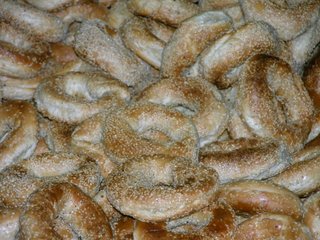
The pictured ones are at St-Viateur, shortly after they've been expertly thrown through the air off the narrow paddle on which they're baked into the pile from which they're selected by customers. I was impressed by the huge stack of 100-lb. sacks of sesame seeds in the bakery area, since apparently the iconic Montreal bagel is a sesame one, but they had other flavors, too. From there we sped to Fairmount Bagels, the dreaded competition, for another dozen. I dutifully sampled each, and, while I agreed with Victoria that the Fairmounts were just a bit better, my problem with Montreal bagels overall is that they're sweet, which bagels should never be unless you're making blueberry bagels or some other form which must be prohibited in the Torah, if not the Old Testament itself. Maybe toasted and buttered they'd be better, but I prefer to think of them the way I think of Cincinnati chili, ie, as a similar, but different foodstuff entirely.
From there it was time for my hosts to do their weekend shopping, which meant stops at both of Montreal's stunning markets, Jean Talon (for vegetables) and Atwater (for meat). Both are available at both places, but it must be admitted that each seems superior to the other in just that way.
It was mid-October, remember, so the glories of the harvest were behind us. I can't imagine what the place must look like in high summer, what with a pepper display like this:
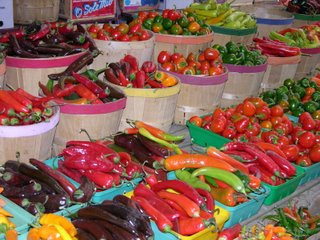
Not to mention psychedelic cauliflower:

Victoria and Rodney patronize M. Charles' vegetable shop, just outside the market, for a lot of their stuff, and he proudly uncorked a box of white truffles he'd bought. Unfortunately, it was one of two, and the other one had walked out as he was helping several restaurants get their orders together. He said he knew it was someone from one of the restaurants, but he was damned if he could tell whom, or even which restaurant. The display at his place, though, was astonishing.
From there it was off across town to the Atwater Market, where, in addition to even more temptations, they were having an "Octoberfest" of micro-brews from around Quebec that I was in no shape to try due to a cold. Here, the mighty M. Yves plies his trade, and my brain was about to explode from the assembled goodies. As arranged, we met my college pal Terry there, and I escaped with him back to his house for some long-delayed catching up. Victoria pressed the remaining bagels, a wedge of local Shropshire Blue cheese, and a little basket of assorted chiles on him.
Dinner that evening with Victoria and Rodney was at Au Pied de Cochon, a place Anthony Bourdain likes a lot, and it was easy to see why: it's not fancy, but it's exquisite in its quality, which means the prices aren't so high. Oh, there's the odd $1700 bottle on the wine list, but we had a microbrewed stout which suited the meal just fine. I'd settled on a bison rib, after one passed me on a plate, looking perfectly barbequed, and, because they had the gall to offer it, I ordered French onion soup for a starter. What a cliché! What a amazing rendition of it, too! Man, it must've been the onions, because I can't think of what else would have imparted such a rich, sweet yet vegetal flavor to the soup. I almost stood up and cheered. Sadly, the rib, although absolutely perfectly cooked, was marred by a "barbeque" sauce slathered on it which was way too sweet. Because I like this place so much, though, I offer the following advice to them: in Texas, they don't use sauce at all. Really. What they do use is a salt-and-pepper rub, and hey, you folks know, just like I do, that there are salts and there are salts, and there are peppers and there are peppers. I offer this as a clue, and look forward to seeing you deal with it next time I'm up there.
The next day's eating was unmitigated disappointment: bad Jamaican meat patty and bad empanada at a bakery near Terry's house, followed by a meal at a Caribbean restaurant which started out fine with good appetizers and then went sharply downhill. If that's jerk chicken, you guys, then...ahhh, there's a jerk joke in there somewhere. Fageddit.
Tuesday saw me hit Philadelphia to say hi to the Fresh Air crew, and record a couple of pieces. As I traditionally do, I lunched at the Reading Terminal Market, getting a "super Italian" sub at Carmen's-Formerly-Known-As-Rocco's. Dinner was along the same lines, although it was home-made, an Italian sausage lasagne at the home of the Philadelphia Inquirer's blogger Dan Rubin, along with his wife Mimi, my sister, the Rubin twins, and my nephew Peter. And because of a screwup with the hotel I'd been stashed in, I wound up at another one just two blocks from the Reading Terminal again, so I got to eat breakfast at their famous Down Home Diner, which was a bit of a disappointment. Dang, I shoulda ordered scrapple!
The flight back on Air India was smooth, the food good (but not as good as going over, possibly because I passed on the mutton curry and went for the vegetarian dish, which I swear the flight attendant said was "bunny"), and my fellow passengers just as anarchic as before. I got a great meal (my usual: duck terrine, steak au poivre with potatoes au gratin) at Chez Paul, and the next morning I was on my way back to Berlin.
And a surprise awaited me: I got in too late to shop (and was in no condition to do so anyway) so the dancer, who met me at the station, and I decided to investigate Toco Rouge, the Chinese-fusion joint that sprung up in the space where my late lamented Döner place had been. We each had a different soup and entree, and I have to say, this place looks like it's really happening. Open for lunch, too, so I can see soup for lunch in my future. What a pleasant surprise! Hope it lasts.
Of course, Monday took me to the supermarket, where I beheld acres of empty shelves. Okay, home again.
I was also based a lot of the time in suburban New Jersey, as opposed to what I'd call exurban New Jersey (Jersey City, Newark, etc), although there was a good pizzeria (two, actually) in the town I stayed in, as well as the worst Italian place I've eaten at in ages. (Garlic powder in the "garlic spinach" sauce on the pasta? That's impressive in this day and age!) I had a fine sausage-and-peppers sandwich one day and a slice of pizza stuffed with baked ziti (which would have been better if the red sauce that came with it had been edible) another day that brought back some distant nostalgia.
My first evening's meal in New York sent me and my friends to the Saigon Grill on University Place, where there were tremendous summer rolls and a mindblowing "Vietnamese bouillabaisse" so full of seafood (including real crab, not surimi) that I almost ignored the sweet-spicy broth. Highly recommended if you're in the neighborhood, although there's also a branch of Madhur Jaffrey's highly successful and mega-tasty Cafe Spice very nearby. Didn't get there this time.
The next night, although I wasn't wild about more Indian food since I'd just had some on Air India, I met with some folks at a place called Angon on East 6th St., in the middle of that gaggle of Indian restaurants. I was afraid it was going to be like all of them there, but it wasn't. It wasn't unlike them, but it was different. The samosa chaat and the pani puri appetizers were quite distinctive (even if the latter was rather bland), the the khichuri rice dish was another change from the usual stuff.
The next day I met a friend for a really forgettable lunch at a supposed Thai restaurant in the Village. I was already suspicious when the waiter took our orders in Chinese, but soggy pad thai noodles clinched the deal. For dinner, I was with the guy who'd recommended Saigon Grill, so his recommendation of another Vietnamese place, Bao Noodles, was eagerly accepted. Sad to say, they were having an off night, and we were disappointed.
Then it was off on the train to Montreal, fortified with a bagel and coffee from Seattle's Finest (Starbuck's hasn't won -- yet), and I've already commented on la cuisine d'Amtrak. The first dinner was an amazing cassoulet at my hosts' place, with an equally stunning wine I forgot to note. The meats were all hand-picked by the legendary M. Yves at the Atwater Market:

Dessert was a selection of about seven Quebec cheeses, which offered stiff competition to any I've had in France. Man, Quebec's come a long way since I first visited in the mid-'70s!
The next morning, I got a long-held wish, which was to taste the legendary "steel-cut oats" I'd read about. I'm no oatmeal fan, but these barely qualify as oatmeal, especially after a long cooking, dressing with warm cream, and maple syrup bruléed on top with a blowtorch -- not to mention a short shot of whiskey. After that, it was into the car, and a wild trip through Montreal intended to prove to me the superiority of Montreal bagels:
The pictured ones are at St-Viateur, shortly after they've been expertly thrown through the air off the narrow paddle on which they're baked into the pile from which they're selected by customers. I was impressed by the huge stack of 100-lb. sacks of sesame seeds in the bakery area, since apparently the iconic Montreal bagel is a sesame one, but they had other flavors, too. From there we sped to Fairmount Bagels, the dreaded competition, for another dozen. I dutifully sampled each, and, while I agreed with Victoria that the Fairmounts were just a bit better, my problem with Montreal bagels overall is that they're sweet, which bagels should never be unless you're making blueberry bagels or some other form which must be prohibited in the Torah, if not the Old Testament itself. Maybe toasted and buttered they'd be better, but I prefer to think of them the way I think of Cincinnati chili, ie, as a similar, but different foodstuff entirely.
From there it was time for my hosts to do their weekend shopping, which meant stops at both of Montreal's stunning markets, Jean Talon (for vegetables) and Atwater (for meat). Both are available at both places, but it must be admitted that each seems superior to the other in just that way.
It was mid-October, remember, so the glories of the harvest were behind us. I can't imagine what the place must look like in high summer, what with a pepper display like this:

Not to mention psychedelic cauliflower:

Victoria and Rodney patronize M. Charles' vegetable shop, just outside the market, for a lot of their stuff, and he proudly uncorked a box of white truffles he'd bought. Unfortunately, it was one of two, and the other one had walked out as he was helping several restaurants get their orders together. He said he knew it was someone from one of the restaurants, but he was damned if he could tell whom, or even which restaurant. The display at his place, though, was astonishing.
From there it was off across town to the Atwater Market, where, in addition to even more temptations, they were having an "Octoberfest" of micro-brews from around Quebec that I was in no shape to try due to a cold. Here, the mighty M. Yves plies his trade, and my brain was about to explode from the assembled goodies. As arranged, we met my college pal Terry there, and I escaped with him back to his house for some long-delayed catching up. Victoria pressed the remaining bagels, a wedge of local Shropshire Blue cheese, and a little basket of assorted chiles on him.
Dinner that evening with Victoria and Rodney was at Au Pied de Cochon, a place Anthony Bourdain likes a lot, and it was easy to see why: it's not fancy, but it's exquisite in its quality, which means the prices aren't so high. Oh, there's the odd $1700 bottle on the wine list, but we had a microbrewed stout which suited the meal just fine. I'd settled on a bison rib, after one passed me on a plate, looking perfectly barbequed, and, because they had the gall to offer it, I ordered French onion soup for a starter. What a cliché! What a amazing rendition of it, too! Man, it must've been the onions, because I can't think of what else would have imparted such a rich, sweet yet vegetal flavor to the soup. I almost stood up and cheered. Sadly, the rib, although absolutely perfectly cooked, was marred by a "barbeque" sauce slathered on it which was way too sweet. Because I like this place so much, though, I offer the following advice to them: in Texas, they don't use sauce at all. Really. What they do use is a salt-and-pepper rub, and hey, you folks know, just like I do, that there are salts and there are salts, and there are peppers and there are peppers. I offer this as a clue, and look forward to seeing you deal with it next time I'm up there.
The next day's eating was unmitigated disappointment: bad Jamaican meat patty and bad empanada at a bakery near Terry's house, followed by a meal at a Caribbean restaurant which started out fine with good appetizers and then went sharply downhill. If that's jerk chicken, you guys, then...ahhh, there's a jerk joke in there somewhere. Fageddit.
Tuesday saw me hit Philadelphia to say hi to the Fresh Air crew, and record a couple of pieces. As I traditionally do, I lunched at the Reading Terminal Market, getting a "super Italian" sub at Carmen's-Formerly-Known-As-Rocco's. Dinner was along the same lines, although it was home-made, an Italian sausage lasagne at the home of the Philadelphia Inquirer's blogger Dan Rubin, along with his wife Mimi, my sister, the Rubin twins, and my nephew Peter. And because of a screwup with the hotel I'd been stashed in, I wound up at another one just two blocks from the Reading Terminal again, so I got to eat breakfast at their famous Down Home Diner, which was a bit of a disappointment. Dang, I shoulda ordered scrapple!
The flight back on Air India was smooth, the food good (but not as good as going over, possibly because I passed on the mutton curry and went for the vegetarian dish, which I swear the flight attendant said was "bunny"), and my fellow passengers just as anarchic as before. I got a great meal (my usual: duck terrine, steak au poivre with potatoes au gratin) at Chez Paul, and the next morning I was on my way back to Berlin.
And a surprise awaited me: I got in too late to shop (and was in no condition to do so anyway) so the dancer, who met me at the station, and I decided to investigate Toco Rouge, the Chinese-fusion joint that sprung up in the space where my late lamented Döner place had been. We each had a different soup and entree, and I have to say, this place looks like it's really happening. Open for lunch, too, so I can see soup for lunch in my future. What a pleasant surprise! Hope it lasts.
Of course, Monday took me to the supermarket, where I beheld acres of empty shelves. Okay, home again.
Sunday, October 29, 2006
More Transportation
Last night I staggered off the train from Cologne, which I'd boarded after getting off the train from Paris, fifteen minutes late, the apologies of the train crew, broadcast on the intercom, still ringing in my ears. What a difference from Amtrak, I thought.
I'd wanted to visit Montreal on this trip, because I hadn't seen my old college friend Terry in what turned out to be 19 years, which is way too long. I also wanted to visit a couple of friends I knew only from the Well, and, mostly, I figured that after four days, I'd want to get out of New York. I'd remembered how wonderful the trip up there was when I'd taken the train -- a long trip, sure, ten hours or so, but among some of the most gorgeous scenery the East Coast has to offer. Idly, I went by the website and found I could make the round trip for a whopping $113, or just under half what a similar trip on Deutsche Bahn would cost. How could I resist?
So last Friday morning, bright and early, I found myself in Penn Station, sticking my credit card into a machine which identified me immediately, had me punch in the code they'd sent me in confirmation of the purchase, and seconds later two tickets slid out. Boy, that was easy. Easier than Deutsche Bahn's website, which works until you get to the moment of purchase, and then crashes, and which won't quote you fares or sell you tickets if you're leaving Germany, for some reason.
At 8:30, we pulled out of Penn Station on schedule. I found it rather odd that, although the ticket said "reserved" on it, there wasn't a seat or car number on it, as there would have been in Europe. Still, there weren't enough people on the train to make that an issue. Unfortunately for the scenery, it was raining hard. Maybe, I thought, this will let up at some point. Didn't really matter when; the whole trip, pretty much, is scenic.
It was at our first stop that I noticed the first big difference between Amtrak and European trains. There's a board by the exit, just as there is here, but it only gives you the name of the train, and, for variety, a couple of ads for Amtrak, including one for something called Rail Fone, long superceded by the cell phone. Where were we? I had no idea, and, having grown up in the area, I had some interest in knowing. But there was no indication from the board, and no announcement over the loudspeaker. Nor were the signs at the station terribly visible. It was Yonkers, I think.
Later, I discovered that in the snack car there was a stack of timetables, French on one side, English on the other (hey, it was going to Quebec; no sense in risking a fine!). This was good as long as you were capable of remembering what the last stop was or could find a sign (some of the stations we stopped at were so small only one car was opened at the stop, while the rest of the train slopped over each end). But really, folks, what's wrong with making an announcement? Or jiggering the sign so it shows the station, and maybe even the next station with estimated time of arrival and all?
Sad to say, as we proceeded up the Hudson, the scenery was behind a scrim of driving grey rain, so any sightseeing was restricted to the marshes just off the river and the river itself. There was an awful lot of wildlife: several species of ducks, blue and green herons, and, once, a glimpse of a group of those flat-shelled, bottle-nosed snapping turtles. I'd have thought it was too cold for them by now.
Once past Albany, though, you're off the Hudson, and you plunge right into the fall foliage as you work your way towards several other lakes, winding up with the huge one which divides Vermont from New York, Lake Champlain. This is summer tourist country, and yet it's very nice at this time of year (well, it was a week ago: a couple of good cold rainstorms and that foliage just says good-bye). The train zips through some nice granite outcroppings, and you realize just how depopulated bits of upstate New York are.
Poor, too. That was one thing that shocked me. Of course, the nicest parts of anyplace are rarely found by the railroad tracks, for obvious reasons, but in Europe that usually means either industrial or immigrant areas. You don't see rural poverty in the parts of Europe I've ridden through on trains -- largely Germany, France, Switzerland, Holland, Belgium, Denmark and Norway. Only in Poland have I seen dwellings I assumed belonged to poor people. But it's a shock in America: some of the houses out there in the country are downright hovels, and yet there were people living in them. This was a shock not only after relatively affluent Europe, but after deeply sanitized New York, which seems to have had a soulectomy since I was last there about eight years ago.
The border check was painless. We'd been warned at the start of the journey to attach tags which had been stamped CANADA onto all of our bags, and I, of course, managed to drop one on the way in. I was afraid my camera or my laptop would be impounded on the way in. Fortunately, I found it on the floor, but the conductor said there was no worry about them anyway. The Canadian border guards were friendly, joked in French and English with the passengers, and got in and out fast.
By then, the sun was going down, and it looked like we'd make our destination only a half hour late -- not, again, that anyone was telling us this except for Dean. Dean looked like one of the Village People, specifically the one with the leather cap, and was one of a number of homosexual stereotypes in our car; perhaps there was a convention that weekend, because there were two more of them sitting across from me, going "Tsk" loudly every time Dean made or received a call on his cell phone. Oblivious to the fact that we didn't all want to know the intimate details of his life, he shared them with his friends and us in a voice that I'm sure carried to the next car. It was, however, useful for knowing how close we were to Montreal.
Thirty minutes late is early for Amtrak, sad to say, although things have improved since the day in the early '70s when, frightened out of the sky by a plane ride from hell that had nuns praying at the top of their lungs and the businessman who just a moment earlier had been saying how boring flying was yelling "I don't want to die" at the top of his lungs, I took the train from San Francisco to Austin -- well, San Antonio, which was as close as it went -- for my first visit to that city. It was understood we'd take the bus to Oakland, because there was no train from San Francisco, but when we got there -- and I am not making this up -- the train from Seattle was 24 hours late. Thus, we took the bus from Oakland to Los Angeles, where there actually was a train.
The ride back from Montreal, though, wasn't nearly as punctual, and this one was more of a nail-biter, because I was staying in New Jersey, and the trains there don't run all night. The U.S. border guards took several people for questioning into the snack car, but they all -- all the ones I saw, anyway -- returned to their seats without incident. We were a good 2 1/2 hours late getting to Penn Station. No apologies, let alone the discount cards Deutsche Bahn hands out when things like this happen.
Oh, and I mentioned the snack car? I'm going to do a post later on some of the food I encountered, but let's just say that Amtrak is still upholding some great traditions: I fondly remember biting into a roast-beef sandwich on that early '70s trip and finding the center frozen solid. This time, I bought an "Italian sandwich" on the way down, fairly certain I'd get back to Jersey too late to get delivery pizza, even (I was right), and although the guy stuck it in the oven for a goodly amount of time, when I took it out of the cellophane, there was a comforting cold, wet spot directly in the center. The mighty Hudson still shows off its colors in the fall, and Amtrak still can't manage to defrost a sandwich.
I'd wanted to visit Montreal on this trip, because I hadn't seen my old college friend Terry in what turned out to be 19 years, which is way too long. I also wanted to visit a couple of friends I knew only from the Well, and, mostly, I figured that after four days, I'd want to get out of New York. I'd remembered how wonderful the trip up there was when I'd taken the train -- a long trip, sure, ten hours or so, but among some of the most gorgeous scenery the East Coast has to offer. Idly, I went by the website and found I could make the round trip for a whopping $113, or just under half what a similar trip on Deutsche Bahn would cost. How could I resist?
So last Friday morning, bright and early, I found myself in Penn Station, sticking my credit card into a machine which identified me immediately, had me punch in the code they'd sent me in confirmation of the purchase, and seconds later two tickets slid out. Boy, that was easy. Easier than Deutsche Bahn's website, which works until you get to the moment of purchase, and then crashes, and which won't quote you fares or sell you tickets if you're leaving Germany, for some reason.
At 8:30, we pulled out of Penn Station on schedule. I found it rather odd that, although the ticket said "reserved" on it, there wasn't a seat or car number on it, as there would have been in Europe. Still, there weren't enough people on the train to make that an issue. Unfortunately for the scenery, it was raining hard. Maybe, I thought, this will let up at some point. Didn't really matter when; the whole trip, pretty much, is scenic.
It was at our first stop that I noticed the first big difference between Amtrak and European trains. There's a board by the exit, just as there is here, but it only gives you the name of the train, and, for variety, a couple of ads for Amtrak, including one for something called Rail Fone, long superceded by the cell phone. Where were we? I had no idea, and, having grown up in the area, I had some interest in knowing. But there was no indication from the board, and no announcement over the loudspeaker. Nor were the signs at the station terribly visible. It was Yonkers, I think.
Later, I discovered that in the snack car there was a stack of timetables, French on one side, English on the other (hey, it was going to Quebec; no sense in risking a fine!). This was good as long as you were capable of remembering what the last stop was or could find a sign (some of the stations we stopped at were so small only one car was opened at the stop, while the rest of the train slopped over each end). But really, folks, what's wrong with making an announcement? Or jiggering the sign so it shows the station, and maybe even the next station with estimated time of arrival and all?
Sad to say, as we proceeded up the Hudson, the scenery was behind a scrim of driving grey rain, so any sightseeing was restricted to the marshes just off the river and the river itself. There was an awful lot of wildlife: several species of ducks, blue and green herons, and, once, a glimpse of a group of those flat-shelled, bottle-nosed snapping turtles. I'd have thought it was too cold for them by now.
Once past Albany, though, you're off the Hudson, and you plunge right into the fall foliage as you work your way towards several other lakes, winding up with the huge one which divides Vermont from New York, Lake Champlain. This is summer tourist country, and yet it's very nice at this time of year (well, it was a week ago: a couple of good cold rainstorms and that foliage just says good-bye). The train zips through some nice granite outcroppings, and you realize just how depopulated bits of upstate New York are.
Poor, too. That was one thing that shocked me. Of course, the nicest parts of anyplace are rarely found by the railroad tracks, for obvious reasons, but in Europe that usually means either industrial or immigrant areas. You don't see rural poverty in the parts of Europe I've ridden through on trains -- largely Germany, France, Switzerland, Holland, Belgium, Denmark and Norway. Only in Poland have I seen dwellings I assumed belonged to poor people. But it's a shock in America: some of the houses out there in the country are downright hovels, and yet there were people living in them. This was a shock not only after relatively affluent Europe, but after deeply sanitized New York, which seems to have had a soulectomy since I was last there about eight years ago.
The border check was painless. We'd been warned at the start of the journey to attach tags which had been stamped CANADA onto all of our bags, and I, of course, managed to drop one on the way in. I was afraid my camera or my laptop would be impounded on the way in. Fortunately, I found it on the floor, but the conductor said there was no worry about them anyway. The Canadian border guards were friendly, joked in French and English with the passengers, and got in and out fast.
By then, the sun was going down, and it looked like we'd make our destination only a half hour late -- not, again, that anyone was telling us this except for Dean. Dean looked like one of the Village People, specifically the one with the leather cap, and was one of a number of homosexual stereotypes in our car; perhaps there was a convention that weekend, because there were two more of them sitting across from me, going "Tsk" loudly every time Dean made or received a call on his cell phone. Oblivious to the fact that we didn't all want to know the intimate details of his life, he shared them with his friends and us in a voice that I'm sure carried to the next car. It was, however, useful for knowing how close we were to Montreal.
Thirty minutes late is early for Amtrak, sad to say, although things have improved since the day in the early '70s when, frightened out of the sky by a plane ride from hell that had nuns praying at the top of their lungs and the businessman who just a moment earlier had been saying how boring flying was yelling "I don't want to die" at the top of his lungs, I took the train from San Francisco to Austin -- well, San Antonio, which was as close as it went -- for my first visit to that city. It was understood we'd take the bus to Oakland, because there was no train from San Francisco, but when we got there -- and I am not making this up -- the train from Seattle was 24 hours late. Thus, we took the bus from Oakland to Los Angeles, where there actually was a train.
The ride back from Montreal, though, wasn't nearly as punctual, and this one was more of a nail-biter, because I was staying in New Jersey, and the trains there don't run all night. The U.S. border guards took several people for questioning into the snack car, but they all -- all the ones I saw, anyway -- returned to their seats without incident. We were a good 2 1/2 hours late getting to Penn Station. No apologies, let alone the discount cards Deutsche Bahn hands out when things like this happen.
Oh, and I mentioned the snack car? I'm going to do a post later on some of the food I encountered, but let's just say that Amtrak is still upholding some great traditions: I fondly remember biting into a roast-beef sandwich on that early '70s trip and finding the center frozen solid. This time, I bought an "Italian sandwich" on the way down, fairly certain I'd get back to Jersey too late to get delivery pizza, even (I was right), and although the guy stuck it in the oven for a goodly amount of time, when I took it out of the cellophane, there was a comforting cold, wet spot directly in the center. The mighty Hudson still shows off its colors in the fall, and Amtrak still can't manage to defrost a sandwich.
Wednesday, October 18, 2006
Very Public Transportation
I'll have to confess: ever since I was a kid, I've wanted to fly Air India. Many years ago, someone told me the world's best Indian restaurant was the Air India flight from New York to London. London was someplace I wanted to see, and getting there with good food just made it all the more attractive. But when I finally did get to go to London, economy won out over gastronomy, and I flew, uhhh, whatever was cheapest from Austin.
But it was "whatever was cheaper" that got me onto Air India for this trip to the States which started on Monday. Rock-bottom prices from Paris made the deal inevitable, although I'd been warned that the flights originate in India and can be late. Mine was -- by 90 minutes. But it was an education.
It had originated in Bombay -- or Mumbai, if you will -- and there weren't many places for us Paris-boarding passengers. But that didn't matter, because I had a center group of seats in the aging 747 all to myself. But I'd never been on a plane like this. Not the equipment -- I've been on plenty of 747s -- but the social scene. I've never been to India, but I'd be willing to bet that a significant number of my fellow-passengers were flying for the first time, and likely not urban dwellers. How else, after all, to explain the video demonstrating how to flush the toilet? (Which, I hasten to add, unlike on other flights I've been on, they did, thank heavens).
Another way you knew it was an Indian flight was that the little map with the little plane on it was interrupted now and again by a screen that said "Physical features map only. NO POLITICAL BORDERS DEPICTED." Take that, Pakistan! Oh, and the entertainment, which alternated between the most lascivious (and unintentionally funny) rock videos ever (yes, there were a couple of clowns in that party scene where the guy gets shot, although what they were doing there was obscure) and Hindi TV shows, American TV shows I'd never heard of, a film about basketball which reinforced every stereotype about black people the NAACP has been trying to overturn since Reconstruction, and a ludicrous Indian film about entrepreneurs called Corporate, which I dozed through.
Not that I could have accessed the soundtrack if I'd wanted. I was delighted to see a channel of Indian classical music, but apparently the sound system didn't work at all. Not surprising: the video was so out of whack that everything showed in sepia, giving an appropriately antique touch to things.
But the food made up for it. With drinks we were served some astonishing little chips, pillow-shaped, made from potato flour, and spiced just enough to make me sit up and take notice. They were called, appropriately enough, Mo'pleez, although I notice the website given on the bag is a list of janitorial services. After a decent interval, the meal was wheeled around, and I got the Indian one, non-vegetarian, with a chicken curry called Dum Ka Murg, okay pilau rice, and a nice dal. I even ate the dessert, which was very low-sugar, unlike any Indian dessert I've ever had, something called Shahi Tukla, which had little cubes of what seemed to be dense bread in a sauce made from concentrated milk, the whole thing dusted with crushed pistachios. I'd tried to order a Gujarati meal from the bewildering variety offered by the Air India website, but twice got back an enigmatic e-mail saying Mr. Gomes was not in the database. I don't care about Mr. Gomes, I want my Gujarati feast!
When the plane touched down in Newark the entire cabin rose as one man and started stampeding to the door, despite the fact that the plane was still taxiing down the runway. The cabin attendants beat them back, and only had to restore order twice more.
India is a place about which I've always quipped that I read about it obsessively to keep from actually going there. I think this flight actually added a bit of reinforcement to that theory, although I gotta say, I can't wait to see what the grub on the return is going to be like. But...I've got to wait a week to find out.
***
Footnote: The biggest disappointment about not being able to hear the audio on the flight was that the classical channel heavily featured my new favorite Indian classical musician, Amjad Ali Khan, who plays with all the clarity of a well-performed Mozart piano sonata. He communicates so well that I believe someone who knew nothing whatever about Indian classical music could pretty much get the basics after one of his better-performed ragas (the titles I'd point you to are on CDs I burned from eMusic downloads back in Berlin, though). Anyway, I was walking past Carnegie Hall yesterday and was astonished to see that Amjad Ali Khan, Amaan Ali Khan, and Ayaan Ali Khan were playing there on Sunday, with tickets maxing out at $90. I don't know if anyone reading this has that kind of dough or that kind of interest, but boy, if I had the money, and was going to be in New York at that time (I'll be in Montreal), I'd have walked in and snapped one up. Adventurous New Yorkers take note.
But it was "whatever was cheaper" that got me onto Air India for this trip to the States which started on Monday. Rock-bottom prices from Paris made the deal inevitable, although I'd been warned that the flights originate in India and can be late. Mine was -- by 90 minutes. But it was an education.
It had originated in Bombay -- or Mumbai, if you will -- and there weren't many places for us Paris-boarding passengers. But that didn't matter, because I had a center group of seats in the aging 747 all to myself. But I'd never been on a plane like this. Not the equipment -- I've been on plenty of 747s -- but the social scene. I've never been to India, but I'd be willing to bet that a significant number of my fellow-passengers were flying for the first time, and likely not urban dwellers. How else, after all, to explain the video demonstrating how to flush the toilet? (Which, I hasten to add, unlike on other flights I've been on, they did, thank heavens).
Another way you knew it was an Indian flight was that the little map with the little plane on it was interrupted now and again by a screen that said "Physical features map only. NO POLITICAL BORDERS DEPICTED." Take that, Pakistan! Oh, and the entertainment, which alternated between the most lascivious (and unintentionally funny) rock videos ever (yes, there were a couple of clowns in that party scene where the guy gets shot, although what they were doing there was obscure) and Hindi TV shows, American TV shows I'd never heard of, a film about basketball which reinforced every stereotype about black people the NAACP has been trying to overturn since Reconstruction, and a ludicrous Indian film about entrepreneurs called Corporate, which I dozed through.
Not that I could have accessed the soundtrack if I'd wanted. I was delighted to see a channel of Indian classical music, but apparently the sound system didn't work at all. Not surprising: the video was so out of whack that everything showed in sepia, giving an appropriately antique touch to things.
But the food made up for it. With drinks we were served some astonishing little chips, pillow-shaped, made from potato flour, and spiced just enough to make me sit up and take notice. They were called, appropriately enough, Mo'pleez, although I notice the website given on the bag is a list of janitorial services. After a decent interval, the meal was wheeled around, and I got the Indian one, non-vegetarian, with a chicken curry called Dum Ka Murg, okay pilau rice, and a nice dal. I even ate the dessert, which was very low-sugar, unlike any Indian dessert I've ever had, something called Shahi Tukla, which had little cubes of what seemed to be dense bread in a sauce made from concentrated milk, the whole thing dusted with crushed pistachios. I'd tried to order a Gujarati meal from the bewildering variety offered by the Air India website, but twice got back an enigmatic e-mail saying Mr. Gomes was not in the database. I don't care about Mr. Gomes, I want my Gujarati feast!
When the plane touched down in Newark the entire cabin rose as one man and started stampeding to the door, despite the fact that the plane was still taxiing down the runway. The cabin attendants beat them back, and only had to restore order twice more.
India is a place about which I've always quipped that I read about it obsessively to keep from actually going there. I think this flight actually added a bit of reinforcement to that theory, although I gotta say, I can't wait to see what the grub on the return is going to be like. But...I've got to wait a week to find out.
***
Footnote: The biggest disappointment about not being able to hear the audio on the flight was that the classical channel heavily featured my new favorite Indian classical musician, Amjad Ali Khan, who plays with all the clarity of a well-performed Mozart piano sonata. He communicates so well that I believe someone who knew nothing whatever about Indian classical music could pretty much get the basics after one of his better-performed ragas (the titles I'd point you to are on CDs I burned from eMusic downloads back in Berlin, though). Anyway, I was walking past Carnegie Hall yesterday and was astonished to see that Amjad Ali Khan, Amaan Ali Khan, and Ayaan Ali Khan were playing there on Sunday, with tickets maxing out at $90. I don't know if anyone reading this has that kind of dough or that kind of interest, but boy, if I had the money, and was going to be in New York at that time (I'll be in Montreal), I'd have walked in and snapped one up. Adventurous New Yorkers take note.
Friday, October 13, 2006
Crumby Miscellany
First, a word to regular visitors that I'm off on Sunday morning for a trip to New York, Montreal, and Philadelphia, among other places, and won't be back until the evening of the 28th. My newly-repaired (and, seemingly well-functioning) laptop will be making the trip with me, and I may add a word or two while on the road. Or not.
The main aim of the trip is to push ahead the acquisition of my book, which got rudely interrupted when my "agent" turned out not to be one this summer. I've rewritten the pitch, and it's already been turned down with a great deal of snark by one publisher. But I figure over ten million people hear the words "Ed Ward lives in Berlin" on Fresh Air with Terry Gross each week, and if one percent of them ask themselves "Why on earth?" and are willing to spend a little money to find out, I'm in good shape.
Plus, it's, like, a good read.
***
I splurged a few Euros for something to read on the trip, and thus went to the "culture department store" Dussmann down on Friedrichstr. Interestingly, the new hotel on Friedrichstr. whose construction has blocked the sidewalk and imperilled foot-traffic for well over two years is open at last, and you can walk on the eastern side of the street without a Berlin driver trying to pick you off. I walked past the place and it looked like, well, another high-end hotel. Just what we need, with almost no tourism and virtually nothing in the middle-price business-traveller class.
But its gift shop had a sign in the window advertising a perfume called Berlin (no, not the Joop fragrance; it apparently has no web presence) for men and women, each variety of which comes in a bottle shaped like the Fernsehturm. Its motto is priceless:
"As diverse as its city will never be
But always will be becoming."
Get back to me when you've got that figured out, okay? And no, it doesn't make any more sense in German.
***
More news of NIke! The torso of the woman on all fours which I blogged last October vanished overnight. It had already been defaced days after I shot it last year by some idiot with a sharpie showing off. I suspect this disappearance, though, was intentional. The former White Trash club location has been taken over by one of Berlin's worst art galleries, one which professes feminism while showing art which seems to prove that women shouldn't even think of becoming artists. Honestly, if junior high students did this well, they'd be called "promising," but adults should be held to a higher standard. I suspect that Nike's torso (which I'd begun calling Ostrich Woman because of her weirdly elongated neck) was so much better on both a conceptual and technical level that the jealous gallery folks decided it was showing them up. I don't get to meditate, now, on the mysterious inscription ("You mustn't think...") every time I pass it.
***
I occasionally get criticized for never saying anything positive about Germany. I think it's more accurate to accuse me of never saying anything positive about Berlin, but I was quite amused by this cartoon in Salon the other day. Our own Sauerkrautmeister (in his "Steven Augustine" disguise -- and no, that's not his real name) comments and plugs this blog, but I think the cartoon's got some points.
***
Anyway, time to hope my meager packings meet the latest standards of the security guys and it's an uneventful flight. After I get there, that's another matter.
The main aim of the trip is to push ahead the acquisition of my book, which got rudely interrupted when my "agent" turned out not to be one this summer. I've rewritten the pitch, and it's already been turned down with a great deal of snark by one publisher. But I figure over ten million people hear the words "Ed Ward lives in Berlin" on Fresh Air with Terry Gross each week, and if one percent of them ask themselves "Why on earth?" and are willing to spend a little money to find out, I'm in good shape.
Plus, it's, like, a good read.
***
I splurged a few Euros for something to read on the trip, and thus went to the "culture department store" Dussmann down on Friedrichstr. Interestingly, the new hotel on Friedrichstr. whose construction has blocked the sidewalk and imperilled foot-traffic for well over two years is open at last, and you can walk on the eastern side of the street without a Berlin driver trying to pick you off. I walked past the place and it looked like, well, another high-end hotel. Just what we need, with almost no tourism and virtually nothing in the middle-price business-traveller class.
But its gift shop had a sign in the window advertising a perfume called Berlin (no, not the Joop fragrance; it apparently has no web presence) for men and women, each variety of which comes in a bottle shaped like the Fernsehturm. Its motto is priceless:
"As diverse as its city will never be
But always will be becoming."
Get back to me when you've got that figured out, okay? And no, it doesn't make any more sense in German.
***
More news of NIke! The torso of the woman on all fours which I blogged last October vanished overnight. It had already been defaced days after I shot it last year by some idiot with a sharpie showing off. I suspect this disappearance, though, was intentional. The former White Trash club location has been taken over by one of Berlin's worst art galleries, one which professes feminism while showing art which seems to prove that women shouldn't even think of becoming artists. Honestly, if junior high students did this well, they'd be called "promising," but adults should be held to a higher standard. I suspect that Nike's torso (which I'd begun calling Ostrich Woman because of her weirdly elongated neck) was so much better on both a conceptual and technical level that the jealous gallery folks decided it was showing them up. I don't get to meditate, now, on the mysterious inscription ("You mustn't think...") every time I pass it.
***
I occasionally get criticized for never saying anything positive about Germany. I think it's more accurate to accuse me of never saying anything positive about Berlin, but I was quite amused by this cartoon in Salon the other day. Our own Sauerkrautmeister (in his "Steven Augustine" disguise -- and no, that's not his real name) comments and plugs this blog, but I think the cartoon's got some points.
***
Anyway, time to hope my meager packings meet the latest standards of the security guys and it's an uneventful flight. After I get there, that's another matter.
Tuesday, October 10, 2006
The Last Nice Day
Around about noon today, the phone rang and it was the guy at the repair shop telling me my iBook was ready, so after I'd done some stuff around the house I headed for the U-Bahn and went down there. It was about 2 when I got out, and, checking my change, I saw I didn't have enough to take the U-Bahn back. This is one of the more annoying innovations of recent years: it used to be that your (slightly more expensive) ticket bought you two hours of riding the public transportation system. Now, it only goes for two hours in one direction, although if you keep going and make creative use of the Ringbahn, you can likely make it home from the opposite direction from which you left.
Still, although I also had a €20 bill in my pocket, I figured that, with the weather in the mid-60s, no clouds in sight, and the sun warming you further when you stood in it, it might be a good day for a slow walk home. Not that I had nothing else to do, but it's almost inevitable that within a week or so our usual winter weather's going to start closing in, not to lift until at least May. Gather ye rosebuds and all that good stuff.
The repair place is in a rather nondescript section of Kreuzberg below Oranienstr., so I headed up towards it and then headed north on Heinrich-Heine-Str. This was to be what the Germans call a Bummel, a stroll without any particular urgency, and one of my Bummel-rules is always to investigate placards and historical markers. That's how I found the marker for what had been the Heinrich-Heine-Str. Checkpoint, a German-German checkpoint in the Wall. Several people had been shot trying to escape, and a truckdriver had rammed himself into the West, only to die as soon as he got there from his injuries. There's a photo of his wrecked truck on the glass placard.
The last time I'd walked back from the place (and then I really didn't have €2.10 for the ticket) I'd headed down Köpenicker Str., but this time I just kept heading straight ahead as the street turned into Brückestr. Sure enough, as I'd thought, it ended at a bridge right by the Chinese Embassy. I decided to walk west along the water instead, because this was the neighborhood I'd worked in when I'd helped put on the music conference here in 1993, after I'd moved -- the event had been held at the Haus am Köllnischen Park, a ratty little convention center.
Pretty soon the bulk of the Märkisches Museum rose in front of me, and I decided to take a look at it again, my first in about 13 years. They'd added some slices of the Wall to the mix of miscellaneous bits of stone on the grounds, as well as an audio stand where you could hear important excerpts from radio programs about the Wall, as well as speeches in the Bundestag and the like. Another thing I hadn't noticed back then was a statue of Heinrich Zille, the famous Berlin caricaturist, cartoonist, and photographer, standing with cigar stub firmly clenched in his jaws, drawing something, while a kid looked over his shoulder. The Märkisches Museum I remember as a dark, disorganized place filled with badly sourced and badly selected exhibits. I remember one, about iron works in early Berlin, showing some iron tools and hinges and the like with a caption that said something like "The products of the early Berlin iron works probably looked like these," and going on to say they were from a whole other part of the country. Didn't make me want to go back.
Anyway, as long as I was there, I figured I'd go pay my respects to the official Berlin bears. I used to be able to look out the window of the Haus and see Tilo and Maxi pacing around, but today there was only one bear, not distinguished by name. A drunk came by, making odd noises and yelling things I couldn't understand, and the bear looked at him with disdain. "But it's true!" the guy said, before lurching off in the direction of the museum. By now, I was beginning to regret not taking my camera, but I had no idea I was going to end up at the bear pit, or, indeed, taking this walk.
At any rate, I turned the corner and there was the seafood restaurant I'd noticed when I'd first come here. The fish they offered back then was all fresh-water fish, not much to my liking, and today I didn't investigate the menu so much as a freshly-cleaned bronze plaque which proclaimed the house which contained the restaurant to have been the headquarters of some Prussian maritime union which held the fort against the forces of counterrevolution after the First World War and always took the side of the proletariat. No points for guessing the vintage of that plaque.
I crossed a bridge and found myself on Fischerinsel, the smaller of the two islands on which the city was founded. Here there's the Historic Harbor of Berlin, an institution I've never figured out, but which seems to be a collection of old boats, some of which are available for rent, some of which are just sitting there. There's apparently a museum on one of them, but I've never seen any sign that it's ever open (although the website indicates otherwise). At any rate, it was nice to see the old boats sitting in the algae-choked water.
Fischerinsel leads to Museumsinsel, the larger of the two founding islands, and one which, while very central, still holds some secrets. Approaching it from the south, as I did, by the Gertraudenbrücke with its mysterious statue of St. Gertrude, the gooseherd, and the mice (again, I have to photograph this bizarre statue), if you walk along the east side of the river (as you have to, thanks to construction these days), you find remnants of an 18th Century neighborhood that's worth roaming around if you have the time. There's another obscure museum in here, in a former wealthy doctor's house, but I'm not sure what's in it. These houses have yet to be fully restored, but once they are, I bet they'll go for a ton of money. You'll also come to Berlin's oldest intact bridge, the Jungfernbrücke, with its four wheels attached (once upon a time) to the chains which can raise and lower it for boat traffic. Nearby, there's a small metal placard with a photo on it taken around the turn of the century, showing the neighborhood as it was, complete with vanished streets and a lock in the Spree River where the Schleussbrücke, Berlin's oldest bridge, but bombed and rebuilt dozens of times since the 1650s, stands. The photo reminded me that this was one of the neighborhoods the great Willy Römer had documented.
I walked the Spree all the way to Tucholskystr., and noticed a lot of fishermen, which brought up two questions: what were they fishing for, and, you're not going to eat it, are you? One guy hauled in a three-incher as I walked past, and a woman gave him a horrified expression. I didn't stop to see if he threw it back. And as I got to Tucholskystr. I saw that the ship which has been anchored there, the MS Marie, was from the Historic Harbor. They play bad Shakespeare there and give salsa-dancing lessons, although my guess is it's going to shut down pretty soon.
After all, the nice days are just about over.
Still, although I also had a €20 bill in my pocket, I figured that, with the weather in the mid-60s, no clouds in sight, and the sun warming you further when you stood in it, it might be a good day for a slow walk home. Not that I had nothing else to do, but it's almost inevitable that within a week or so our usual winter weather's going to start closing in, not to lift until at least May. Gather ye rosebuds and all that good stuff.
The repair place is in a rather nondescript section of Kreuzberg below Oranienstr., so I headed up towards it and then headed north on Heinrich-Heine-Str. This was to be what the Germans call a Bummel, a stroll without any particular urgency, and one of my Bummel-rules is always to investigate placards and historical markers. That's how I found the marker for what had been the Heinrich-Heine-Str. Checkpoint, a German-German checkpoint in the Wall. Several people had been shot trying to escape, and a truckdriver had rammed himself into the West, only to die as soon as he got there from his injuries. There's a photo of his wrecked truck on the glass placard.
The last time I'd walked back from the place (and then I really didn't have €2.10 for the ticket) I'd headed down Köpenicker Str., but this time I just kept heading straight ahead as the street turned into Brückestr. Sure enough, as I'd thought, it ended at a bridge right by the Chinese Embassy. I decided to walk west along the water instead, because this was the neighborhood I'd worked in when I'd helped put on the music conference here in 1993, after I'd moved -- the event had been held at the Haus am Köllnischen Park, a ratty little convention center.
Pretty soon the bulk of the Märkisches Museum rose in front of me, and I decided to take a look at it again, my first in about 13 years. They'd added some slices of the Wall to the mix of miscellaneous bits of stone on the grounds, as well as an audio stand where you could hear important excerpts from radio programs about the Wall, as well as speeches in the Bundestag and the like. Another thing I hadn't noticed back then was a statue of Heinrich Zille, the famous Berlin caricaturist, cartoonist, and photographer, standing with cigar stub firmly clenched in his jaws, drawing something, while a kid looked over his shoulder. The Märkisches Museum I remember as a dark, disorganized place filled with badly sourced and badly selected exhibits. I remember one, about iron works in early Berlin, showing some iron tools and hinges and the like with a caption that said something like "The products of the early Berlin iron works probably looked like these," and going on to say they were from a whole other part of the country. Didn't make me want to go back.
Anyway, as long as I was there, I figured I'd go pay my respects to the official Berlin bears. I used to be able to look out the window of the Haus and see Tilo and Maxi pacing around, but today there was only one bear, not distinguished by name. A drunk came by, making odd noises and yelling things I couldn't understand, and the bear looked at him with disdain. "But it's true!" the guy said, before lurching off in the direction of the museum. By now, I was beginning to regret not taking my camera, but I had no idea I was going to end up at the bear pit, or, indeed, taking this walk.
At any rate, I turned the corner and there was the seafood restaurant I'd noticed when I'd first come here. The fish they offered back then was all fresh-water fish, not much to my liking, and today I didn't investigate the menu so much as a freshly-cleaned bronze plaque which proclaimed the house which contained the restaurant to have been the headquarters of some Prussian maritime union which held the fort against the forces of counterrevolution after the First World War and always took the side of the proletariat. No points for guessing the vintage of that plaque.
I crossed a bridge and found myself on Fischerinsel, the smaller of the two islands on which the city was founded. Here there's the Historic Harbor of Berlin, an institution I've never figured out, but which seems to be a collection of old boats, some of which are available for rent, some of which are just sitting there. There's apparently a museum on one of them, but I've never seen any sign that it's ever open (although the website indicates otherwise). At any rate, it was nice to see the old boats sitting in the algae-choked water.
Fischerinsel leads to Museumsinsel, the larger of the two founding islands, and one which, while very central, still holds some secrets. Approaching it from the south, as I did, by the Gertraudenbrücke with its mysterious statue of St. Gertrude, the gooseherd, and the mice (again, I have to photograph this bizarre statue), if you walk along the east side of the river (as you have to, thanks to construction these days), you find remnants of an 18th Century neighborhood that's worth roaming around if you have the time. There's another obscure museum in here, in a former wealthy doctor's house, but I'm not sure what's in it. These houses have yet to be fully restored, but once they are, I bet they'll go for a ton of money. You'll also come to Berlin's oldest intact bridge, the Jungfernbrücke, with its four wheels attached (once upon a time) to the chains which can raise and lower it for boat traffic. Nearby, there's a small metal placard with a photo on it taken around the turn of the century, showing the neighborhood as it was, complete with vanished streets and a lock in the Spree River where the Schleussbrücke, Berlin's oldest bridge, but bombed and rebuilt dozens of times since the 1650s, stands. The photo reminded me that this was one of the neighborhoods the great Willy Römer had documented.
I walked the Spree all the way to Tucholskystr., and noticed a lot of fishermen, which brought up two questions: what were they fishing for, and, you're not going to eat it, are you? One guy hauled in a three-incher as I walked past, and a woman gave him a horrified expression. I didn't stop to see if he threw it back. And as I got to Tucholskystr. I saw that the ship which has been anchored there, the MS Marie, was from the Historic Harbor. They play bad Shakespeare there and give salsa-dancing lessons, although my guess is it's going to shut down pretty soon.
After all, the nice days are just about over.
Tuesday, October 03, 2006
Neighborhood Noodlings
I guess someone's been reading this blog; immediately after I complained about the second-rate galleries springing up on Brunnenstr. just off Rosenthaler Platz, Nike got to work:
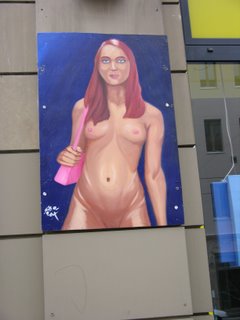
Thanks, Nike! And this makes a real nice contrast with the canary-yellow Statue of Liberty the travel-agency in the building to which this is affixed puts out on the sidewalk during opening hours, too. My only concern is that this painting is dated '04, like most of them are, and I'm wondering if there's any recent work. Still, the pink handbag and rather ambiguous nether regions are all part of that weird primitive Nike vibe, so long may she wave.
***
Long ago, I posted two paper graffiti naked lady wrestlers who appeared on a doorstop just a few buildings away from me, and I forgot to document how, in the middle of a particularly cold winter, one of them got warmed up with an "I [heart] NY" t-shirt. The same artist, though, appeared a few months ago just a block away, and I'd been meaning to shoot this funny piece for ages. Got it today while I set out for the Nike shoot, though:
The name in the heart tattoo is in Russian, a language I simply can't read, but what the photo really fails to make plain is that he's only about nine inches tall and the rose bush he's standing by is over six feet tall. I like seeing him as I walk down Torstr., with his mixture of awe and determination as he gets ready to trim the giant rose.
***
Finally, the late, beloved Bistro Tor, the Döner Kebap place which stood for years outside my place, and which closed suddenly and permanently a couple of months ago, is slowly turning into something called Toco Rouge. There are Toco Rouge stickers all over the neighborhood, as well as on the bikes of the folks who are busily working inside. From the fact that they all look Thai or Vietnamese, and the fact that, in a rare moment when I could see inside, there were woks on the stove, I'm afraid we're in for another "Asia Food" place serving brown glop on glass-noodles. Gotta have glass-noodles: I was in a Japanese restaurant a couple of weeks back, and the meal began with a small glass-noodle salad, which would certainly have puzzled any Japanese person who ate there. Anyway, my expectations are nil for this place, and I'm wondering where I can get a decent Döner -- something I eat about once a month, if that often -- close enough so that in the cold weather it won't totally cool off before I get it home.

Thanks, Nike! And this makes a real nice contrast with the canary-yellow Statue of Liberty the travel-agency in the building to which this is affixed puts out on the sidewalk during opening hours, too. My only concern is that this painting is dated '04, like most of them are, and I'm wondering if there's any recent work. Still, the pink handbag and rather ambiguous nether regions are all part of that weird primitive Nike vibe, so long may she wave.
***
Long ago, I posted two paper graffiti naked lady wrestlers who appeared on a doorstop just a few buildings away from me, and I forgot to document how, in the middle of a particularly cold winter, one of them got warmed up with an "I [heart] NY" t-shirt. The same artist, though, appeared a few months ago just a block away, and I'd been meaning to shoot this funny piece for ages. Got it today while I set out for the Nike shoot, though:
The name in the heart tattoo is in Russian, a language I simply can't read, but what the photo really fails to make plain is that he's only about nine inches tall and the rose bush he's standing by is over six feet tall. I like seeing him as I walk down Torstr., with his mixture of awe and determination as he gets ready to trim the giant rose.
***
Finally, the late, beloved Bistro Tor, the Döner Kebap place which stood for years outside my place, and which closed suddenly and permanently a couple of months ago, is slowly turning into something called Toco Rouge. There are Toco Rouge stickers all over the neighborhood, as well as on the bikes of the folks who are busily working inside. From the fact that they all look Thai or Vietnamese, and the fact that, in a rare moment when I could see inside, there were woks on the stove, I'm afraid we're in for another "Asia Food" place serving brown glop on glass-noodles. Gotta have glass-noodles: I was in a Japanese restaurant a couple of weeks back, and the meal began with a small glass-noodle salad, which would certainly have puzzled any Japanese person who ate there. Anyway, my expectations are nil for this place, and I'm wondering where I can get a decent Döner -- something I eat about once a month, if that often -- close enough so that in the cold weather it won't totally cool off before I get it home.
Sunday, October 01, 2006
Weekend Wordage
Blog Post of the Week: When belledame222 gets mad, she doesn't hold back. I was absolutely thrilled by this post, even though she didn't write a word of it herself. Errr, not that she couldn't write that well if she tried, he said, not wanting to incur her wrath.
***
In other news of the blogosphere, some months ago I was astonished to find an outpost of the extreme American right blogging here in Berlin. Called Davids Medienkritik, it analyzed German media for "anti-American bias," and not only found loads of it lurking in the mainstream media, but found actual socialism happening at the highest government levels! Like most of the echo chamber, they don't take well to criticism, and so Radio Free Mike, who freelances for Spiegel Online, has been taking crap from them recently. If you've got an interest in this sort of thing, I invite you to go over there and check out the ongoing battle. You can find Davids Medienkritik's link yourself, if you see fit. I don't much feel like giving them more hits, for some reason.
***
In a daring experiment, the government, this weekend, allowed stores to open on Sunday for a few hours. The reason is that German Unity Day, Oct. 3, a federal holiday, falls on Tuesday, so this Sunday opening takes the place of that. Not that anyone was at the Stupidmarket when I was over there just now (including the personnel in the fish, meat, and cheese departments), but it was nice not to have to jam everything into a Saturday rush. It appears also that a lot of art galleries took advantage of this, particularly the brand-new ones on Brunnenstr., which seems to be picking up the second-rate gallery banner from Schröderstr., which now only has one mediocre gallery on it. But Germans still haven't picked up on the idea of Sunday shopping, and they may never do so.
As for me, I hope to enjoy the holiday at the last races of the season out at Hoppegarten. From the looks of things, fall is coming in, and one last day in the sun sounds like a real good idea.
***
In other news of the blogosphere, some months ago I was astonished to find an outpost of the extreme American right blogging here in Berlin. Called Davids Medienkritik, it analyzed German media for "anti-American bias," and not only found loads of it lurking in the mainstream media, but found actual socialism happening at the highest government levels! Like most of the echo chamber, they don't take well to criticism, and so Radio Free Mike, who freelances for Spiegel Online, has been taking crap from them recently. If you've got an interest in this sort of thing, I invite you to go over there and check out the ongoing battle. You can find Davids Medienkritik's link yourself, if you see fit. I don't much feel like giving them more hits, for some reason.
***
In a daring experiment, the government, this weekend, allowed stores to open on Sunday for a few hours. The reason is that German Unity Day, Oct. 3, a federal holiday, falls on Tuesday, so this Sunday opening takes the place of that. Not that anyone was at the Stupidmarket when I was over there just now (including the personnel in the fish, meat, and cheese departments), but it was nice not to have to jam everything into a Saturday rush. It appears also that a lot of art galleries took advantage of this, particularly the brand-new ones on Brunnenstr., which seems to be picking up the second-rate gallery banner from Schröderstr., which now only has one mediocre gallery on it. But Germans still haven't picked up on the idea of Sunday shopping, and they may never do so.
As for me, I hope to enjoy the holiday at the last races of the season out at Hoppegarten. From the looks of things, fall is coming in, and one last day in the sun sounds like a real good idea.
Saturday, September 30, 2006
Apartment Quest Berlin: A Few Bits Of Advice
A couple of weeks ago, a reader of this blog contacted me about finding an apartment here. His girlfriend has a grant, he's coming with her, they're going to live here until next summer. So far, so straightforward. They want to live in the east, naturally, since it's Hip! Edgy! Berlin! and to tell the truth, if I were in the same position, I would, too. This narrows down the possibilities, because apartments are slightly harder to find on this side of town, but not by very much.
It occurs to me that there may be one or two of you out there in blog-reading land who are entertaining similar fantasies, and so I thought I'd take a few minutes to say some things that people here would find incredibly obvious and elementary, but might be less so especially to residents of the U.S. So, in no particular order:
* In Europe, the first floor is the second floor. In other words, you have the ground floor, and above it the first floor, then the second floor, and so on. It took me a couple of years to internalize this.
* What you're renting is a box. It is empty, although the chances are the kitchen will have a stove and a very rudimentary refrigerator of the type Americans call "dorm-size" because it can just accommodate a six-pack and what's left of last night's pizza. (It should also be noted that American pizzas are bigger than European ones). Oh, and there'll be a toilet and a shower and/or bath in the bathroom. Everything else, you're going to have to provide yourself. There are no closets. You'll have to buy a clothes cabinet to hang your clothes in. That wire sticking out of the ceiling? You'll turn off the electricity at the fuse-box and install a light fixture and a ceiling lamp, if you want one. Otherwise, you can get floor lamps like I did. You'll provide your own rugs or do without. In other words, a lot of the stuff that's already there in an American apartment rental isn't in a European one.
* The electricity may be on, and the heat almost certainly will be. If you're very, very lucky you'll have a gas stove and the gas will also be on. The cable for the TV will also be on. You'll need to get all of this stuff in your name immediately. The telephone will not be on, and after prostrating yourself to Satan, ie, Deutsche Telekom, you'll wait a couple of weeks for that, which may be one reason so many people have given up on land-lines here. Also: check to see if the rent is "warm" or "cold." If it's the latter, the utility bills aren't included. Also check what the "Nebenskosten," the yearly maintenance fees, for cleaning the stairwells and other services, come to.
* You can't get a bank account without an address. You can't get an address without a bank account, unless you find a landlord who doesn't want money. These people are usually identified by a thin glowing toroid hovering several inches above their heads, I'm told. Having had my first address given to me free, I never had to wrestle with this, so I can't advise you here.
* The absolute best way to find an apartment used to be -- and may still be -- to head down to Zoo Station on a Saturday night and offer sexual services to...wait a minute, I mean pick up a copy of the Berliner Morgenpost's Sunday edition when it arrives from the printer. Throw out all of it except the Immobilien pages, find the area of town you want to move to, and start trying to figure out the abbreviations. Don't worry about calling the numbers you find at any time of night or day; nobody else does, and do you want to miss the apartment of a lifetime? And don't worry about the person renting the apartment speaking English. You can be assured they don't.
* You will notice that some -- most -- ads contain the word "Makler." This means broker, and it also means that you'll be parting with at least one month's rent for the honor of renting from this person. Often the Makler conducts a "Besichtigung," which is a cattle-call for all the people who have called expressing interest in the same apartment. Walking down the streets of Berlin on a Friday night, you sometimes come to these groups of people, gathered into clumps of two or three, each clump eyeing the other clumps suspiciously, the odd single person looking paranoid. These people are all competing for the same place, and the wily Makler, who is showing up late to show it to them, almost certainly has two or three other apartments in the building for those who want to strike deals or have lost out on the (invariably bargain-priced, to provoke an on-the-spot auction and attract the suckers who'll bid on the other available apartments) place that's been advertised. The way to avoid Maklers is to look for the word "privat." That way you're dealing with the owner directly.
* Another couple of words to look out for are "Untermieter" and "Nachmieter." An Untermieter is a sub-letter, and subletting is a very popular activity in a place which, the 100,000-plus vacancies currently on the market notwithstanding, still remembers the days when it could take, conservatively speaking, a year to find an apartment. You'd get a place. You'd meet a girl. You'd move in with her or she'd move in with you. One of you sublets the unused apartment. That's how I -- and many other people I knew -- got their first apartments here. A word of caution, though: make sure the sublet is legal. Many rental contracts specifically forbid subletting, which doesn't stop most people, because for the most part nobody concerned cares as long as the rent is paid. Nor does this stop people from offering sublets which are illegal and not telling the poor renter. One more strip of paper goes on the mailbox, which is already collecting mail for a half-dozen past tenants, you add "bei So-and-So" to your address and it's cool. Unless, as happened to me, your mailman is a stickler for rules, his ponytail and John Lennon glasses being just a disguise for a rigid, rules-for-their-own-sake kinda guy. The eviction notice comes quickly and is enforced by various police. But hey, that's the kind of thing that only happens to me.
* Now, a Nachmieter is something else entirely, and it's a much friendlier situation. If you can't serve out your lease, you may offer it to someone else. Of course, the landlord has to approve, but because this is Germany, it has to be complicated. By law, you have to offer the lease to three people, of which the landlord will pick one. This is the only way the lease can be transferred. I happen to be the Nachmieter in the apartment I've been in here for almost ten years, and the way we handled the situation was this. The woman who lived here before me had inherited a pile of money and bought a gorgeous house elsewhere in the city as a tax dodge. She put an ad in the Morgenpost -- see above -- for a Nachmieter and I called her. Turned out she knew who I was because she worked for an American wire service here and she decided the landlord would like me, so she arranged for two of her friends who had no intention of moving out of their own apartments to apply before me. Then I met with the landlord, and the next thing you know I was out of my postman-informer situation and in here. Just remember: applying for Nachmieter status doesn't mean you'll get it. But it does mean the rent won't go up as a result of your moving in.
* Furniture is the least of your worries, which is why I find it bizarre that the folks I referred to at the start of this post are insisting on renting a furnished apartment. Who wants to be responsible for someone else's furniture? Who wants to live with what someone else finds attractive? But those considerations pale against the fact that there aren't any furnished apartments anywhere you'd want to live in this city. People throw out nearly-new furniture every day in Berlin -- I'm currently eyeing a nice clothes-cupboard one of my neighbors has out, although I'm not sure if it's for the taking or not, but it'd make a nice replacement for the falling-apart one I have in the bedroom. People give away furniture in the classifieds and on Craigslist. People sell beautiful pieces of antique furniture for fifty bucks. In large part, this is because people are getting the hell out of here. But you can also buy an apartment's worth of new furniture at Ikea and they'll deliver it for a flat fee of €40. There's no reason to rent a furnished apartment in Berlin.
* Remember, too, that apartments are small. You may see ads for big ones, but there are restrictions a lot of the time on how few people are allowed to live in an apartment. If you're a single person, you may or may not be allowed a huge place. Best to check with the owner and see what the restrictions are. I have a couple of friends who bought an apartment and have a ghost roommate because the two of them wouldn't have been allowed to own the place by themselves. (And no, they can't have a baby because they're both guys. Although, come to think of it, they could adopt).
I'd advise against moving here period, but I know that's not going to stop anyone who'd heard the Hip! Edgy! chant of the media and the perfectly real statistic that it's by far the cheapest city in Western Europe to live in. Mind you, you get what you pay for, but it takes a while to realize that.
And finally, no. I don't know of any four-room, sunny, parquet-floor, quiet apartments in Prenzlauer Berg for around €400 warm, so don't ask.
It occurs to me that there may be one or two of you out there in blog-reading land who are entertaining similar fantasies, and so I thought I'd take a few minutes to say some things that people here would find incredibly obvious and elementary, but might be less so especially to residents of the U.S. So, in no particular order:
* In Europe, the first floor is the second floor. In other words, you have the ground floor, and above it the first floor, then the second floor, and so on. It took me a couple of years to internalize this.
* What you're renting is a box. It is empty, although the chances are the kitchen will have a stove and a very rudimentary refrigerator of the type Americans call "dorm-size" because it can just accommodate a six-pack and what's left of last night's pizza. (It should also be noted that American pizzas are bigger than European ones). Oh, and there'll be a toilet and a shower and/or bath in the bathroom. Everything else, you're going to have to provide yourself. There are no closets. You'll have to buy a clothes cabinet to hang your clothes in. That wire sticking out of the ceiling? You'll turn off the electricity at the fuse-box and install a light fixture and a ceiling lamp, if you want one. Otherwise, you can get floor lamps like I did. You'll provide your own rugs or do without. In other words, a lot of the stuff that's already there in an American apartment rental isn't in a European one.
* The electricity may be on, and the heat almost certainly will be. If you're very, very lucky you'll have a gas stove and the gas will also be on. The cable for the TV will also be on. You'll need to get all of this stuff in your name immediately. The telephone will not be on, and after prostrating yourself to Satan, ie, Deutsche Telekom, you'll wait a couple of weeks for that, which may be one reason so many people have given up on land-lines here. Also: check to see if the rent is "warm" or "cold." If it's the latter, the utility bills aren't included. Also check what the "Nebenskosten," the yearly maintenance fees, for cleaning the stairwells and other services, come to.
* You can't get a bank account without an address. You can't get an address without a bank account, unless you find a landlord who doesn't want money. These people are usually identified by a thin glowing toroid hovering several inches above their heads, I'm told. Having had my first address given to me free, I never had to wrestle with this, so I can't advise you here.
* The absolute best way to find an apartment used to be -- and may still be -- to head down to Zoo Station on a Saturday night and offer sexual services to...wait a minute, I mean pick up a copy of the Berliner Morgenpost's Sunday edition when it arrives from the printer. Throw out all of it except the Immobilien pages, find the area of town you want to move to, and start trying to figure out the abbreviations. Don't worry about calling the numbers you find at any time of night or day; nobody else does, and do you want to miss the apartment of a lifetime? And don't worry about the person renting the apartment speaking English. You can be assured they don't.
* You will notice that some -- most -- ads contain the word "Makler." This means broker, and it also means that you'll be parting with at least one month's rent for the honor of renting from this person. Often the Makler conducts a "Besichtigung," which is a cattle-call for all the people who have called expressing interest in the same apartment. Walking down the streets of Berlin on a Friday night, you sometimes come to these groups of people, gathered into clumps of two or three, each clump eyeing the other clumps suspiciously, the odd single person looking paranoid. These people are all competing for the same place, and the wily Makler, who is showing up late to show it to them, almost certainly has two or three other apartments in the building for those who want to strike deals or have lost out on the (invariably bargain-priced, to provoke an on-the-spot auction and attract the suckers who'll bid on the other available apartments) place that's been advertised. The way to avoid Maklers is to look for the word "privat." That way you're dealing with the owner directly.
* Another couple of words to look out for are "Untermieter" and "Nachmieter." An Untermieter is a sub-letter, and subletting is a very popular activity in a place which, the 100,000-plus vacancies currently on the market notwithstanding, still remembers the days when it could take, conservatively speaking, a year to find an apartment. You'd get a place. You'd meet a girl. You'd move in with her or she'd move in with you. One of you sublets the unused apartment. That's how I -- and many other people I knew -- got their first apartments here. A word of caution, though: make sure the sublet is legal. Many rental contracts specifically forbid subletting, which doesn't stop most people, because for the most part nobody concerned cares as long as the rent is paid. Nor does this stop people from offering sublets which are illegal and not telling the poor renter. One more strip of paper goes on the mailbox, which is already collecting mail for a half-dozen past tenants, you add "bei So-and-So" to your address and it's cool. Unless, as happened to me, your mailman is a stickler for rules, his ponytail and John Lennon glasses being just a disguise for a rigid, rules-for-their-own-sake kinda guy. The eviction notice comes quickly and is enforced by various police. But hey, that's the kind of thing that only happens to me.
* Now, a Nachmieter is something else entirely, and it's a much friendlier situation. If you can't serve out your lease, you may offer it to someone else. Of course, the landlord has to approve, but because this is Germany, it has to be complicated. By law, you have to offer the lease to three people, of which the landlord will pick one. This is the only way the lease can be transferred. I happen to be the Nachmieter in the apartment I've been in here for almost ten years, and the way we handled the situation was this. The woman who lived here before me had inherited a pile of money and bought a gorgeous house elsewhere in the city as a tax dodge. She put an ad in the Morgenpost -- see above -- for a Nachmieter and I called her. Turned out she knew who I was because she worked for an American wire service here and she decided the landlord would like me, so she arranged for two of her friends who had no intention of moving out of their own apartments to apply before me. Then I met with the landlord, and the next thing you know I was out of my postman-informer situation and in here. Just remember: applying for Nachmieter status doesn't mean you'll get it. But it does mean the rent won't go up as a result of your moving in.
* Furniture is the least of your worries, which is why I find it bizarre that the folks I referred to at the start of this post are insisting on renting a furnished apartment. Who wants to be responsible for someone else's furniture? Who wants to live with what someone else finds attractive? But those considerations pale against the fact that there aren't any furnished apartments anywhere you'd want to live in this city. People throw out nearly-new furniture every day in Berlin -- I'm currently eyeing a nice clothes-cupboard one of my neighbors has out, although I'm not sure if it's for the taking or not, but it'd make a nice replacement for the falling-apart one I have in the bedroom. People give away furniture in the classifieds and on Craigslist. People sell beautiful pieces of antique furniture for fifty bucks. In large part, this is because people are getting the hell out of here. But you can also buy an apartment's worth of new furniture at Ikea and they'll deliver it for a flat fee of €40. There's no reason to rent a furnished apartment in Berlin.
* Remember, too, that apartments are small. You may see ads for big ones, but there are restrictions a lot of the time on how few people are allowed to live in an apartment. If you're a single person, you may or may not be allowed a huge place. Best to check with the owner and see what the restrictions are. I have a couple of friends who bought an apartment and have a ghost roommate because the two of them wouldn't have been allowed to own the place by themselves. (And no, they can't have a baby because they're both guys. Although, come to think of it, they could adopt).
I'd advise against moving here period, but I know that's not going to stop anyone who'd heard the Hip! Edgy! chant of the media and the perfectly real statistic that it's by far the cheapest city in Western Europe to live in. Mind you, you get what you pay for, but it takes a while to realize that.
And finally, no. I don't know of any four-room, sunny, parquet-floor, quiet apartments in Prenzlauer Berg for around €400 warm, so don't ask.
Subscribe to:
Posts (Atom)